Original, Duplicate, Triplicate Invoice: GST Rule 48
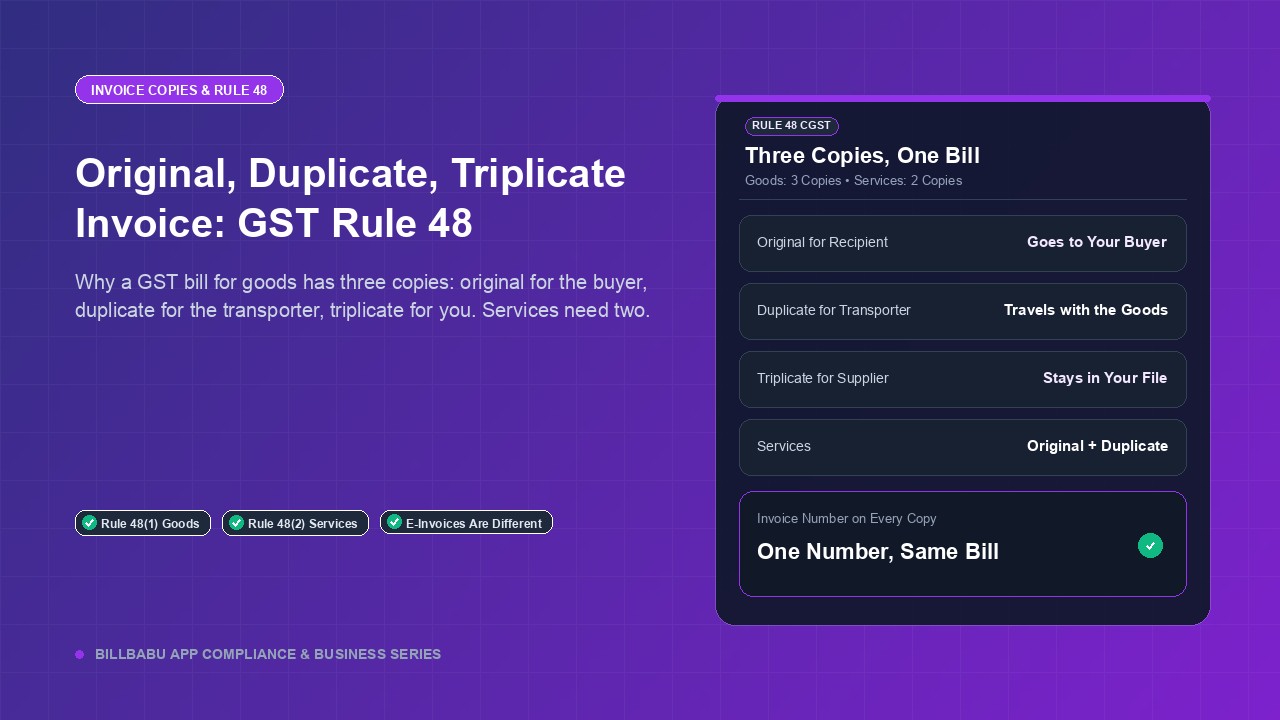
Why a GST bill for goods has three copies: original for the buyer, duplicate for the transporter, triplicate for you. Services need two. Rule 48 explained.
BillBabu App Team
In this article (15 sections)
Open a printed GST bill book and every number comes in a set of three pages: "Original", "Duplicate" and "Triplicate". New registrants often ask why, and which copy goes where. The answer is one short rule, Rule 48 of the CGST Rules.
In short
- Goods: make the invoice in three copies, marked ORIGINAL FOR RECIPIENT, DUPLICATE FOR TRANSPORTER and TRIPLICATE FOR SUPPLIER.
- Services: two copies, marked ORIGINAL FOR RECIPIENT and DUPLICATE FOR SUPPLIER.
- All copies are the same invoice: one number, one date, one entry in GSTR-1.
- E-invoices (with an IRN) follow their own process, and the three-copy rule doesn't apply to them.
What Rule 48 says
Rule 48 is titled "Manner of issuing invoice". Its first two parts set the copies:
| Supply | Copies | Markings |
|---|---|---|
| Goods (Rule 48(1)) | Three | ORIGINAL FOR RECIPIENT; DUPLICATE FOR TRANSPORTER; TRIPLICATE FOR SUPPLIER |
| Services (Rule 48(2)) | Two | ORIGINAL FOR RECIPIENT; DUPLICATE FOR SUPPLIER |
The same wording is on CBIC's invoice rules page. The rule doesn't ask for different colours or carbon paper, only for the copies and their markings.
Which copy goes where
| Copy | Marking | Who has it | Why |
|---|---|---|---|
| First | ORIGINAL FOR RECIPIENT | Your buyer | Their purchase record and the basis of their input tax credit |
| Second | DUPLICATE FOR TRANSPORTER | Travels with the goods | So the person moving the goods can show what is being carried |
| Third | TRIPLICATE FOR SUPPLIER | You | Your office copy for your books and your CA |
"Duplicate for transporter" simply means the copy for the person moving the goods. In everyday Hindi, it is the copy that goes with the माल, "ट्रांसपोर्टर वाली कॉपी". "Triplicate for supplier" is the copy that stays in your file.
Copies and the e-way bill
Goods on the road need paperwork. Rule 138A(1) says the person in charge of the vehicle carries:
- the invoice (or bill of supply or delivery challan); and
- the e-way bill, as a paper copy or as the e-way bill number in electronic form.
Rule 138A(2) lets the QR code of an e-invoice be shown electronically "in lieu of the physical copy" of the invoice. For an ordinary invoice, that means the duplicate copy goes in the truck on paper. The e-way bill number can stay on the phone: the e-way bill FAQ says the driver can simply quote it to the officer.
As of October 2026, an e-way bill is needed when the consignment is worth more than ₹50,000, and states set their own limits for movement within the state (e-way bill FAQ). See e-way bill rules and limits. If the goods go to a different address from the buyer's, read bill to ship to.
Make GST bills and record payments on your phone
Search billbabu on Play Store to get BillBabu App. Start free, no card needed.
Worked example: one bill, three copies
Sample data: the businesses and amounts are made up.
Ganga Agro Traders in Kanpur, Uttar Pradesh, sends goods worth ₹78,000 including GST to a dealer in Gwalior, Madhya Pradesh, by hired truck. The bill is GAT/26-27/0231, dated 12 October 2026.
| Page | Marking | Where it goes |
|---|---|---|
| 1 | ORIGINAL FOR RECIPIENT | Handed to the Gwalior dealer with the goods, and also sent as a PDF |
| 2 | DUPLICATE FOR TRANSPORTER | With the driver, along with the e-way bill number, because this inter-state load is over ₹50,000 |
| 3 | TRIPLICATE FOR SUPPLIER | Stays in Ganga Agro's file in Kanpur |
All three pages show the same number, GAT/26-27/0231, the same date, items and tax. In GSTR-1 it is reported once.
When is the bill made? Section 31(1) says before or at the time the goods are removed for supply, so all three copies are ready before the truck leaves.
Services: two copies
For services there is no transporter, so Rule 48(2) asks for two copies: ORIGINAL FOR RECIPIENT for your client and DUPLICATE FOR SUPPLIER for you.
Printed bill book vs PDF
- Bill book: carbon or carbonless sets print one number across three pages, so the copies can't drift apart.
- Billing software: you make one invoice and produce three marked copies of it, either printed or as a PDF with three pages.
- PDF on WhatsApp: fine for the buyer's copy. Rule 46 doesn't require a signature on an electronic invoice issued under the IT Act. The transporter's copy still travels on paper, as explained above. See also sending invoices on WhatsApp.
For what goes on each copy, see the GST bill format and B2B invoice under GST.
What copies don't change
- One number. Rule 46(b) needs a serial number unique for the financial year. The copies share it.
- One return entry. Rule 48(3) says the serial numbers of invoices issued in a tax period are furnished in GSTR-1 (and GSTR-1A, if any). Three copies are still one invoice.
- One tax amount. You pay tax on the sale once.
E-invoices are different
If you are required to issue e-invoices, the invoice is prepared by getting an Invoice Reference Number (IRN) from the portal (Rule 48(4)). Rule 48(6) says the triplicate and duplicate rules in sub-rules (1) and (2) don't apply to such invoices. As of October 2026, e-invoicing covers businesses whose aggregate turnover crossed ₹5 crore in any financial year since 2017-18 (the limit since 1 August 2023, Notification 10/2023-CT); check the e-invoice portal for any change.
Common mistakes
- Different numbers on different copies. They are one invoice and need one number.
- Goods going out without the transporter's copy. Rule 138A expects the invoice in the vehicle.
- Editing one copy only. A correction made by hand on the original but not on your copy leaves you with two different bills.
- Making a "duplicate bill" when the buyer loses theirs. Send another copy of the same invoice, with the same number and date. A new bill number would look like a second sale. If the bill itself is wrong, that is a correction, not a copy; see correcting a wrong GSTIN.
Making the three copies in BillBabu App
In BillBabu App, open your bills and tap a saved invoice. A "Generate Multiple Copies" sheet opens, listing Original Copy, Duplicate Copy, Triplicate Copy and All Copies. Pick All Copies, and the app makes one PDF with a page for each copy, all under the same bill number and with the same details. Share it from your phone's share menu, or print it for the truck and your file.
To be clear about the wording: each page is headed "Original Copy", "Duplicate Copy" or "Triplicate Copy" above "Tax Invoice". The words "for recipient", "for transporter" and "for supplier" show in the app's picker, not on the PDF. So the PDF doesn't yet carry Rule 48's exact markings. If you want the exact words on the paper, write or stamp them on the printed copies, and ask your CA whether it matters for your business.
The bill also has optional fields for the e-way bill number and vehicle number, which print on the PDF. BillBabu App doesn't generate e-way bills or e-invoices.
Frequently asked questions
What comes after triplicate?
Quadruplicate, a fourth copy. Rule 48 asks for three copies for goods; a fourth is your own choice, for example for your accounts team.
What does "duplicate for transporter" mean in Hindi?
ट्रांसपोर्टर के लिए कॉपी: the copy that travels with the goods in the vehicle.
Is a WhatsApp PDF enough?
For the buyer's copy, an electronic invoice is fine. For goods in transit, carry the paper invoice in the vehicle, unless it is an e-invoice whose QR code can be shown instead (Rule 138A).
Do the copies need separate numbers?
No. Copies share one invoice number and date.
Three copies of the same bill, in one PDF. BillBabu App makes the original, duplicate and triplicate pages of a saved bill together, ready to print or share. Start free, no card needed; unlimited bills need Pro (paid). Search billbabu on Play Store.
Rules checked on 23 October 2026.
This article is general information, not tax or legal advice. Rules change; check the official GST portal and your CA before acting. BillBabu App is a private app by Central Bharat Labs; it is not a government service.
Official sources: CGST Rules 46, 48 and 138A on CBIC; CBIC invoice rules page; e-way bill FAQ; e-invoice portal.
Tags
Related Articles
GST invoicing made easy for Indian small businesses
Make GST invoices and estimates, record payments, see party dues and keep stock, all from your phone. Start free, no card needed; upgrade to Pro for unlimited bills.