E-Way Bill Rules 2026: Distance Validity, State-Wise Thresholds, and Consolidated E-Way Bills
Complete 2026 guide to GST E-Way Bill rules: 200 km per day validity, interstate vs intrastate thresholds, Part-B vehicle updates, and Section 129 penalties.
BillBabu Team
BillBabu Compliance Team
In this article (16 sections)
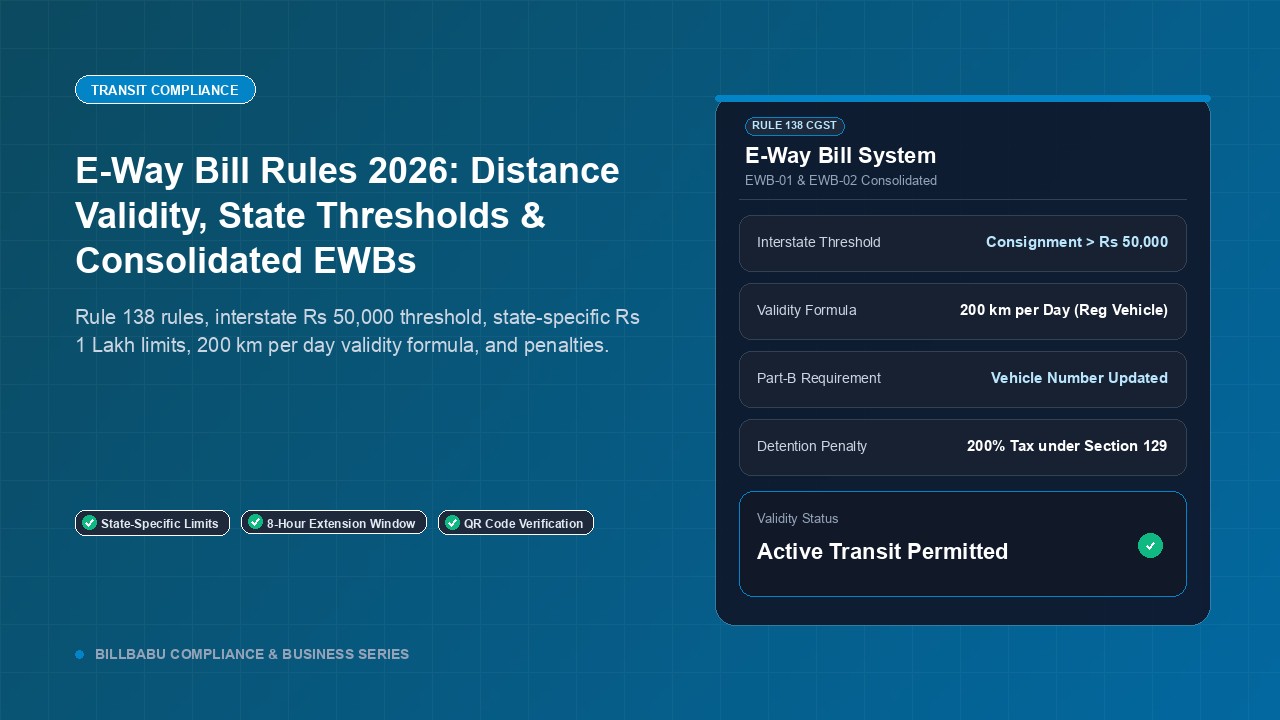
Under Rule 138 of the Central Goods and Services Tax (CGST) Rules, 2017, the physical conveyance of goods exceeding designated financial thresholds is illegal without an active Electronic Way Bill (E-Way Bill). First conceptualized to eliminate interstate border check-posts and curb tax evasion, the E-Way Bill framework in 2026 is tightly integrated with RFID fastags, e-invoicing portals, and automated number plate recognition (ANPR) highway cameras. An expired e-way bill, an unassigned vehicle registration, or a miscalculated transit distance can trigger highway interception and confiscation penalties equal to 200% of the tax due under Section 129. This authoritative guide details distance validity formulas, state-specific monetary thresholds, Part-A/Part-B rules, extension windows, and transit compliance.
Statutory Grounding & Consignment Value Threshold
The requirement to generate an E-Way Bill (Form GST EWB-01) is triggered whenever there is movement of goods:
- In relation to a Supply (sales, exchange, or barter).
- For reasons other than Supply (job work, branch transfer, repair, exhibition).
- Due to Inward supply from an unregistered person.
The Monetary Thresholds (Interstate vs. Intrastate)
- Standard Interstate Threshold: Mandatory for all interstate movements where the consignment value exceeds ₹50,000. (Consignment value includes the invoice value plus all applicable GST taxes, excluding exempt supplies).
- Mandatory Zero-Threshold Exceptions: For interstate movement of goods sent for Job Work by a principal to a job worker, and interstate transport of Handicraft Goods by exempt dealers, an E-Way Bill is mandatory irrespective of consignment value (even for consignments worth ₹500!).
- Intrastate State-Wise Relaxations: Many state governments have exercised statutory powers to increase the threshold for movement entirely within their state boundaries:
| State / Union Territory | Intrastate E-Way Bill Threshold | Special Conditions / Exemptions |
|---|---|---|
| Maharashtra | ₹1,00,000 | Exempted for specific goods within same city/district |
| Delhi (NCT) | ₹1,00,000 | All goods within Delhi territory |
| West Bengal | ₹1,00,000 | Threshold is ₹50,000 for specific notified items |
| Tamil Nadu | ₹1,00,000 | Applicable to all intra-state movement |
| Gujarat | ₹50,000 / ₹1,00,000 | ₹50,000 for 19 notified items; ₹1,00,000 for other goods |
| Karnataka | ₹50,000 | Follows standard national threshold for all items |
| Uttar Pradesh | ₹50,000 | Standard ₹50,000 limit across all districts |
The Anatomy of Form GST EWB-01: Part-A vs. Part-B
An E-Way Bill consists of two distinct data sections, and understanding their distinction is critical to avoid transit penalties:
Part-A (Consignment Metadata)
Completed by the consignor or consignee. Contains static trade data: GSTIN of supplier and recipient, place of delivery (with PIN code), invoice or challan number and date, 6-digit or 8-digit HSN code, taxable value, and reason for transportation.
Part-B (Conveyance & Vehicle Information)
Completed by the consigner, consignee, or the assigned logistics transporter. Contains operational transport data: vehicle registration number (for road transport) or Railway Receipt (RR) / Airway Bill (AWB) / Bill of Lading number.
Critical Transit Warning: Generating Part-A alone does NOT constitute a valid E-Way Bill! A Part-A slip merely reserves an e-way bill number. If a truck moves on the highway carrying goods with only a Part-A slip, it is legally treated as moving without an e-way bill under Section 129! (The only exception is intra-state movement up to 50 km from supplier's premises to the transporter's hub for loading).
Create GST invoices & track payments in 30 seconds
Join thousands of Indian businesses using BillBabu. 14-day free trial on Android.
Distance-Based Validity Formula: 200 KM Rule in 2026
Under Rule 138(10), the validity period of an E-Way Bill is strictly calculated based on the distance between the point of dispatch and the destination:
| Cargo Classification | Base Distance for 1 Day Validity | Additional Validity Rate |
|---|---|---|
| Normal Cargo (Standard Trucks & Lorry) | Up to 200 km = 1 Day | +1 additional day for every 200 km (or part thereof) |
| Over Dimensional Cargo (ODC) / Multimodal with Ship | Up to 20 km = 1 Day | +1 additional day for every 20 km (or part thereof) |
Worked Distance Calculation Example
A consignment is shipped from an industrial warehouse in Ahmedabad, Gujarat to a distributor in Bengaluru, Karnataka. The route distance calculated by the portal PIN-to-PIN engine is 1,480 km:
- Day 1: Covers first 200 km.
- Days 2 through 7: Covers next 1,200 km (6 × 200 km).
- Day 8: Covers remaining 80 km (part of 200 km).
- Total E-Way Bill Validity: Exactly 8 Days.
Expiry Time: The validity period expires at midnight (23:59:59) of the final day.
Extending Validity & Consolidated E-Way Bills (EWB-02)
The 8-Hour Rule for Validity Extension
If a vehicle is delayed due to breakdown, natural disaster, traffic blockades, or accident, the transporter or supplier can extend the validity online. However, under Rule 138(10), the extension must be applied for strictly within 8 hours before or 8 hours after the time of expiry. If you miss this 16-hour operational window, the e-way bill lapses permanently, and a fresh document must be created!
Consolidated E-Way Bill (Form GST EWB-02)
When a logistics transporter carries multiple consignments from different suppliers in a single vehicle, each consignment must have its individual EWB-01. The transporter then generates a Consolidated E-Way Bill (Form GST EWB-02) containing the vehicle number and all individual EWB numbers, allowing highway officers to verify the entire truck with a single scan.
Penalties Under Section 129: The Cost of Transit Errors
Under amended Section 129 of the CGST Act, highway interception penalties are severe:
- For Taxable Goods: A mandatory penalty equal to 200% of the tax payable on the transported goods! For instance, if goods worth ₹10,00,000 carry 18% GST (₹1,80,000), the penalty to release the detained truck is ₹3,60,000.
- For Exempt Goods: Penalty of 2% of the value of goods or ₹25,000, whichever is lower.
- Section 130 Confiscation: If the owner fails to pay penalties within 14 days, authorities can initiate confiscation proceedings and auction the vehicle and cargo.
Generate Instant E-Way Bills Directly in BillBabu
Protect your shipments from highway interception and Section 129 penalties. BillBabu auto-calculates PIN-to-PIN distances, populates Part-A and Part-B seamlessly from tax invoices, and alerts your team before validity expires.
Start Free Trial on BillBabuFrequently Asked Questions (FAQs)
1. Is an E-Way Bill required for transporting goods by railway or air?
Yes. For rail and air transit, Part-A must be generated before movement. Unlike road transport, railways will not deliver goods to the recipient unless an E-Way Bill is produced at the destination station.
2. Are any goods completely exempt from E-Way Bills?
Yes. Annexure to Rule 138(14) lists items exempt from e-way bills, including LPG for household supply, kerosene, postal baggage, currency, used personal and household effects, and non-motorized conveyances (cycle rickshaws, bullock carts).
3. Can an E-Way Bill be cancelled if the shipment is called off?
Yes. If goods are not transported, the E-Way Bill can be cancelled within 24 hours of generation. However, if the vehicle has already been intercepted and inspected by a tax officer in transit, cancellation is blocked.
Tags
Related Articles
GST ITC Reversal Rules 2026: 180-Day Payment Rule, GSTR-2B Matching, and Re-Availment
6 min read
Credit Note and Debit Note in GST: Time Limits, GSTR-1 Reporting, and Accounting Entries
6 min read
MSME 45-Day Payment Rule under Section 43B(h): Rules, Penalties, and Year-End Compliance for 2026
7 min read
GST invoicing made easy for Indian small businesses
Create GST-compliant invoices & estimates, track payments, manage parties and inventory — all from your phone. 14-day free trial, no credit card needed.