MSME 45-Day Payment Rule under Section 43B(h): Rules, Penalties, and Year-End Compliance for 2026
Complete 2026 guide to Section 43B(h) MSME 45-day payment rule. Understand disallowance, compound interest penalties, Udyam verification, and tax audit rules.
BillBabu Team
BillBabu Compliance Team
In this article (14 sections)
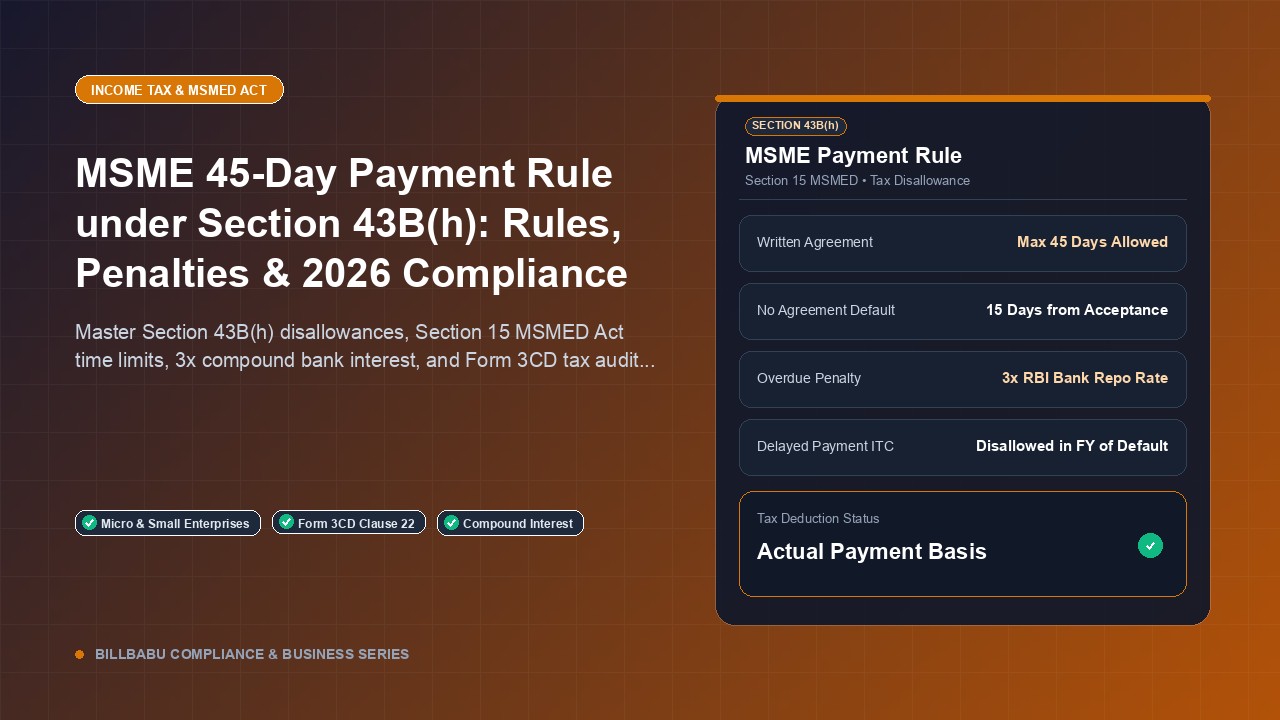
Under Section 43B(h) of the Income Tax Act, 1961, any outstanding payment due to a registered Micro or Small Enterprise beyond the statutory credit period is disallowed as a tax deduction in the financial year of purchase. First introduced to dismantle the endemic culture of delayed receivables choking India's small businesses, Section 43B(h) continues to reshape corporate procurement, year-end balance sheet audits, and trade terms in 2026. This comprehensive guide details the statutory timelines, enterprise classification boundaries, trader exemptions, year-end tax disallowances, compound interest penalties, and practical steps to ensure seamless compliance.
Statutory Framework: Section 43B(h) & Section 15 of MSMED Act
To understand the tax disallowance under the Income Tax Act, one must examine its direct statutory bridge to the Micro, Small and Medium Enterprises Development (MSMED) Act, 2006.
Section 43B(h) specifies that any sum payable by an assessee to a Micro or Small enterprise beyond the time limit specified in Section 15 of the MSMED Act, 2006 shall be allowed as a deduction only in the previous year in which such sum is actually paid.
The Two Statutory Credit Windows Under Section 15
- 15-Day Rule (In Absence of Written Agreement): Where the buyer and supplier have no formal written agreement specifying credit terms, the buyer must make payment within 15 calendar days from the "appointed day" (the date of actual delivery of goods or rendering of services).
- 45-Day Absolute Ceiling (With Written Agreement): Where a written contract or purchase order stipulates agreed credit terms, the agreed period cannot exceed 45 calendar days from the date of delivery. Even if both parties mutually sign an agreement providing 60, 90, or 120 days of credit, the law supersedes the contract—the payment deadline is capped at exactly 45 days.
Key Difference from Other Section 43B Clauses: Unlike statutory liabilities like GST, provident fund, or bonus covered under clauses (a) through (g) of Section 43B—which are allowed as deductions if cleared before the Income Tax Return filing due date under Section 139(1)—Section 43B(h) does NOT enjoy the proviso benefit. If an invoice remains unpaid past the 15/45 day limit on 31st March, it is strictly disallowed for that financial year, even if cleared in April or May before filing the return!
Applicability Matrix: Who is Covered and Who is Exempt?
A frequent compliance pitfall is assuming that every vendor registered on the Udyam portal falls under the 45-day rule. The law creates sharp distinctions based on enterprise scale and business activity:
| Enterprise Category | Investment & Turnover Criteria | Section 43B(h) Applicability |
|---|---|---|
| Micro Enterprise | Investment ≤ ₹1 Crore AND Turnover ≤ ₹5 Crore | APPLICABLE (Protected) |
| Small Enterprise | Investment ≤ ₹10 Crore AND Turnover ≤ ₹50 Crore | APPLICABLE (Protected) |
| Medium Enterprise | Investment ≤ ₹50 Crore AND Turnover ≤ ₹250 Crore | NOT APPLICABLE (Excluded) |
| Traders (Retail & Wholesale) | NIC Codes 45, 46, 47 (even if Udyam registered) | NOT APPLICABLE (Clarified by Office Memorandum) |
The Crucial Trader Exemption (Office Memorandum Clarification)
In July 2021, the Ministry of MSME allowed retail and wholesale traders to register on the Udyam portal solely for Priority Sector Lending (PSL) benefits. However, through subsequent Office Memorandums (OM No. 5/2(2)/2021-E/P & M dated 25th March 2022 and 01st September 2021), the government clarified that Chapter V of the MSMED Act (which includes Sections 15 through 25 on delayed payments) does NOT apply to traders. Therefore, if your supplier's Udyam certificate lists primary activities under wholesale or retail trade, unpaid amounts to them are not subject to Section 43B(h) disallowance.
Create GST invoices & track payments in 30 seconds
Join thousands of Indian businesses using BillBabu. 14-day free trial on Android.
Tax Disallowance Mechanics: Worked Financial Example
To see how Section 43B(h) directly impairs corporate cash flows, consider a manufacturing company, Apex Engineering Pvt Ltd, subject to a corporate tax rate of 25% plus 7% surcharge and 4% cess (effective rate 27.82%).
Scenario Analysis
Apex Engineering purchases raw castings worth ₹10,00,000 from a registered Micro supplier on 10th February 2026. The written purchase contract specifies 45 days credit. The statutory payment due date is 27th March 2026.
- Case A (Payment made on 25th March 2026): Paid within the 45-day limit. The entire ₹10,00,000 is allowed as a business expense in FY 2025-26. Zero tax impact.
- Case B (Payment made on 20th April 2026): The 45-day limit expired on 27th March 2026. Since the payment was made after 31st March 2026, the entire ₹10,00,000 is disallowed and added back to taxable profit for FY 2025-26!
- Immediate additional income tax liability in FY 2025-26: ₹10,00,000 × 27.82% = ₹2,78,200.
- The deduction of ₹10,00,000 will be permitted only in FY 2026-27 (the year of actual payment).
Compounding Penal Interest Under Section 16 of MSMED Act
The tax disallowance under Section 43B(h) is only half the penalty. Under Section 16 of the MSMED Act, any buyer failing to make payment within the statutory limit is legally liable to pay penal interest to the MSME supplier:
- Interest Rate: Three times (3x) the Bank Rate notified by the Reserve Bank of India (RBI).
- Compounding Frequency: Compounded with monthly rests from the appointed day or agreed due date.
- No Income Tax Deduction for Interest: Under Section 23 of the MSMED Act, penal interest paid to an MSME supplier is strictly disallowed as a business deduction under the Income Tax Act! It is treated as a permanent disallowance.
| Overdue Principal | RBI Bank Rate (Illustrative) | Mandated MSME Interest Rate (3x) | Interest Penalty for 90 Days Delay |
|---|---|---|---|
| ₹10,00,000 | 6.75% | 20.25% per annum (compounded monthly) | ~₹51,460 (Non-deductible) |
Year-End Audit Protocols: Form 3CD Clause 22 Disclosure
During the statutory tax audit under Section 44AB, Chartered Accountants are legally mandated to scrutinize MSME outstandings under Clause 22 of Form 3CD. The auditor requires:
- Vendor Master Classification: Clear segregation of trade creditors into Micro, Small, Medium, and Large/Non-MSME enterprises supported by verified Udyam certificates.
- Aging Analysis: Bill-by-bill aging schedule showing invoice date, delivery date, agreed credit period, statutory due date, actual payment date, and overdue days.
- Disallowance Quantification: Accurate computation of invoice values remaining unpaid beyond 15/45 days as of 31st March to be added back in the computation of total income.
- Interest Computation: Computation of Section 16 penal interest payable to MSME suppliers, whether provided in the books or not.
Actionable Compliance Checklist for Businesses
To avoid crippling tax additions and audit qualifications, every business should implement a strict operational routine:
- Send Annual Vendor Declaration Requests: Before the end of each financial year, circulate a formal confirmation letter to all vendors requesting their active Udyam Registration Number, enterprise classification (Micro/Small/Medium), and activity type (Manufacturing/Services/Trading).
- Verify on Udyam Portal: Validate vendor Udyam numbers on the official
udyamregistration.gov.inportal to confirm that the certificate is active and not cancelled. - Review Standard Purchase Terms: Ensure that all Purchase Orders (POs) and contracts explicitly state written payment terms capped at 45 days. If a PO is silent, the default statutory deadline is 15 days!
- Prioritize MSME Aging Buckets: Configure accounts payable workflows to trigger automated payment alerts at 10 days (for 15-day terms) and 35 days (for 45-day terms).
Automate Section 43B(h) Vendor Aging in BillBabu
Don't let unexpected tax disallowances erode your year-end profits. BillBabu automatically tags vendors by Udyam status, tracks 15-day and 45-day statutory deadlines, alerts your accounts team before bills lapse, and generates audit-ready aging reports for Form 3CD.
Start Free Trial on BillBabuFrequently Asked Questions (FAQs)
1. Does Section 43B(h) apply to purchases made from unregistered MSMEs?
No. Section 43B(h) applies strictly to suppliers who hold a valid, active Udyam registration at the date of supply. If a vendor is not registered on the Udyam portal, the 15/45 day payment rule and Section 43B(h) disallowance do not apply.
2. What happens if an invoice is disputed due to damaged or deficient goods?
Under Section 15 of the MSMED Act, if the buyer raises a formal written objection regarding defects or deficiency within 15 days of delivery, the "day of acceptance" is postponed until the supplier rectifies the defect. The 15 or 45-day clock begins only after the defect is formally resolved.
3. If payment is made via cheque on the 45th day but cleared later, is it compliant?
As per established judicial precedents, handing over a valid cheque on or before the due date (which is subsequently honoured upon presentation without delay) constitutes valid payment on the date of delivery of the cheque.
Tags
Related Articles
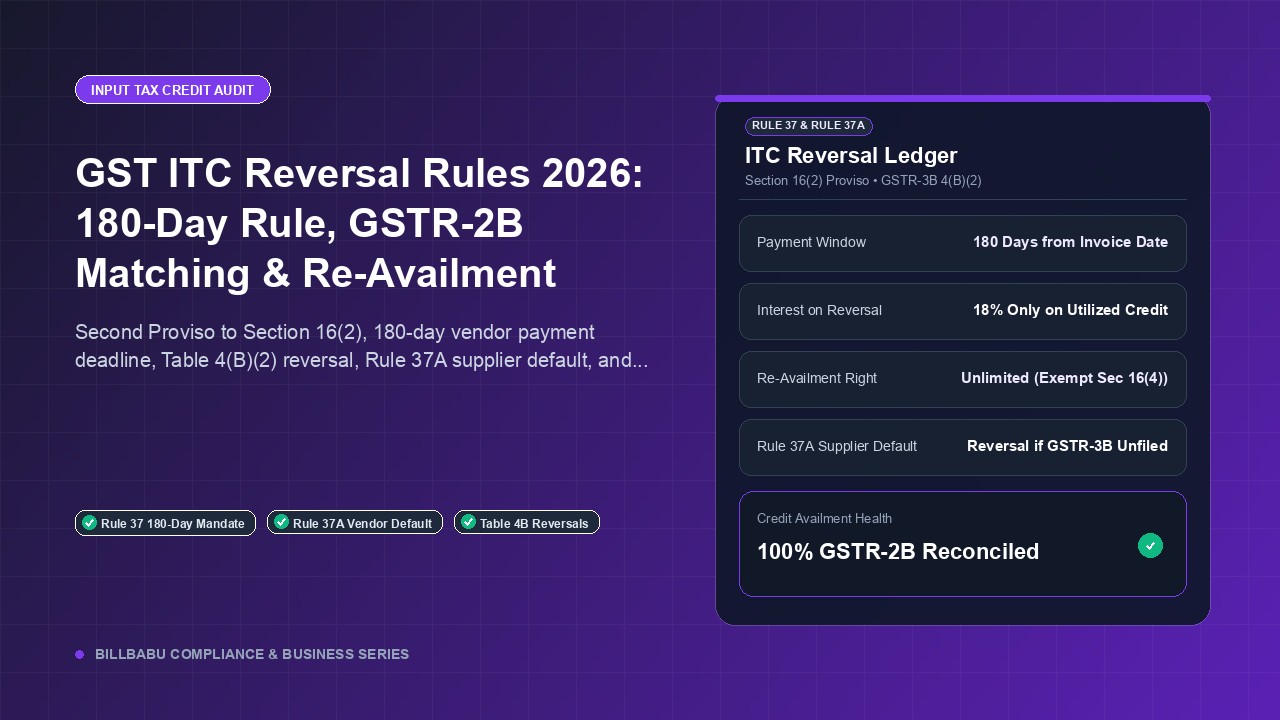
GST ITC Reversal Rules 2026: 180-Day Payment Rule, GSTR-2B Matching, and Re-Availment
6 min read
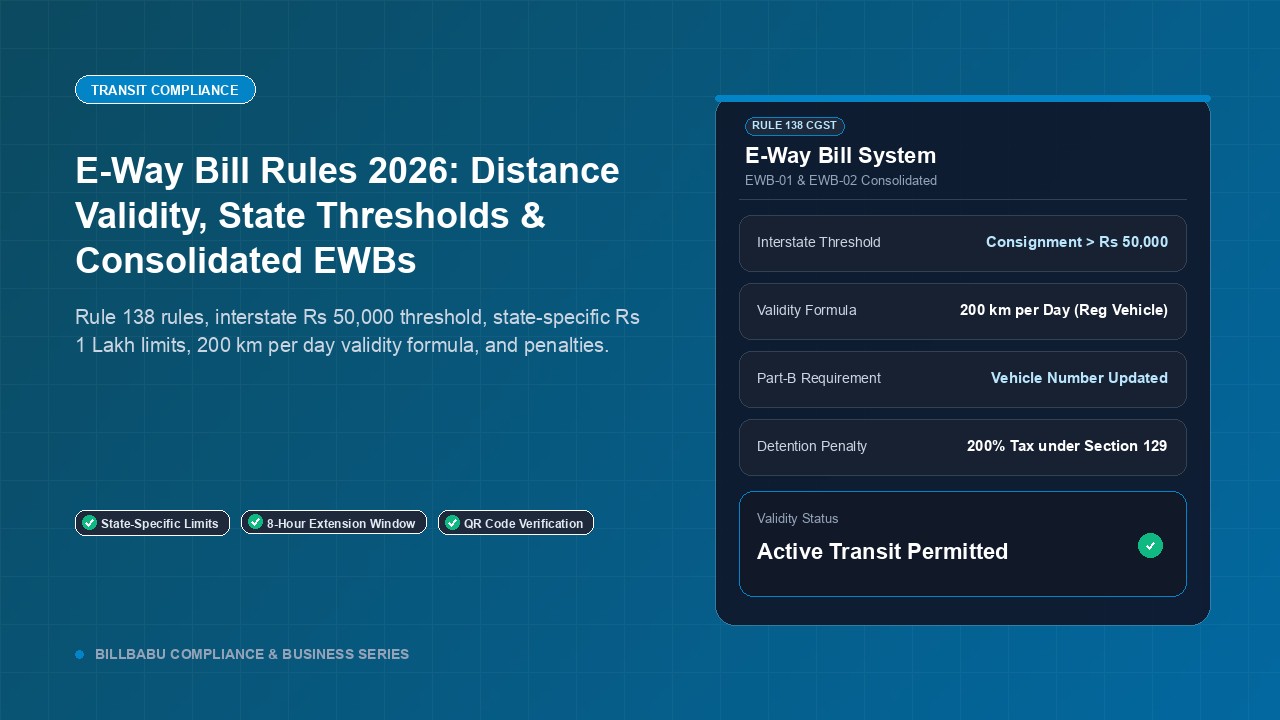
E-Way Bill Rules 2026: Distance Validity, State-Wise Thresholds, and Consolidated E-Way Bills
6 min read
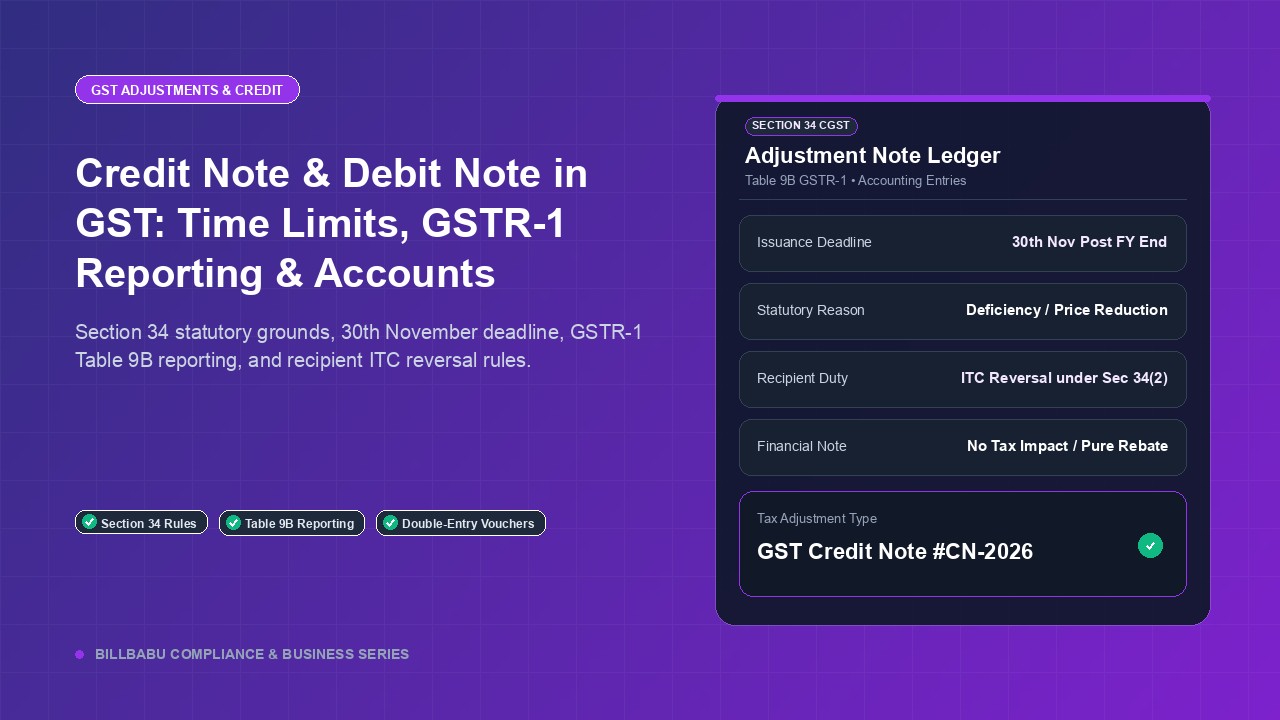
Credit Note and Debit Note in GST: Time Limits, GSTR-1 Reporting, and Accounting Entries
6 min read
GST invoicing made easy for Indian small businesses
Create GST-compliant invoices & estimates, track payments, manage parties and inventory — all from your phone. 14-day free trial, no credit card needed.