Bill To Ship To Under GST: Invoice, IGST and E-Way Bill
Billing one party and delivering to another? Which state decides IGST or CGST + SGST, what the invoice must show, and how to fill the e-way bill.
BillBabu App Team
In this article (13 sections)
A buyer phones: "Bill it to our Mumbai office, but deliver to our customer here in Delhi." This is "bill to, ship to". One party orders, pays and gets the invoice, and the goods go somewhere else.
It raises three questions every time: which tax to charge, what to print on the invoice, and how to fill the e-way bill. Here are the answers, with the official sources.
In short
- The bill-to party is the buyer who orders and pays. The ship-to party (consignee) is where the goods go.
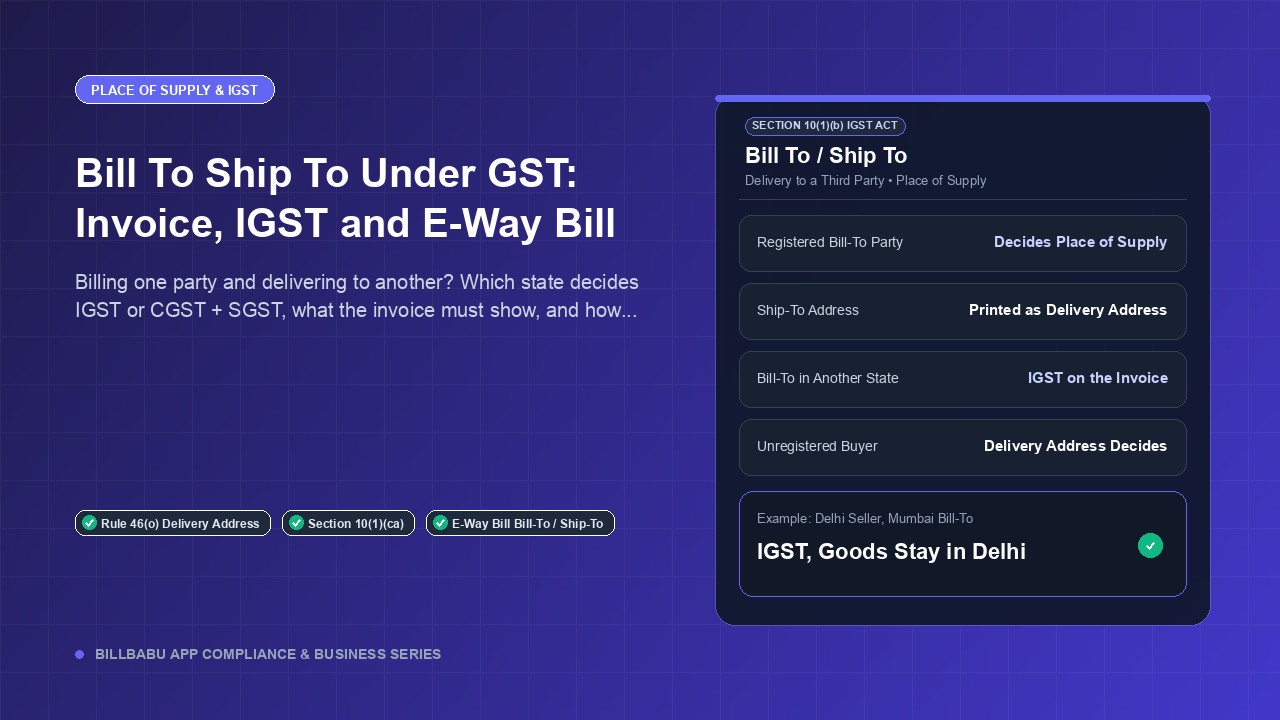
- When a buyer tells you to deliver to someone else, the place of supply is the buyer's principal place of business, not the delivery point (IGST Act, Section 10(1)(b)). That decides IGST or CGST + SGST.
- The invoice carries the buyer's GSTIN, and the delivery address when it differs from the place of supply.
- On the e-way bill, choose the transaction type "Bill to - Ship to".
What "bill to, ship to" means
Three parties are involved:
- You, the supplier who raises the invoice and sends the goods.
- The bill-to party, who places the order, gets your invoice, pays you and claims the input tax credit.
- The ship-to party, where the goods are delivered: the buyer's customer, a project site or a branch.
For dealers and wholesalers this is routine. A contractor wants cement at a site. A distributor in one city wants stock sent straight to a retailer in another.
Which tax applies: IGST or CGST + SGST
For goods that move, the usual rule is that the place of supply is where the movement ends (IGST Act, Section 10(1)(a)). Bill to ship to has its own clause. Under Section 10(1)(b), when goods are delivered "to a recipient or any other person on the direction of a third person", that third person is treated as having received the goods. The place of supply is then that person's principal place of business.
Then compare the place of supply with your own state. If they are the same, charge CGST + SGST. If they differ, charge IGST. For the basic rule, see CGST, SGST or IGST, the basic rule.
Sample data in all three examples: the businesses and amounts are made up, and 18% is an example rate.
Example 1: the truck never leaves Delhi, but the bill is IGST
Yamuna Hardware in Delhi (state code 07) gets an order from Konkan Builders in Mumbai (27). Konkan asks for the goods, worth ₹60,000 before tax, to be delivered to its customer in Okhla, Delhi.
- The bill-to party is in Maharashtra, so the place of supply is Maharashtra.
- Yamuna Hardware is in Delhi, so this is an inter-state supply: IGST 18% = ₹10,800, total ₹70,800.
The goods move only inside Delhi, but the tax follows the buyer who gave the direction.
Example 2: everyone in one state
Malwa Pipes in Indore (23) bills Rathore Plumbing, also in Indore, and delivers to Rathore's customer in Ujjain. The place of supply is Madhya Pradesh, the same as the supplier's state, so CGST 9% + SGST 9%.
Example 3: the buyer is not registered
For goods sold to an unregistered person, a newer clause applies: Section 10(1)(ca). The place of supply is the address of that person recorded on the invoice. CBIC's Circular 209/3/2024-GST confirms this has applied since 1 October 2023. It also says that where the billing and delivery addresses differ, the delivery address recorded on the invoice decides.
So if Malwa Pipes bills an unregistered customer with an Indore billing address and delivers to Nagpur, the place of supply is Maharashtra, and the bill carries IGST. This is the opposite of Example 1. The circular's own example is an online sale, so confirm your case with your CA.
| Supplier | Bill to | Ship to | Place of supply | Tax | |
|---|---|---|---|---|---|
| Example 1 | Delhi | Mumbai, registered | Delhi | Maharashtra | IGST |
| Example 2 | Indore | Indore, registered | Ujjain | Madhya Pradesh | CGST + SGST |
| Example 3 | Indore | Unregistered | Nagpur | Maharashtra | IGST |
One more case: if the ship-to address is the buyer's own site or branch in another state, the buyer may have a separate GSTIN there. Ask the buyer which GSTIN to bill, and check with your CA.
Make GST bills and record payments on your phone
Search billbabu on Play Store to get BillBabu App. Start free, no card needed.
What the invoice must show
Rule 46 of the CGST Rules covers bill to ship to through three fields:
- the recipient's name, address and GSTIN, if registered (clause d). This is the bill-to party;
- the place of supply with the state's name, for an inter-state supply (clause n);
- "address of delivery where the same is different from the place of supply" (clause o).
Rule 46 doesn't list the consignee's GSTIN. Printing it when the consignee has one is common, and it does no harm.
Here is the top of Yamuna Hardware's bill from Example 1:
| Field | On the bill (sample data) |
|---|---|
| Bill to | Konkan Builders, Andheri, Mumbai; GSTIN 27…; Maharashtra (27) |
| Ship to | Konkan's customer, Okhla, New Delhi |
| Place of supply | Maharashtra (27) |
| Tax | IGST 18% (example rate) |
For the rest of the layout, see our GST bill format and B2B invoice under GST.
Bill to ship to on the e-way bill
Rule 138A says the person in charge of the vehicle carries the invoice and the e-way bill, either a paper copy or the number in electronic form. The e-way bill FAQ covers the rest:
- Transaction type: select "Bill to - Ship to" in the Transaction Type dropdown. The system then opens a "Ship to" field for the delivery state and PIN code.
- When it's needed: for a consignment worth more than ₹50,000 (as of October 2026). For movement within a state, the FAQ refers you to that state's own limit. In Example 1 the goods move inside Delhi, so check Delhi's limit.
- No edits later: once generated, an e-way bill can't be edited. Only Part B (vehicle details) can be updated. A wrong one can be cancelled within 24 hours and made again.
There is also a "Bill From - Dispatch From" type, for goods that leave from a premises other than yours. If you have seen news about changes to the Ship To fields: on 23 October 2026, the Latest Updates on the official e-way bill portal listed no such change. Check that page before you act on a news report. For limits and validity, see e-way bill rules, limits and validity. For the copy that rides with the goods, see which invoice copy travels with the goods.
Common mistakes
- Charging tax by the delivery state when a registered buyer directed the delivery. Example 1 shows why that's wrong.
- Leaving the delivery address off the bill. Rule 46(o) asks for it.
- Billing the consignee instead of the buyer. The invoice must name the party that ordered and pays, because that party claims the credit.
- Choosing "Regular" on the e-way bill. You can't edit it later.
Ship To in BillBabu App
- Ship To details: in the bill form, tap "Add Ship To (Consignee)" and fill in the consignee's name, address, GSTIN, state, email and mobile. "Same as Bill To" copies the party's details if you need to start from them.
- Where it prints: the Classic and Ledger PDF designs print it as a "Consignee (Ship To)" block under the buyer. Other designs don't show it yet, so use one of those two for these bills.
- Tax type: the app works out CGST + SGST or IGST from the bill-to party's saved state, which fits Examples 1 and 2. For Example 3, where the delivery state decides, check the tax line on the review step and ask your CA.
- E-way bill number: the bill has optional fields for the e-way bill number and vehicle number, and they print on the PDF. Make the e-way bill itself on the government portal; BillBabu App doesn't generate e-way bills.
Frequently asked questions
Who claims the input tax credit in bill to ship to?
The bill-to party, whose GSTIN is on your invoice. Section 16(2)(b) treats goods delivered to another person on the buyer's direction as received by the buyer.
Is the ship-to GSTIN mandatory on the invoice?
Rule 46 doesn't list it. It asks for the delivery address when that differs from the place of supply.
Who generates the e-way bill?
The e-way bill FAQ says it is generated by the registered person or the transporter who causes the goods to move. In bill to ship to, that is usually the supplier.
Fill Ship To once and send the right bill. In BillBabu App, add the consignee on the bill, type in the e-way bill and vehicle numbers, and share the PDF. Start free, no card needed; unlimited bills need Pro (paid). Search billbabu on Play Store.
Rules checked on 23 October 2026.
This article is general information, not tax or legal advice. Rules change; check the official GST portal and your CA before acting. BillBabu App is a private app by Central Bharat Labs; it is not a government service.
Official sources: IGST Act, Section 10 and CGST Rule 46 on CBIC; Circular 209/3/2024-GST; e-way bill FAQ and e-way bill portal.
Tags
Related Articles
GST invoicing made easy for Indian small businesses
Make GST invoices and estimates, record payments, see party dues and keep stock, all from your phone. Start free, no card needed; upgrade to Pro for unlimited bills.