B2B Invoice Under GST: Format, Rules and Your Buyer's ITC
What a B2B GST invoice must show so your buyer can claim ITC: GSTIN, place of supply, HSN, copies and GSTR-1. With a wholesaler-to-retailer example.
BillBabu App Team
In this article (19 sections)
When you sell to another GST-registered business, such as a retailer, a contractor or another dealer, your bill does two jobs. It records your sale, and it is the paper your buyer's input tax credit (ITC) depends on.
This guide explains what a B2B invoice must show, how it differs from a bill to a consumer, and what happens to it after you hand it over.
In short
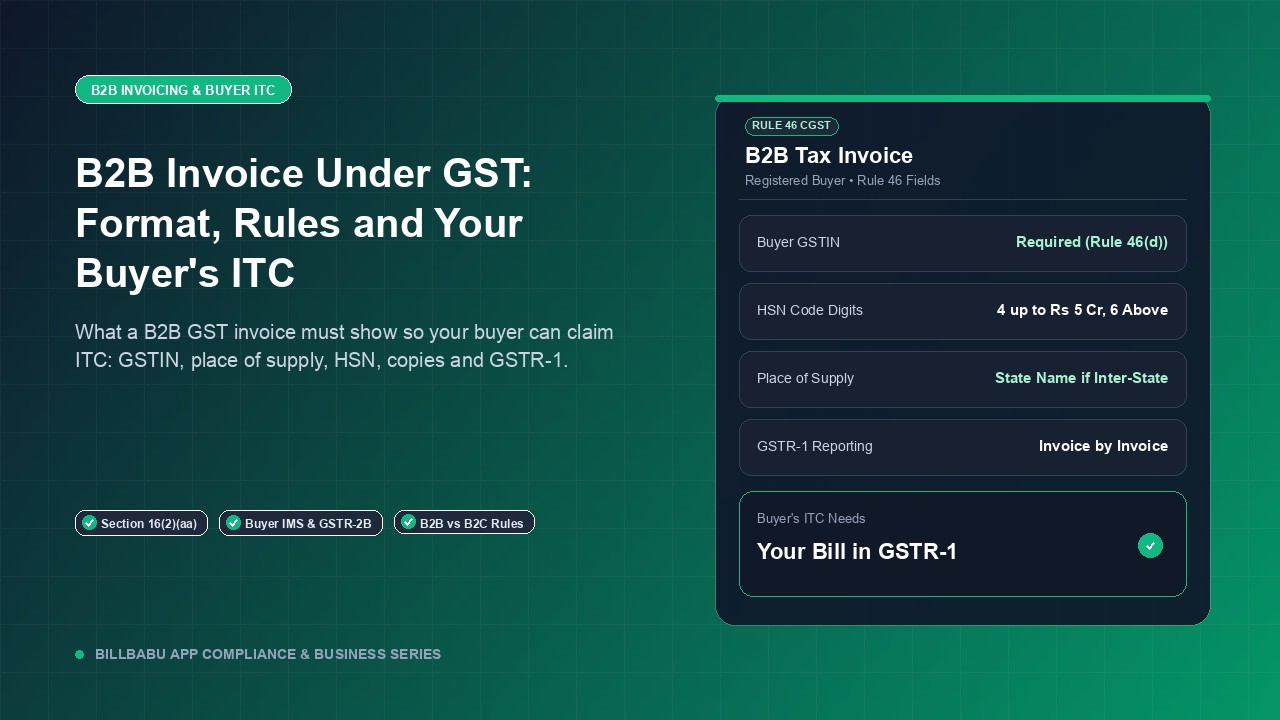
- A B2B invoice is a tax invoice to a buyer who has a GSTIN. It carries the buyer's GSTIN and the other fields listed in Rule 46.
- HSN codes are needed on B2B bills: 4 digits if your turnover last year was up to ₹5 crore, 6 digits above that (as of October 2026).
- Your buyer gets ITC only for invoices you report in GSTR-1, so the bill and your return must match.
- For goods, make three copies of the same invoice.
What a B2B invoice is
B2B means business to business: the buyer is GST-registered and gives you a GSTIN. Rule 46 of the CGST Rules says a tax invoice must show the recipient's "name, address and Goods and Services Tax Identification Number ... if registered" (clause d).
B2B vs B2C at a glance
Limits as of October 2026:
| B2B: registered buyer | B2C: unregistered buyer | |
|---|---|---|
| Buyer's GSTIN on the bill | Required (Rule 46(d)) | None. Name and address are needed if the taxable value is ₹50,000 or more, or if the buyer asks (Rule 46(e), (f)) |
| HSN code | 4 or 6 digits, by your turnover | May be left off if your turnover was up to ₹5 crore (Notification 78/2020-CT) |
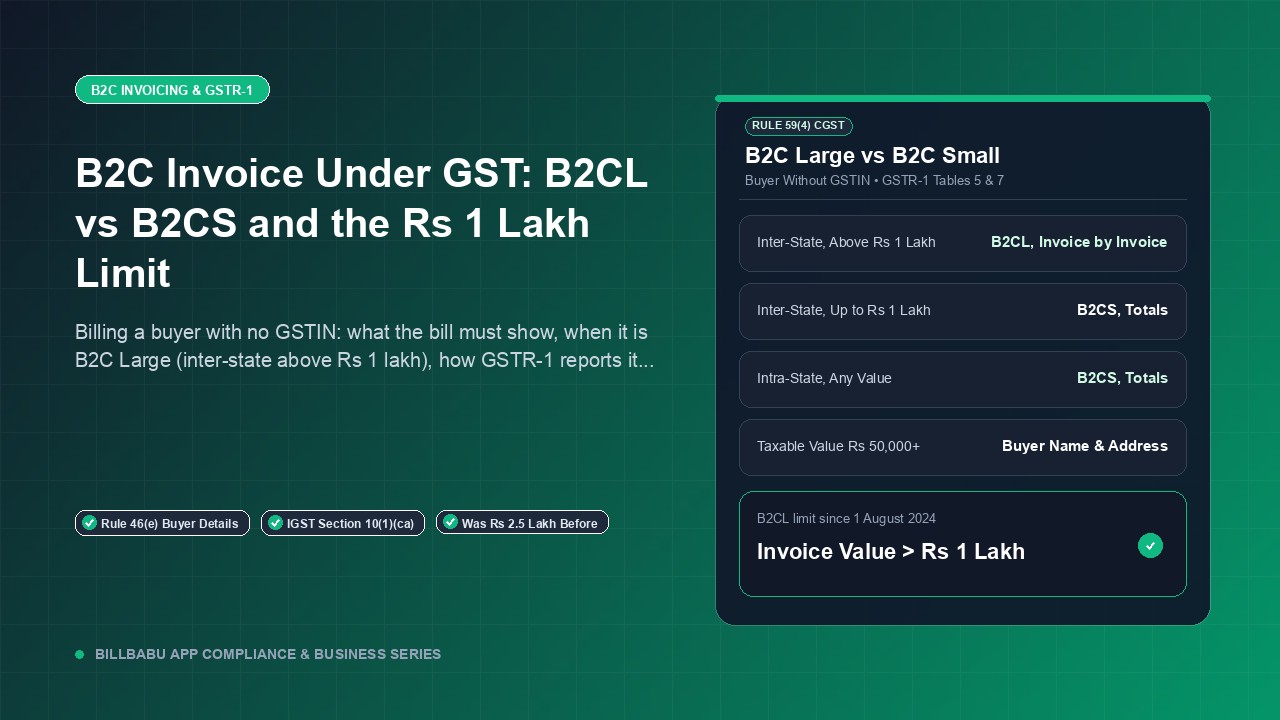
| How it goes into GSTR-1 | Invoice by invoice | Totalled by tax rate, except inter-state bills above ₹1 lakh, which go invoice by invoice (Rule 59(4)) |
| Input tax credit | The buyer can claim it if the conditions are met | Credit is for registered persons only (Section 16(1)) |
The fields your buyer's accountant checks
Here are the Rule 46 fields as a business buyer reads them.
Your details and your buyer's
Print your name, address and GSTIN (clause a), then the buyer's (clause d). A GSTIN has 15 characters: a two-character state code, the 10-character PAN, a two-character entity code and a checksum character (CBIC registration rules). If the first two digits don't match the buyer's state, stop and check. Delhi is 07, Madhya Pradesh 23 and Maharashtra 27 (state code list).
Invoice number and date
The number must be consecutive, at most 16 characters (letters, numbers, hyphens, slashes), and unique for the financial year. You may run more than one series (clause b). Add the date of issue (clause c).
HSN code
Clause g asks for the HSN code. Since 1 April 2021, Notification 78/2020-CT sets the digits by your previous year's turnover: 4 up to ₹5 crore, 6 above. The relief that lets smaller sellers skip the HSN covers only bills to unregistered buyers, so a B2B bill always needs it.
From the May 2025 return period, GSTR-1's HSN table has separate B2B and B2C tabs, and codes are picked from a list (GSTN advisory). Unsure of a code? Try our HSN code finder.
Place of supply and the tax split
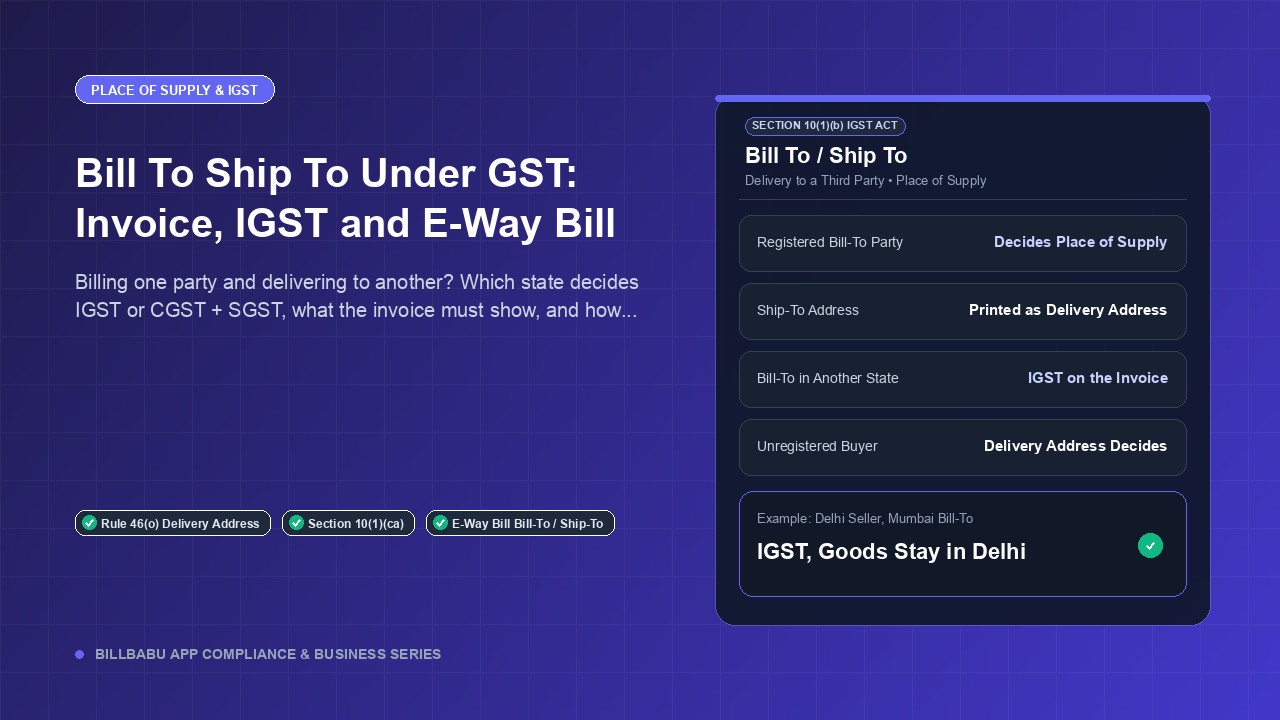
Show the rate and amount of each tax (clauses l, m). For a sale to another state, also print the place of supply with the state's name (clause n). A buyer in your own state usually means CGST + SGST; another state means IGST. Delivering to someone other than the buyer has its own rule: see bill to ship to.
Goods, values and the rest
Rule 46 also asks for:
- a description, quantity and unit, total value and taxable value after discount (clauses h to k);
- the delivery address, when it differs from the place of supply (clause o);
- whether tax is payable on reverse charge (clause p);
- a signature or digital signature (clause q), though an electronic invoice under the IT Act needs none (a proviso to Rule 46).
For a filled-in layout, see our GST bill format with a filled example.
Why your bill decides your buyer's ITC
Section 16(2)(aa) of the CGST Act lets your buyer take credit only when you have reported the invoice in your statement of outward supplies (GSTR-1) and it has been passed on to them.
On the portal, GSTN's IMS FAQ (September 2024) describes it like this:
- Once you save an invoice in GSTR-1 or IFF, it appears in your buyer's Invoice Management System (IMS).
- The buyer can accept, reject or keep it pending. A record with no action counts as accepted when GSTR-2B is generated on the 14th, and accepted records flow into their GSTR-3B.
IMS has had updates since, so check the portal for current details, and see how GSTR-2B works for your buyer.
So a bill you forget to report never reaches your buyer, and a bill with the wrong GSTIN lands in someone else's IMS (see what to do if the GSTIN is wrong).
Make GST bills and record payments on your phone
Search billbabu on Play Store to get BillBabu App. Start free, no card needed.
When to issue it and how many copies
For goods that move, Section 31(1) says the invoice is issued before or at the time the goods are removed for supply. In other words, the bill goes out with the goods, not at month end.
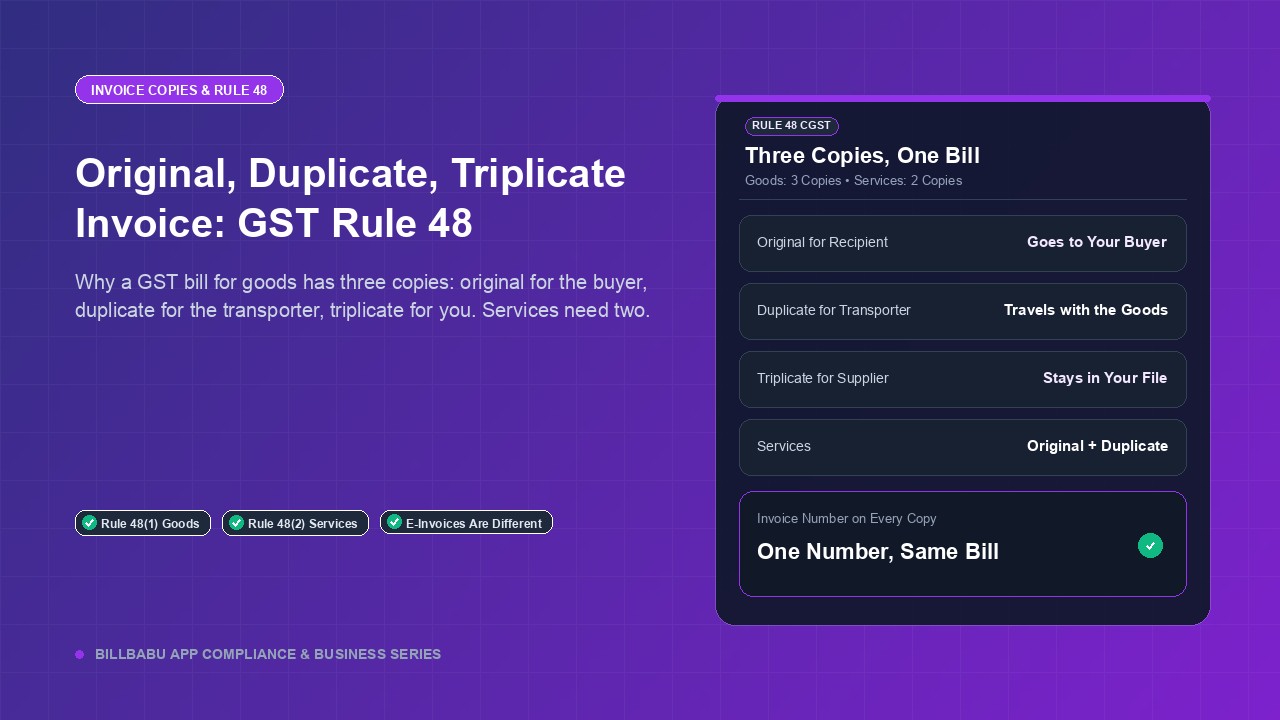
Rule 48 asks for three copies for goods: ORIGINAL FOR RECIPIENT, DUPLICATE FOR TRANSPORTER and TRIPLICATE FOR SUPPLIER. Services need two. Our post on original, duplicate and triplicate copies explains which copy goes where.
Worked example: one wholesaler, two retailers
Sample data: the businesses, numbers and amounts are made up, and 18% is an example rate.
Narmada Traders is a wholesaler in Indore, Madhya Pradesh (GSTIN starting 23). On the same day it sells the same goods to two retailers:
- Shree Ganesh Stores in Bhopal, also in Madhya Pradesh (GSTIN starting 23);
- Patil Kitchenware in Nagpur, Maharashtra (GSTIN starting 27).
| Bill 1: Bhopal | Bill 2: Nagpur | |
|---|---|---|
| Invoice number | NT/26-27/0145 | NT/26-27/0146 |
| Buyer GSTIN | 23………… | 27………… |
| Place of supply | Madhya Pradesh (23) | Maharashtra (27) |
| Goods | 50 steel utensil sets × ₹400 | 50 steel utensil sets × ₹400 |
| HSN | your item's code | your item's code |
| Taxable value | ₹20,000 | ₹20,000 |
| CGST 9% | ₹1,800 | – |
| SGST 9% | ₹1,800 | – |
| IGST 18% | – | ₹3,600 |
| Invoice total | ₹23,600 | ₹23,600 |
The goods and totals match; only the tax split changes, because Bhopal is in the seller's state and Nagpur is not. Both buyers are registered, so both bills go into GSTR-1 one by one, and each buyer sees their bill in IMS.
Reporting B2B invoices in GSTR-1
- Invoice-wise: every sale to a registered buyer is reported as a separate invoice (Rule 59(4)).
- Due dates: the 11th of the next month if you file monthly, or the 13th of the month after the quarter if you file quarterly (GSTR-1 FAQ, Q10).
- Quarterly filers: B2B invoices for the first two months can go through IFF, from the 1st to the 13th of the next month, up to ₹50 lakh a month (Rule 59(2)).
- Fixing a mistake: GSTR-1A lets you amend or add records after filing GSTR-1 and before filing GSTR-3B for the same period (Rule 59(1), proviso).
Usually your CA files these; your job is a clean list of bills.
Mistakes that hold up a buyer's ITC
- Wrong GSTIN: one wrong digit sends the invoice to another business.
- Wrong state: CGST + SGST where IGST was due, or the reverse.
- Missing or short HSN: the bill falls short of Rule 46.
- Bill not in GSTR-1: the buyer sees nothing until you file.
- One number on two bills: Rule 46(b) needs a unique number.
Making B2B invoices in BillBabu App
BillBabu App is an Android app for GST tax invoices, estimates and purchase entries. For B2B bills:
- Parties: save each buyer once with their GSTIN and state. The GSTIN box accepts only the right kind of character in each position, and the app won't save the same GSTIN twice in one business. It doesn't look the number up on the GST portal, so check a new buyer there once.
- Products: save each item's HSN/SAC code and GST rate once; they fill into every bill.
- Tax split: the place of supply fills from the party's state, and the review step shows "Intra-State Transaction (CGST + SGST)" or "Inter-State Transaction (IGST)" before you save.
- Numbers: bills are numbered in a series, and no two bills in a business share a number.
- Sharing: the PDF can carry your logo, signature and stamp; share it from your phone's share menu, for example on WhatsApp.
Open the PDF and check the buyer's GSTIN, state and HSN codes before you send it. BillBabu App doesn't print a reverse-charge line, file GSTR-1, or make e-invoices (IRN) or e-way bills.
Frequently asked questions
Is there a minimum amount for a B2B invoice?
No. Section 31(3)(b) lets a seller skip the invoice below ₹200, but Rule 46 allows that only when the buyer is unregistered and doesn't want one. A registered buyer gets a tax invoice for every sale.
Is HSN mandatory on B2B invoices?
Yes: 4 digits if last year's turnover was up to ₹5 crore, 6 above. The option to leave it off covers only bills to unregistered buyers.
Do I need an e-invoice?
Only if e-invoicing applies to you. As of October 2026, the limit set from 1 August 2023 is aggregate turnover above ₹5 crore in any financial year from 2017-18 (Notification 10/2023-CT; wording as in Rule 46(s)). Check the e-invoice portal for later changes. BillBabu App doesn't generate IRNs.
Can I send the bill as a PDF on WhatsApp?
For the buyer's copy, yes: an electronic invoice under the IT Act needs no signature (Rule 46). For goods on the road, Rule 138A has the person in charge of the vehicle carry the invoice; only an e-invoice's QR code may be shown on a phone instead. So print the copy that travels with the goods.
Bills your business buyers can use. In BillBabu App, save each buyer's GSTIN and each item's HSN once, check the tax split before you save, and share the PDF. Start free, no card needed; unlimited bills need Pro (paid). Search billbabu on Play Store.
Rules checked on 23 October 2026.
This article is general information, not tax or legal advice. Rules change; check the official GST portal and your CA before acting. BillBabu App is a private app by Central Bharat Labs; it is not a government service.
Official sources: CGST Rule 46 and Section 16 on CBIC; GSTR-1 FAQ and IMS FAQ on the GST portal; e-invoice portal.
Tags
Related Articles
GST invoicing made easy for Indian small businesses
Make GST invoices and estimates, record payments, see party dues and keep stock, all from your phone. Start free, no card needed; upgrade to Pro for unlimited bills.