B2C Invoice Under GST: B2CL vs B2CS and the ₹1 Lakh Limit
Billing a buyer with no GSTIN: what the bill must show, when it is B2C Large (inter-state above ₹1 lakh), how GSTR-1 reports it and fixing it later.
BillBabu App Team
In this article (15 sections)
You sell to someone who has no GSTIN: a walk-in customer, a family buying for a new house, or a small shop that isn't registered. That sale is B2C, business to consumer. You still issue a tax invoice and charge GST. What changes is what the bill must carry and how your GST return reports it.
In short
- A B2C invoice is a tax invoice to an unregistered buyer. You charge GST as usual; the buyer just can't claim input tax credit on it.
- When the taxable value is ₹50,000 or more, print the buyer's name, address, delivery address and state with its code (Rule 46(e)).
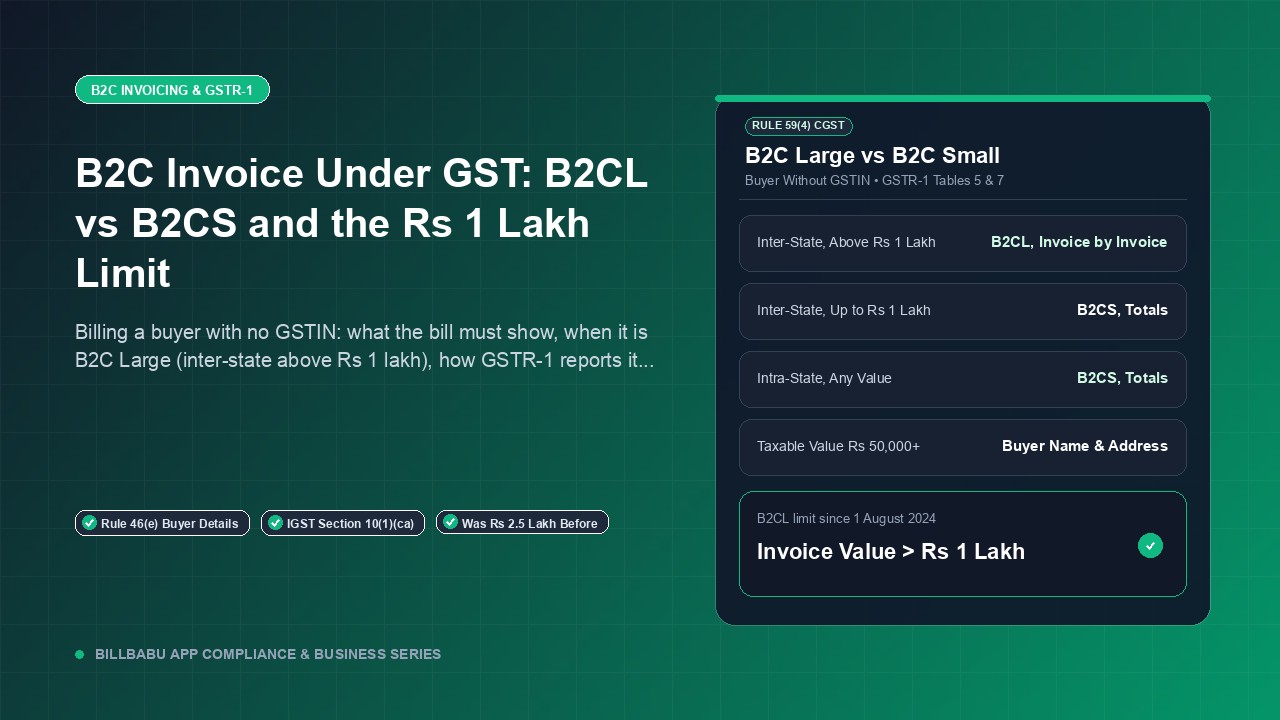
- In GSTR-1, only inter-state B2C bills with an invoice value above ₹1 lakh are reported one by one, as B2C Large (B2CL). All other B2C sales are B2C Small (B2CS), reported as totals (Rule 59(4)).
- The ₹1 lakh limit has applied since 1 August 2024. Before that it was ₹2.5 lakh.
What a B2C invoice is
The GST portal's GSTR-1 FAQ (Q16) puts it simply: B2C means a sale by a registered supplier to an unregistered buyer. The bill is still a tax invoice under Rule 46, with your GSTIN, a serial number, the date, a description, quantity, taxable value, and the rate and amount of each tax. The only thing missing is the buyer's GSTIN, because there isn't one.
Two practical differences from a B2B invoice under GST:
- HSN code: if your turnover last year was up to ₹5 crore, you may leave the HSN code off bills to unregistered buyers (Notification 78/2020-CT). Above ₹5 crore, show 6 digits as usual.
- Input tax credit: your buyer can't claim it, so they rarely check the bill closely. The GST department still can, so fill it in properly.
What the bill must show for an unregistered buyer
Rule 46 sets the buyer details by the size of the sale:
| Taxable value of the sale | Buyer details on the bill |
|---|---|
| ₹50,000 or more | Name and address, delivery address, and the state's name and code (Rule 46(e)) |
| Below ₹50,000 | The same details, but only if the buyer asks (Rule 46(f)) |
| Below ₹200, and the buyer doesn't want a bill | You may skip the bill for each sale and issue one consolidated invoice at the end of the day (Section 31(3)(b) and the Rule 46 proviso) |
For the end-of-day option, see our post on the consolidated invoice for small sales. For the rest of the layout, see our GST bill format.
Even below ₹50,000, it helps to record at least the buyer's state. The next section explains why.
Place of supply when the buyer has no GSTIN
For goods sold to an unregistered person, IGST Act Section 10(1)(ca) says the place of supply is the location as per the buyer's address recorded on the invoice. If no address is recorded, it is your own location. Recording just the name of the buyer's state counts as recording the address.
CBIC's Circular 209/3/2024-GST confirms this clause has applied since 1 October 2023. Where the billing address and the delivery address on the invoice differ, it says the delivery address decides.
So, for goods:
- Address in your state: CGST + SGST.
- Address in another state: IGST.
- No address on the bill: your own state, so CGST + SGST.
If you sell over the counter to a visitor from another state, ask your CA how this applies to your shop. For the basic tax split, see CGST, SGST or IGST, or IGST कब लगता है in Hindi.
Make GST bills and record payments on your phone
Search billbabu on Play Store to get BillBabu App. Start free, no card needed.
B2CL and B2CS: how GSTR-1 reports B2C bills
Rule 59(4) splits B2C sales into two groups, and the GSTR-1 manual gives each its own table:
| Sale to an unregistered buyer | Invoice value | Group | How it goes into GSTR-1 |
|---|---|---|---|
| Inter-state | Above ₹1 lakh | B2C Large (B2CL), Table 5 | Invoice by invoice, with the place of supply |
| Inter-state | Up to ₹1 lakh | B2C Small (B2CS), Table 7 | Totals for each state and tax rate |
| Intra-state | Any value | B2C Small (B2CS), Table 7 | Totals for each tax rate |
Three points people miss:
- There is no B2CL limit within your state. A ₹5 lakh bill to an unregistered buyer in your own state still goes into the B2CS totals. The ₹50,000 rule for buyer details on the bill still applies.
- The limit changed. Rule 59(4) was amended by Notification 12/2024-CT from 1 August 2024. The limit was ₹2.5 lakh before that. The portal's GSTR-1 FAQ (Q6) still mentions ₹2,50,000; the rule is what counts.
- The test uses the invoice value. Rule 59 says "invoice value", and the GSTR-1 FAQ (Q12) says the Total Invoice Value column includes taxes. So a bill of ₹90,000 plus ₹16,200 IGST, ₹1,06,200 in all, is above the limit. Confirm with your CA if a bill sits close to ₹1 lakh.
Worked example: one wholesaler, three unregistered buyers
Sample data: the businesses and amounts are made up, and 18% is an example rate.
Kapoor Wholesale in Jaipur, Rajasthan (state code 08), makes three sales to buyers without a GSTIN:
| Sale 1 | Sale 2 | Sale 3 | |
|---|---|---|---|
| Buyer | Retailer in Agra | Retailer in Ajmer | Customer in Delhi |
| Delivered to | Agra, Uttar Pradesh (09) | Ajmer, Rajasthan (08) | Delhi (07) |
| Taxable value | ₹1,20,000 | ₹1,50,000 | ₹40,000 |
| Tax | IGST ₹21,600 | CGST ₹13,500 + SGST ₹13,500 | IGST ₹7,200 |
| Invoice value | ₹1,41,600 | ₹1,77,000 | ₹47,200 |
| Buyer details on the bill | Required (₹50,000 or more) | Required (₹50,000 or more) | Only if asked, but record the Delhi address so the place of supply is right |
| In GSTR-1 | B2CL, invoice by invoice | B2CS (same state, any value) | B2CS, in the Delhi total |
Sale 2 is the largest bill, yet it is not B2C Large, because the buyer is in Kapoor's own state. Sale 3 is inter-state but under ₹1 lakh, so it is B2C Small.
Kapoor keeps one list of all bills with the buyer's state and the invoice value. That list is what the CA needs to split B2CL from B2CS.
Credit and debit notes on B2C bills
The GSTR-1 FAQ (Q19) says credit and debit notes on B2C Large bills are reported separately, while B2C Small sales are reported net of their notes. Read our guide to credit and debit notes under GST for time limits. BillBabu App doesn't make credit notes, so issue them the way your CA advises.
When the buyer gives a GSTIN after the bill
This happens often: a month later the Agra retailer says, "I had a GSTIN all along, I need the credit."
- They were registered on the sale date but didn't give the GSTIN. The sale was really B2B, and the invoice should have carried their GSTIN (Rule 46(d)). The GSTR-1A FAQ says the recipient's GSTIN can't be changed in GSTR-1A; it can be done only through GSTR-1 of a later period. Corrections for a year close on 30 November after that year ends (GSTR-1 FAQ, Q11). Your CA makes the change; see our post on a wrong GSTIN on an invoice.
- They registered after the sale. On the sale date they were unregistered, so the bill stays B2C. Confirm with your CA.
Two habits prevent this. Ask every business buyer for a GSTIN before you bill, and check it once (how to check a GST number, in Hindi). And get the state right on B2CL bills: the GSTR-1 manual says the place of supply of a B2C Large invoice can't be amended later.
E-invoice and B2C bills
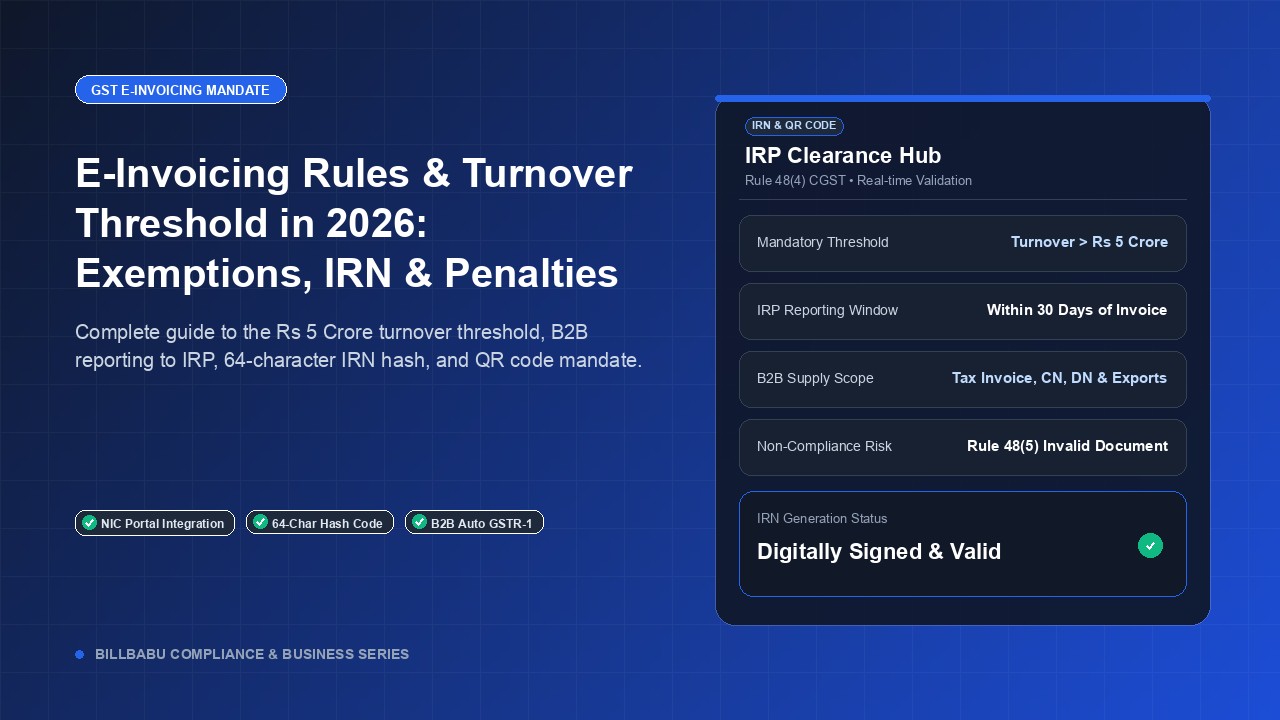
E-invoicing (IRN) applies to businesses whose aggregate turnover crossed ₹5 crore in any year from 2017-18, from 1 August 2023 (Notification 10/2023-CT). If you're below that, it doesn't affect your B2C bills. If you're above it, ask your CA how it applies to them, and see e-invoicing limits and IRN.
Making B2C bills in BillBabu App
BillBabu App is an Android app for GST tax invoices, estimates and purchase entries. For buyers without a GSTIN:
- Parties: the GSTIN box is optional. Save the buyer's name, address and state once, so bills of ₹50,000 and more carry them.
- Tax split: the place of supply fills in from the party's state, and the review step shows "Intra-State Transaction (CGST + SGST)" or "Inter-State Transaction (IGST)" before you save. The app works this out from the party's saved state. If you deliver to a different state, as in Circular 209, check the tax line and ask your CA.
- Delivery address: tap "Add Ship To (Consignee)" on the bill. It prints on the Classic and Ledger PDF designs.
- For your CA: a monthly GST report PDF with CGST, SGST and IGST by period, plus the bill list.
BillBabu App doesn't sort bills into B2CL and B2CS, file GSTR-1, or make credit notes or e-invoices. Your CA does the split from your bill list. If you run a counter shop, see billing for a kirana store. For the tax on a price, try the GST calculator.
Frequently asked questions
What is the B2CL limit?
An invoice value above ₹1 lakh, for an inter-state sale to an unregistered buyer. It has applied since 1 August 2024 (Rule 59(4)); it was ₹2.5 lakh before.
Is there a B2CL limit for sales within my state?
No. Intra-state sales to unregistered buyers are always reported as B2C Small totals, at any value. The ₹50,000 rule for printing the buyer's details still applies.
Do I need the customer's name on a B2C bill?
From a taxable value of ₹50,000, yes: name, address, delivery address, and state with its code. Below that, only if the customer asks (Rule 46(e), (f)).
Does the ₹1 lakh test use the taxable value or the invoice value?
Rule 59 says invoice value, and the GSTR-1 FAQ says the invoice value column includes taxes. Check bills close to ₹1 lakh with your CA.
Can a B2C invoice be changed to B2B?
If the buyer was registered on the sale date, your CA can correct it in a later GSTR-1, before 30 November after the year ends. GSTR-1A can't change the recipient's GSTIN.
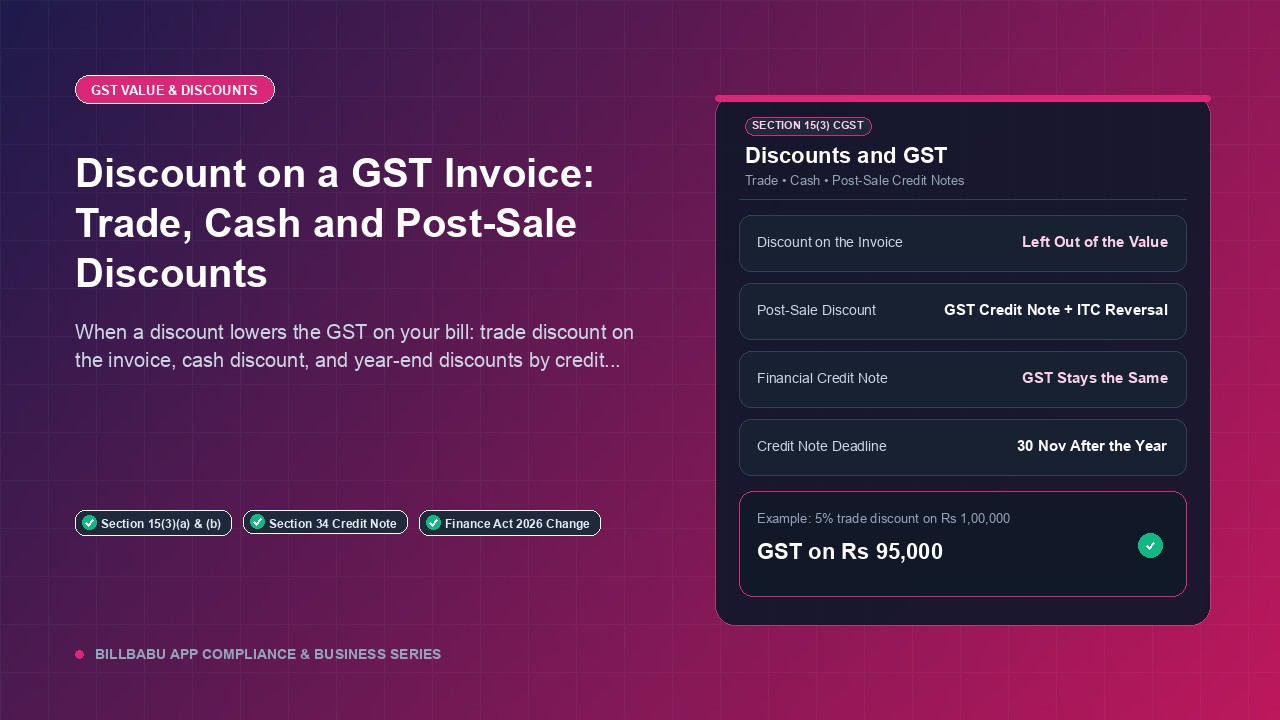
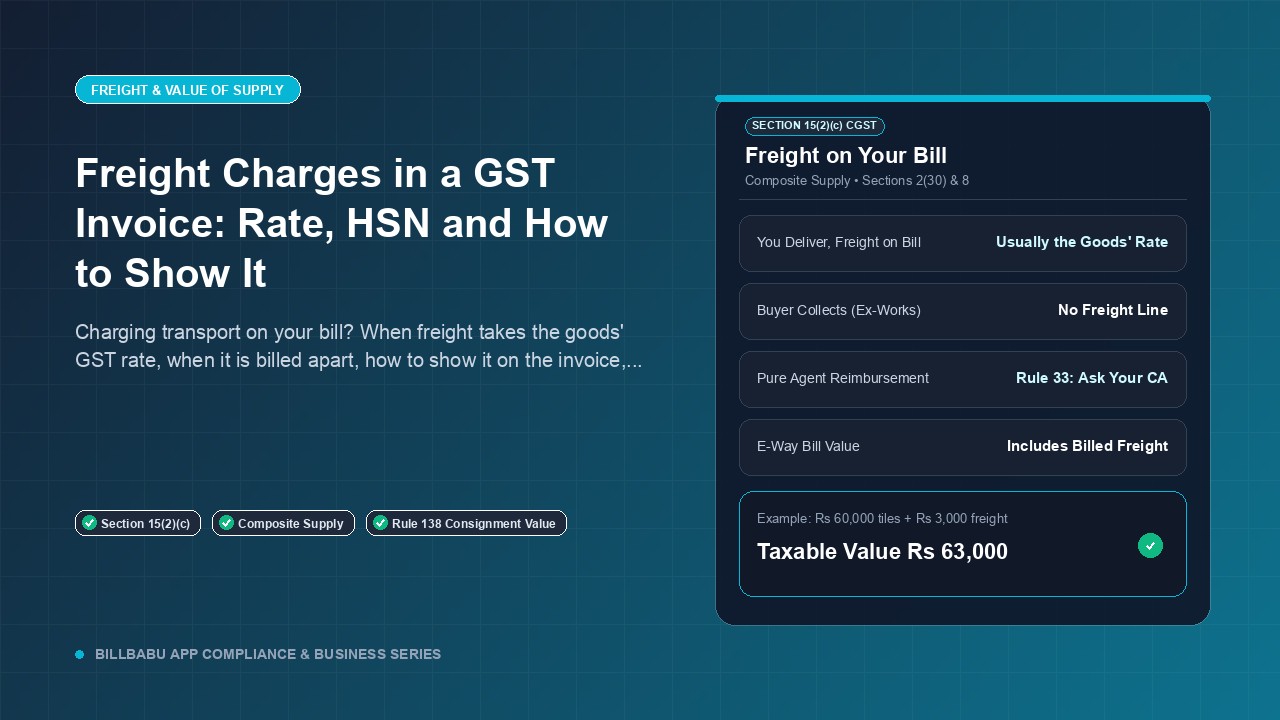
You might also read our posts on discounts on a GST invoice and freight on a GST invoice, or पक्का बिल और कच्चा बिल in Hindi.
Bills for buyers with or without a GSTIN. In BillBabu App, save the buyer's address and state once, check the tax line before you save, and share the PDF. Start free, no card needed; unlimited bills need Pro (paid). Search billbabu on Play Store.
Rules checked on 27 October 2026.
This article is general information, not tax or legal advice. Rules change; check the official GST portal and your CA before acting. BillBabu App is a private app by Central Bharat Labs; it is not a government service.
Official sources: CGST Rule 46 and Rule 59, IGST Act Section 10 on CBIC; Circular 209/3/2024-GST; GSTR-1 FAQ, GSTR-1 manual and GSTR-1A FAQ on the GST portal.
Tags
Related Articles
GST invoicing made easy for Indian small businesses
Make GST invoices and estimates, record payments, see party dues and keep stock, all from your phone. Start free, no card needed; upgrade to Pro for unlimited bills.