Discount on a GST Invoice: Trade, Cash and Post-Sale Discounts
When a discount lowers the GST on your bill: trade discount on the invoice, cash discount, and year-end discounts by credit note, with a distributor example.
BillBabu App Team
In this article (19 sections)
A distributor gives a retailer 5% off the list price. A company runs a year-end scheme for its dealers. A customer asks for "something off if I pay today". Each of these is a discount, and GST treats each one differently. Whether a discount lowers your GST depends on when it is given and how it is recorded.
In short
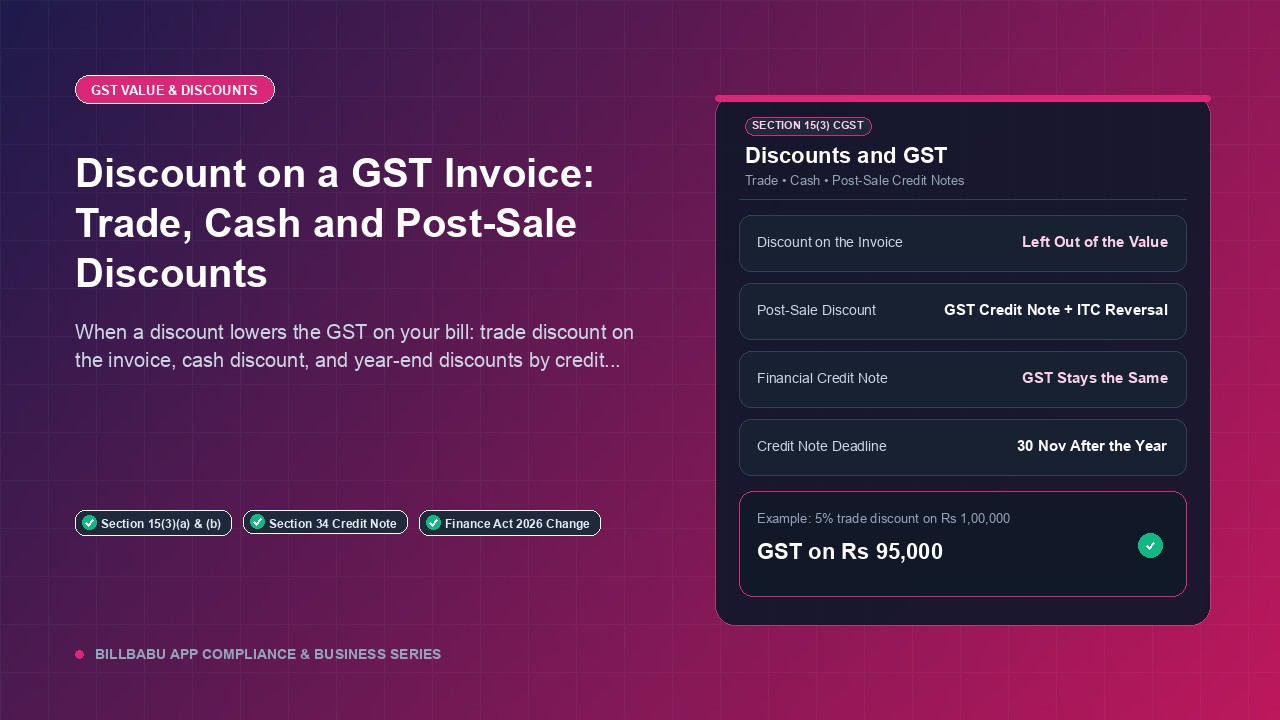
- A discount given before or at the time of sale and recorded on the invoice is left out of the taxable value. GST is charged on the price after the discount (CGST Act, Section 15(3)(a)).
- A discount given after the sale lowers GST only through a GST credit note, and only if the buyer reverses the matching input tax credit (ITC). Today it must also have been agreed before the sale and linked to the invoices (Section 15(3)(b)).
- The Finance Act 2026 drops the "agreed before the sale" condition. On 27 October 2026 that change was not yet in force on CBIC's site.
- A discount passed on by a plain financial credit note, without GST, doesn't reduce your GST, and the buyer keeps the credit.
The rule in one line
GST is charged on the transaction value, "the price actually paid or payable" (Section 15(1)). Section 15(3) then says the value does not include a discount given:
- (a) before or at the time of the supply, if it is duly recorded in the invoice; or
- (b) after the supply, only when certain conditions are met (explained below).
So the question is never just "did I give a discount?" It is "when, and is it on the invoice?"
Trade discount on the bill
A trade discount agreed at the time of sale is the simple case. Rule 46(k) asks for the "taxable value ... taking into account discount or abatement, if any". So show it before the tax:
| Line on the bill (example) | Amount |
|---|---|
| 10 steel almirahs × ₹10,000 list price | ₹1,00,000 |
| Less: trade discount 5% | − ₹5,000 |
| Taxable value | ₹95,000 |
| GST at an example rate of 18% | ₹17,100 |
CBIC's Circular 92/11/2019-GST gives the example of staggered "buy more, save more" discounts (10% above ₹5,000, 20% above ₹10,000 and so on) shown on the invoice itself. Discounts like these are left out of the value, as long as they meet Section 15(3).
A discount printed on the invoice at the time of sale is the cleanest kind. Your buyer's accountant can see it, and your GST matches the money you actually receive.
Cash discount for early payment
"2% off if paid within 7 days" is common in wholesale. The GST law has no separate clause for cash discounts. The question is which part of Section 15(3) your terms fit:
- If the discount and its terms are known at the time of sale and recorded on the invoice, clause (a) may cover it.
- If the buyer earns it only later, by paying early, it can be seen as a discount after the sale, and clause (b) with a credit note comes in.
Your CA should decide which reading fits your terms before you lower any tax. Until then, charge GST on the invoice value and record what the buyer actually paid.
Make GST bills and record payments on your phone
Search billbabu on Play Store to get BillBabu App. Start free, no card needed.
Discounts after the sale: year-end, volume and scheme discounts
This is where the 2026 change matters.
The rule in force on 27 October 2026
Section 15(3)(b) as it reads today lets a discount given after the sale reduce the value only if both of these are true:
- The discount "is established in terms of an agreement entered into at or before the time of such supply and specifically linked to relevant invoices"; and
- The buyer has reversed the input tax credit attributable to the discount, "on the basis of document issued by the supplier".
Circular 92 gives the usual case: a year-end volume discount, say 1% for buying 10,000 pieces in a year, agreed before the sales and passed on by credit notes at year end.
The supplier then issues a GST credit note under Section 34. Since 1 October 2025, a proviso to Section 34(2) says the supplier's output tax is not reduced if a registered buyer hasn't reversed the credit linked to that credit note.
What changes under the Finance Act 2026
The Finance Act 2026 (Act 4 of 2026, 30 March 2026) amends both sections:
- Section 153 replaces Section 15(3)(b). A discount after the sale is left out of the value "if for such discount, a credit note has been issued by the supplier and input tax credit as is attributable to such discount has been reversed by the recipient of the supply, in accordance with the provisions of section 34." The conditions of a prior agreement and invoice linking are gone.
- Section 154 adds "where a discount referred to in clause (b) of sub-section (3) of section 15 is given" to the reasons for a credit note in Section 34(1).
This follows the 56th GST Council meeting of 3 September 2025 (item 7.1). In short, a year-end discount will lower GST if you issue a GST credit note and the buyer reverses the credit, even if the scheme wasn't agreed in writing before the sale.
When does it start?
Section 1(2)(b) of the Finance Act 2026 says Sections 153 to 155 come into force on a date the Central Government notifies in the Official Gazette.
On 27 October 2026, CBIC's text of Section 15 and Section 34 still showed "w.e.f. yet to be notified", and CBIC's list of 2026 Central Tax notifications had no notification for these sections. Some tax news sites report a notification dated 26 October 2026 that brings the change into force on 1 November 2026. We could not find it on an official site.
Until the date is official, follow the current rule above. We will update this page when the notification appears. For discounts given after the start date on sales made before it, ask your CA.
Time limit for the credit note
Section 34(2): declare the credit note in the return for the month it is issued, and no later than 30 November after the end of the financial year of the sale, or the date you file the annual return, if that is earlier. A year-end discount for 2026-27 sales, for example, must be declared by 30 November 2027 at the latest. See credit and debit notes under GST.
Discounts that don't reduce GST
Circular 92 (para 2(D)) covers "secondary discounts", which are not known at the time of sale. A supplier may still pass them on through a financial or commercial credit note, without GST. But the value of the original sale doesn't change, so the GST on it stays.
Circular 251/08/2025-GST (12 September 2025) adds the buyer's side: the buyer need not reverse input tax credit for a discount given through a financial or commercial credit note, because the original value and tax are not reduced.
If an old website quotes Circular 105/24/2019-GST on post-sale discounts: CBIC withdrew it from the start by Circular 112/31/2019-GST.
Scheme discounts from a company to its dealer
Circular 251 also answers two questions dealers ask:
- A company's post-sale discount to a dealer usually just lowers the dealer's purchase price. It is not payment for the dealer's sale to the end customer, and not payment for a separate service.
- Two exceptions: where the company has its own agreement with the end customer to sell at a lower price, the discount counts as part of the price of the dealer's sale to that customer. And where the dealer's agreement names specific promotion work (advertising, co-branding, exhibitions and similar) with a clearly defined payment, GST applies to that service.
Each scheme is worded differently, so take the scheme letter to your CA.
Free goods and "buy one get one"
Circular 92 says a "buy one, get one free" offer is not a free supply. It is two items sold for one price, taxed under the composite or mixed supply rules of Section 8. Samples given away without any consideration are not a supply (with Schedule I exceptions), and the supplier can't take input tax credit on them. Ask your CA how this applies to your scheme.
Worked example: Gupta Distributors
Sample data: the businesses and amounts are made up, and 18% is an example rate.
Gupta Distributors in Lucknow bills a retailer in Kanpur. Both are in Uttar Pradesh, so the bill has CGST + SGST.
| Amount | |
|---|---|
| List price | ₹1,00,000 |
| Trade discount 5%, on the invoice | − ₹5,000 |
| Taxable value | ₹95,000 |
| CGST 9% | ₹8,550 |
| SGST 9% | ₹8,550 |
| Invoice total | ₹1,12,100 |
At year end, Gupta gives a 1% volume discount on this bill: ₹950.
- Route A, GST credit note. The taxable value falls by ₹950 and the GST by ₹171 (CGST ₹85.50 + SGST ₹85.50). The retailer reverses ₹171 of input tax credit. Under today's rule, this works only if the 1% scheme was agreed before the sale and linked to this bill. Once Section 153 is in force, the credit note and the buyer's reversal are enough.
- Route B, financial credit note without GST. Gupta pays or adjusts ₹950. The GST on ₹95,000 stays, and the retailer keeps the full ₹17,100 credit (Circular 251).
Gupta's CA confirms which route fits before the credit note is issued.
Showing a discount in BillBabu App
BillBabu App has no separate discount column on bills. What you can do:
- Trade discount at the time of sale: type the item rate after the discount, for example ₹9,500 instead of ₹10,000. The taxable value and GST on the bill are then on the discounted price.
- If your buyer wants to see the list price: write it in the item description, for example "Steel almirah (list ₹10,000, less 5%)". The description prints on the PDF.
- Early-payment terms: type them in the bill's payment terms box, which can print on the PDF. Ask your CA how to treat the tax on it.
BillBabu App doesn't make credit notes. For a year-end or scheme discount, issue the credit note as your CA advises. To work out GST on a price, use the GST calculator or read GST कैसे निकालें in Hindi.
Frequently asked questions
Can we give a discount in a GST invoice?
Yes. Show the list price, the discount and the taxable value after the discount. GST is charged on the taxable value (Section 15(3)(a), Rule 46(k)). See our GST bill format.
Is GST charged on the MRP or the discounted price?
On the transaction value: the price you actually charge after a discount shown on the invoice, not the MRP printed on the pack. A few goods, such as pan masala and tobacco products, are notified for valuation on the retail sale price instead.
Is GST applicable on a cash discount?
It depends on whether the discount is known and recorded on the invoice at the time of sale, or earned later by paying early. Your CA decides which part of Section 15(3) applies.
What changed for post-sale discounts in 2026?
The Finance Act 2026 lets a discount after the sale lower GST through a GST credit note and the buyer's credit reversal, without a prior agreement linked to invoices. On 27 October 2026 the start date was not yet notified on CBIC's site.
Does the buyer have to reverse input tax credit?
For a discount by GST credit note, yes: that is a condition both today and after the change. For a financial credit note without GST, no (Circular 251/08/2025-GST).
Related reading: input tax credit, time of supply, B2B invoice under GST, B2C invoice under GST, freight charges on a GST invoice and pricing strategies for small businesses.
Bills at the price you actually charge. In BillBabu App, type the rate after the trade discount, check the GST on the review step, and share the PDF. Start free, no card needed; unlimited bills need Pro (paid). Search billbabu on Play Store.
Rules checked on 27 October 2026.
This article is general information, not tax or legal advice. Rules change; check the official GST portal and your CA before acting. BillBabu App is a private app by Central Bharat Labs; it is not a government service.
Official sources: CGST Act Section 15 and Section 34 on CBIC; Finance Act 2026 in the Gazette of India; Circular 92/11/2019-GST; Circular 251/08/2025-GST; 56th GST Council press release.
Tags
Related Articles
GST invoicing made easy for Indian small businesses
Make GST invoices and estimates, record payments, see party dues and keep stock, all from your phone. Start free, no card needed; upgrade to Pro for unlimited bills.