E-Invoicing Rules & Turnover Threshold in 2026: Exemptions, IRN Generation, and Penalties
Detailed guide to GST e-invoicing threshold rules in 2026. Learn AATO limits, exempt sectors, IRN generation, QR code validation, and Rule 48(5) penalties.
BillBabu Team
BillBabu Compliance Team
In this article (11 sections)
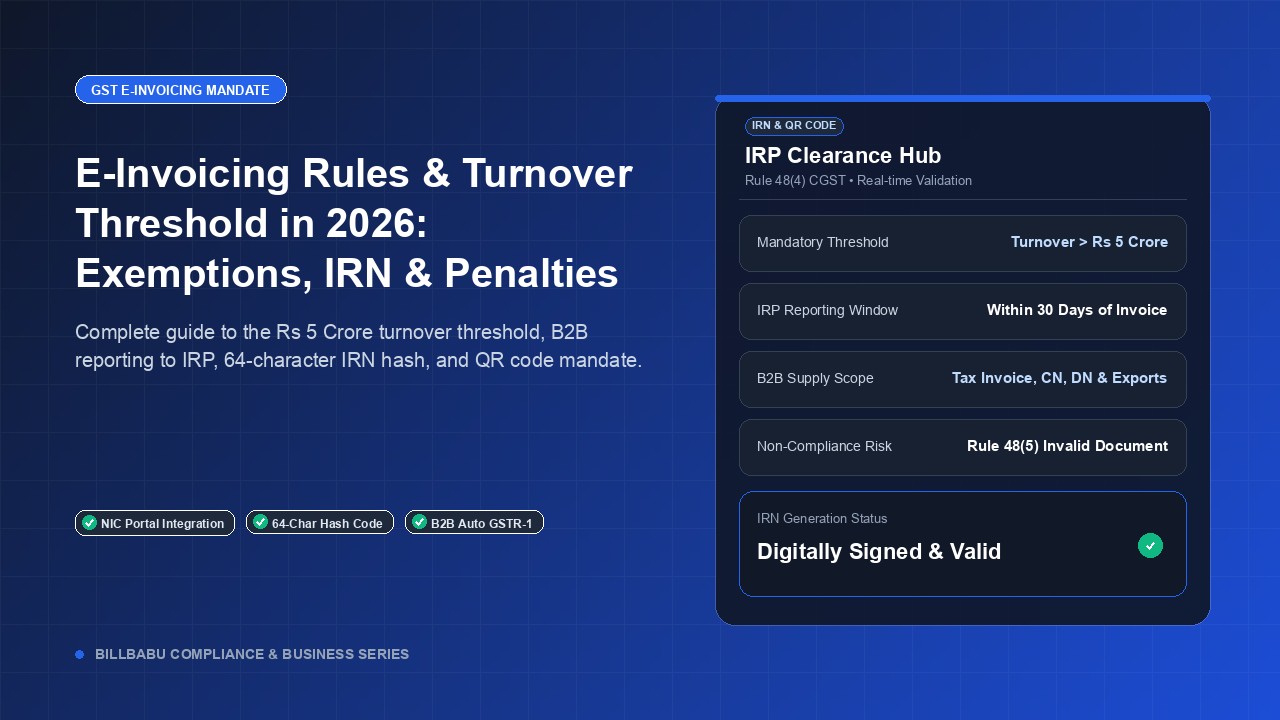
Under Rule 48(4) of the Central Goods and Services Tax (CGST) Rules, 2017, electronic invoicing (e-invoicing) is compulsory for businesses exceeding the prescribed turnover threshold. Rather than generating invoices solely in proprietary ERPs, covered taxpayers must upload standardized invoice payloads to an official Invoice Registration Portal (IRP), which authenticates the transaction, issues a unique 64-character Invoice Reference Number (IRN), and stamps a digitally signed QR code. In 2026, with GST compliance and automated scrutiny reaching peak digitization, operating without a full grasp of e-invoicing rules risks invalidating customer invoices, freezing buyer input tax credit, and inviting severe fiscal penalties.
The Turnover Threshold Rule: How Aggregate Turnover is Evaluated
The applicability of e-invoicing hinges on a business's Aggregate Annual Turnover (AATO). Under statutory notifications:
- Mandatory Threshold in 2026: E-invoicing is mandatory for all registered businesses whose aggregate turnover in any preceding financial year from FY 2017-18 onward exceeds ₹5 Crore.
- The "Any Preceding Year" Rule: This is the most crucial compliance parameter. Even if your turnover in FY 2024-25 or FY 2025-26 dropped to ₹3 Crore, but crossed ₹5 Crore in FY 2022-23, your business remains permanently bound to issue e-invoices! E-invoicing applicability is irrevocable once triggered.
- PAN-Level Aggregation: Aggregate turnover is computed across all GSTINs registered under the same Permanent Account Number (PAN) nationwide. It includes taxable supplies, exempt supplies, exports, and interstate stock transfers, excluding GST taxes.
| Phase & Implementation Date | Turnover Threshold (AATO) | Coverage Scope |
|---|---|---|
| Phase 1 (October 2020) | > ₹500 Crore | Large Conglomerates |
| Phase 2 (January 2021) | > ₹100 Crore | Large Enterprises |
| Phase 3 (April 2021) | > ₹50 Crore | Mid-market Corporates |
| Phase 4 (April 2022) | > ₹20 Crore | Mid-scale Manufacturers |
| Phase 5 (October 2022) | > ₹10 Crore | Small & Mid Enterprises |
| Phase 6 (Current Standard) | > ₹5 Crore | All MSMEs exceeding ₹5 Cr in any year since 2017 |
Create GST invoices & track payments in 30 seconds
Join thousands of Indian businesses using BillBabu. 14-day free trial on Android.
Covered Documents vs. Exempt Entities
E-invoicing does not apply to every paper issued by a company. Understanding which transaction flows require an IRN is essential:
Transactions and Documents Covered
- B2B Tax Invoices: Supplies to registered persons carrying a GSTIN.
- B2B Credit Notes & Debit Notes: Issued under Section 34 of the CGST Act.
- Export Invoices: Supplies to overseas entities (with or without payment of IGST).
- SEZ Supplies: Supplies made to Special Economic Zone (SEZ) units or developers.
- Deemed Exports: Supplies notified under Section 147 of the CGST Act.
Key Exemptions from E-Invoicing
Under Rule 48(4) and related notifications, the following entities and transactions are exempt regardless of turnover:
- Special Economic Zone (SEZ) Units: SEZ units are exempt (Note: SEZ Developers are not exempt and must issue e-invoices).
- Insurers, Banking Companies & Financial Institutions: Including Non-Banking Financial Companies (NBFCs).
- Goods Transport Agencies (GTA): Supplying services in relation to transportation of goods by road in a goods carriage.
- Passenger Transportation Services: Supplying passenger transport services.
- Multiplex / Cinema Admissions: Supplying services by way of admission to exhibition of cinematograph films in multiplex screens.
- Government Departments & Local Authorities: Notified public bodies.
- B2C Supplies: Invoices issued to unregistered end consumers do not require an IRN (large retailers use B2C Dynamic QR codes instead).
IRN Generation Workflow: Step-by-Step Architecture
The electronic invoicing process links internal billing systems with the government's centralized validation infrastructure:
- Payload Generation: The billing software compiles invoice attributes into the standard schema (Form GST INV-01), formatting details such as supplier GSTIN, recipient GSTIN, document type, HSN code, item rates, and CGST/SGST/IGST tax amounts.
- JSON Upload to IRP: The software transmits the JSON file via secure API to an authorized Invoice Registration Portal (such as
einvoice1.gst.gov.inor private GSP/ASP gateways). - Validation & Hash Generation: The IRP runs automated validations to ensure mathematical accuracy, verifies active GSTIN status, checks for duplicate invoice numbers, and generates a unique 64-character hash known as the Invoice Reference Number (IRN).
- Digital Signature & QR Code: The IRP signs the payload with its private key and generates a Digitally Signed QR Code containing key invoice metadata.
- Auto-Population: The IRP automatically pushes the validated invoice data into the National Informatics Centre (NIC) e-way bill system and the seller's GSTR-1 (Table 4A), which ultimately flows into the buyer's GSTR-2B statement.
- Final Invoice Output: The billing system receives the signed payload and prints the official PDF invoice displaying the IRN and the scannable QR code.
The 30-Day Reporting Time Limit: For taxpayers with AATO ≥ ₹100 Crore, the GST authority enforces a strict 30-day time limit to report invoices to the IRP from the invoice date. Failing to upload within 30 days results in the portal rejecting the invoice payload!
Legal & Financial Penalties for Non-Compliance (Rule 48(5))
The consequences of failing to generate an e-invoice when legally obligated are catastrophic for both the seller and the buyer:
- The Invoice is Legally Null and Void (Rule 48(5)): Under Rule 48(5) of the CGST Rules, if an invoice is issued by a covered taxpayer without an IRN, it shall not be treated as an invoice! Legally, goods are considered to be moving without a valid document.
- Denial of Buyer Input Tax Credit (ITC): Under Section 16(2)(a) of the CGST Act, a buyer cannot claim Input Tax Credit without a valid tax invoice. If your customer is audited and your invoice lacks an IRN, their ITC will be summarily denied with 18% penal interest.
- Penalties for Seller under Section 122:
- For failing to issue a valid invoice: 100% of the tax due or ₹10,000 per invoice, whichever is higher (Section 122(1)).
- For issuing incorrect invoices: Penalty up to ₹25,000 per incident (Section 122(3)).
- Transit Interception & Detention (Section 129): Goods transported with an invalid invoice (lacking an IRN) are subject to vehicle interception, seizure, and a mandatory penalty equal to 200% of the tax payable to secure release of the consignment!
Automate 1-Click E-Invoicing & IRN Generation with BillBabu
Eliminate manual JSON uploads and portal errors. BillBabu integrates directly with official IRP gateways to generate IRNs, embed signed QR codes on invoices, and synchronize Part-A E-Way Bills in under 3 seconds.
Start Free Trial on BillBabuFrequently Asked Questions (FAQs)
1. Can an e-invoice with an IRN be edited or amended on the IRP?
No. Once an IRN is generated, the IRP does not allow any edits, modifications, or partial amendments. If there is an error, you must cancel the IRN within 24 hours on the portal and generate a new invoice with a fresh invoice number. If 24 hours have elapsed, amendments must be made via Credit Notes or Debit Notes in your regular GSTR-1 return.
2. Does e-invoicing eliminate the need to generate an E-Way Bill?
No, but it streamlines the process. When generating an e-invoice on the IRP, you can supply transporter details (transporter ID and vehicle number). The IRP will simultaneously generate both the IRN and the integrated E-Way Bill (EWB), printing both on the final invoice PDF.
3. Are B2C invoices subject to e-invoicing under Rule 48(4)?
No. B2C (Business to Consumer) invoices do not require an IRN. However, businesses with turnover exceeding ₹500 Crore are subject to a separate requirement to print a dynamic UPI QR code on B2C invoices to facilitate digital payments.
Tags
Related Articles
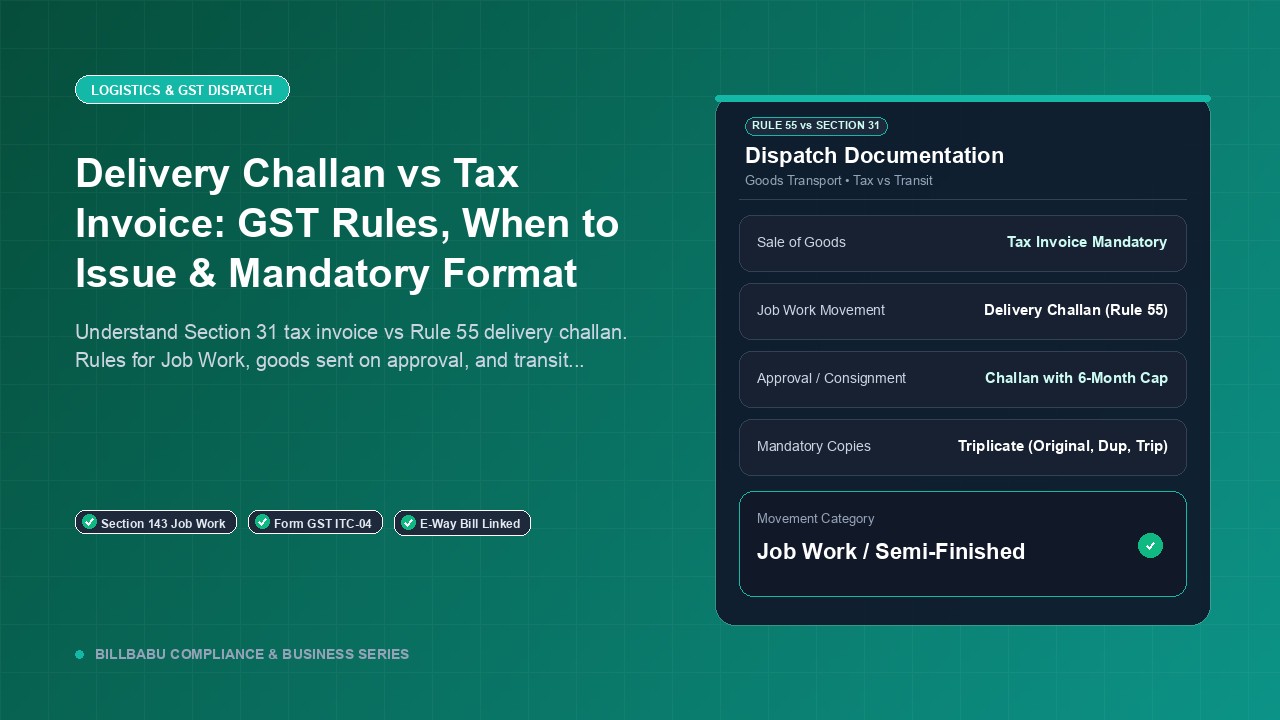
Delivery Challan vs Tax Invoice: GST Rules, When to Issue, and Mandatory Format
5 min read
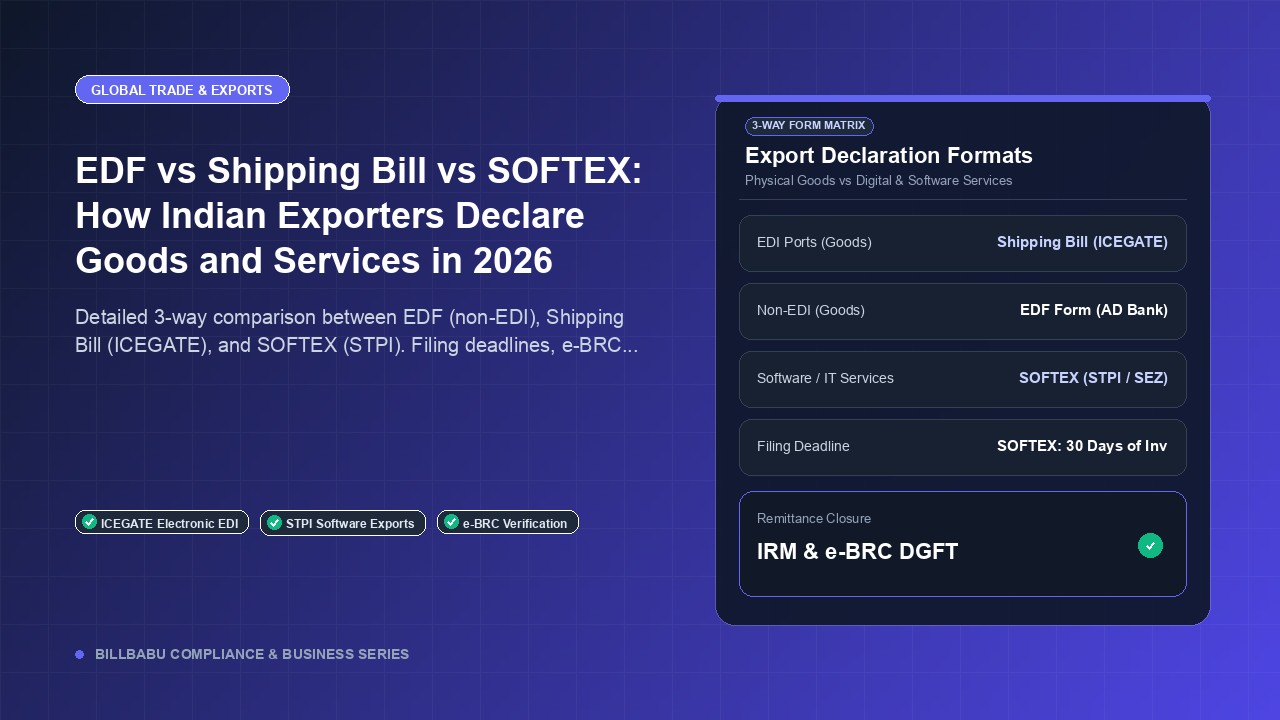
EDF vs Shipping Bill vs SOFTEX: How Indian Exporters Declare Goods and Services in 2026
7 min read
UPI for B2B Payments and Invoice Collections: Limits, Dynamic QR, and AutoPay for Indian Businesses
6 min read
GST invoicing made easy for Indian small businesses
Create GST-compliant invoices & estimates, track payments, manage parties and inventory — all from your phone. 14-day free trial, no credit card needed.