Delivery Challan vs Tax Invoice: GST Rules, When to Issue, and Mandatory Format
Delivery Challan vs Tax Invoice under GST: Learn Rule 55 rules, job work, goods on approval, e-way bill requirements, and mandatory formats for Indian trade.
BillBabu Team
BillBabu Compliance Team
In this article (11 sections)
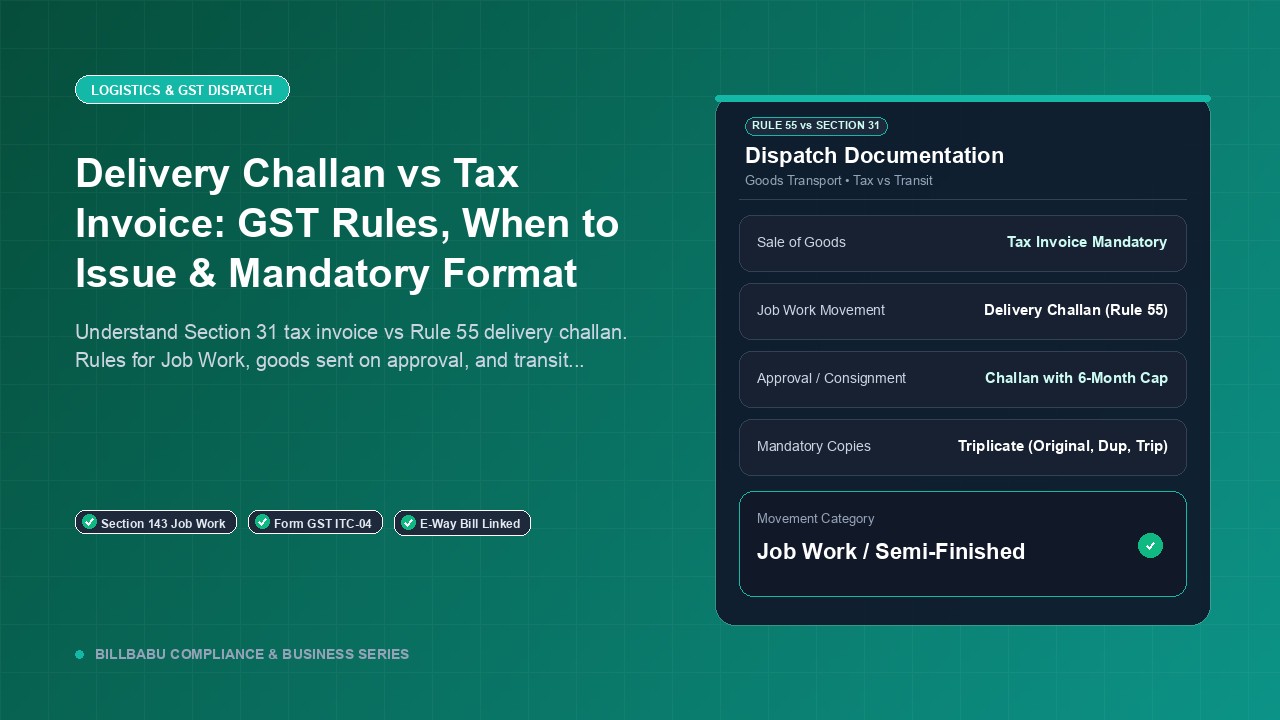
Under Indian Goods and Services Tax (GST) law, every movement of merchandise outside a business premises must be accompanied by valid statutory documentation. When ownership transfers as part of a commercial sale, Section 31 mandates the issuance of a Tax Invoice. However, goods frequently move between locations without an immediate sale—such as materials dispatched for job work processing, machinery transported for client demonstration, or stock sent on approval. In these non-sale scenarios, Rule 55 of the CGST Rules permits the issuance of a Delivery Challan. Confusing these two documents can trigger allegations of tax evasion, vehicle detention, or severe accounting discrepancies. This guide explains statutory boundaries, permissible use cases, mandatory formats, and reconciliation workflows.
Statutory Grounding: Section 31 vs. Rule 55 of CGST Rules
To ensure flawless compliance, accountants and logistics teams must distinguish between the statutory roots of these two instruments:
- Tax Invoice (Section 31 & Rule 46): Issued when there is an actual or agreed "supply" of goods or services for consideration. A tax invoice establishes financial debt, creates an output tax liability for the supplier, and serves as the indispensable voucher for the recipient to avail Input Tax Credit (ITC) under Section 16.
- Delivery Challan (Rule 55): Issued when physical goods are transported for reasons other than by way of supply, or where the exact quantity cannot be ascertained at the time of dispatch. It authorizes movement without immediately creating a sales realization or debiting the customer's trade receivable ledger.
When Can You Legally Issue a Delivery Challan?
Under Rule 55(1) of the CGST Rules, 2017, a Delivery Challan is legally permitted in the following specific scenarios:
| Permitted Scenario | Legal Provision | Statutory Time Limit & Condition |
|---|---|---|
| 1. Goods Dispatched for Job Work | Section 143 & Rule 55(1)(b) | Inputs must return within 1 year; capital goods within 3 years. |
| 2. Goods Sent on Sale on Approval | Section 31(7) & Rule 55(1)(c) | Tax invoice must be issued at approval, or within 6 months from dispatch. |
| 3. Transport of Liquid Gas | Rule 55(1)(a) | Where exact quantity at removal from refinery/plant is unknown. |
| 4. Inter-Branch Transfers (Same GSTIN) | Rule 55(1)(c) | Transfer between godowns/branches within the same state under one GSTIN. |
| 5. Exhibition, Trade Fairs & Demos | Circular No. 108/27/2019-GST | Goods taken for display; invoice issued only if sold on site. |
| 6. SKD / CKD Consignments | Rule 55(5) | Heavy machinery shipped in multiple parts across several trucks. |
Create GST invoices & track payments in 30 seconds
Join thousands of Indian businesses using BillBabu. 14-day free trial on Android.
Side-by-Side Comparison: Delivery Challan vs. Tax Invoice
| Compliance Parameter | Tax Invoice (Rule 46) | Delivery Challan (Rule 55) |
|---|---|---|
| Primary Purpose | Commercial sale & transfer of title | Transit documentation without immediate title transfer |
| Tax Liability Trigger | Yes — Immediate liability in GSTR-1/3B | No — Tax is not payable upon dispatch |
| Input Tax Credit (ITC) Eligibility | Recipient can claim ITC via GSTR-2B | Cannot be used by recipient to claim ITC |
| Accounting Journal Entry | Debits Trade Receivables; credits Sales & GST | No financial entry; internal inventory location transfer only |
| E-Way Bill Requirement | Mandatory if consignment > ₹50,000 (Supply) | Mandatory if consignment > ₹50,000 (Job Work/Others) |
Mandatory Information Format on a Delivery Challan (Rule 55(1))
A delivery challan is not an informal memo. Under Rule 55(1), it must contain the following statutory particulars:
- Challan Number & Date: A unique consecutive serial number not exceeding 16 characters, containing alphabets, numerals, or special characters (hyphen or dash).
- Consigner Details: Name, address, and GSTIN of the supplier/consigner.
- Consignee Details: Name, address, and GSTIN (or Unique Identity Number) of the recipient/consignee. If unregistered, mention full delivery address.
- HSN Code & Description: Harmonized System of Nomenclature (HSN) code and precise description of merchandise.
- Quantity & Units: Quantity dispatched (provisional if exact quantity is not known).
- Taxable Value: Declared fair market value of the consignment.
- Applicable Tax Rate & Amount: CGST, SGST, IGST, or Cess breakdown (calculated on the taxable value for transit assessment purposes).
- Place of Supply: Mandatory in case of interstate movement.
- Signature: Authorized signature or digital signature of the consigner.
Number of Physical Copies Required
Under Rule 55(2), a delivery challan must be prepared in triplicate:
- Original Copy: Marked for the Consignee.
- Duplicate Copy: Marked for the Transporter (must accompany vehicle during transit).
- Triplicate Copy: Retained by the Consigner for book records.
Special Transit Rules: SKD/CKD and Batch Consignments (Rule 55(5))
When large industrial equipment (such as boilers, cranes, or assembly lines) cannot be transported in a single truck, Rule 55(5) provides a specific multi-consignment mechanism:
- The supplier must issue a complete Tax Invoice before dispatch of the first consignment, charging full value and GST.
- Each individual truck is dispatched with a separate Delivery Challan referencing the master Tax Invoice number and date.
- Every vehicle must carry a copy of the master Tax Invoice alongside its specific delivery challan and corresponding E-Way bill.
Generate GST Delivery Challans in BillBabu
Whether dispatching raw materials for job work, moving stock between godowns, or shipping machinery in SKD parts, BillBabu lets you create Rule 55 compliant Delivery Challans, generate auto-linked E-Way bills, and convert challans into tax invoices with one click.
Start Free Trial on BillBabuFrequently Asked Questions (FAQs)
1. Can I collect payment from a customer using a delivery challan?
No. A delivery challan is strictly a movement voucher. It does not establish a legal trade debtor balance. Before demanding payment or recognizing sales revenue, you must issue a valid GST Tax Invoice under Section 31.
2. Is an E-Way Bill mandatory for goods moving on a Delivery Challan?
Yes. If the consignment value exceeds ₹50,000 (or state-notified intrastate limits), an E-Way Bill is mandatory. In the e-way bill portal, select the transaction sub-type as Job Work, For Own Use, Exhibition or Fairs, or Line Sales rather than standard Supply.
3. What happens if goods sent for job work are not returned within 1 year?
Under Section 143(3) of the CGST Act, if inputs sent on a delivery challan are not returned within 1 year, the transaction is deemed to be a taxable supply made by the principal on the day they were originally dispatched! The principal must issue a tax invoice with retroactive GST and pay 18% interest from the original dispatch date.
Tags
Related Articles
E-Invoicing Rules & Turnover Threshold in 2026: Exemptions, IRN Generation, and Penalties
6 min read
EDF vs Shipping Bill vs SOFTEX: How Indian Exporters Declare Goods and Services in 2026
7 min read
UPI for B2B Payments and Invoice Collections: Limits, Dynamic QR, and AutoPay for Indian Businesses
6 min read
GST invoicing made easy for Indian small businesses
Create GST-compliant invoices & estimates, track payments, manage parties and inventory — all from your phone. 14-day free trial, no credit card needed.