EDF vs Shipping Bill vs SOFTEX: How Indian Exporters Declare Goods and Services in 2026
Detailed comparison of EDF, Shipping Bill, and SOFTEX in 2026. Learn when each declaration applies, filing portals, deadlines, and foreign remittance closure.
BillBabu Team
BillBabu App Team
Under Section 7 of the Foreign Exchange Management Act, 1999 (FEMA), every single cross-border commercial outbound transaction from India must be officially declared to the Reserve Bank of India (RBI). However, whether you are shipping containers of engineering goods, clearing handloom textiles through a border land station, or delivering cloud software from Bengaluru, your statutory declaration vehicle is entirely different. Using the wrong mechanism or missing filing deadlines can paralyze foreign exchange realization, forfeit export incentives, and trigger regulatory inquiries. This comprehensive guide provides an in-depth comparison of the Export Declaration Form (EDF), the Shipping Bill, and the SOFTEX Form in 2026.
The Tripartite Export Declaration Framework in India
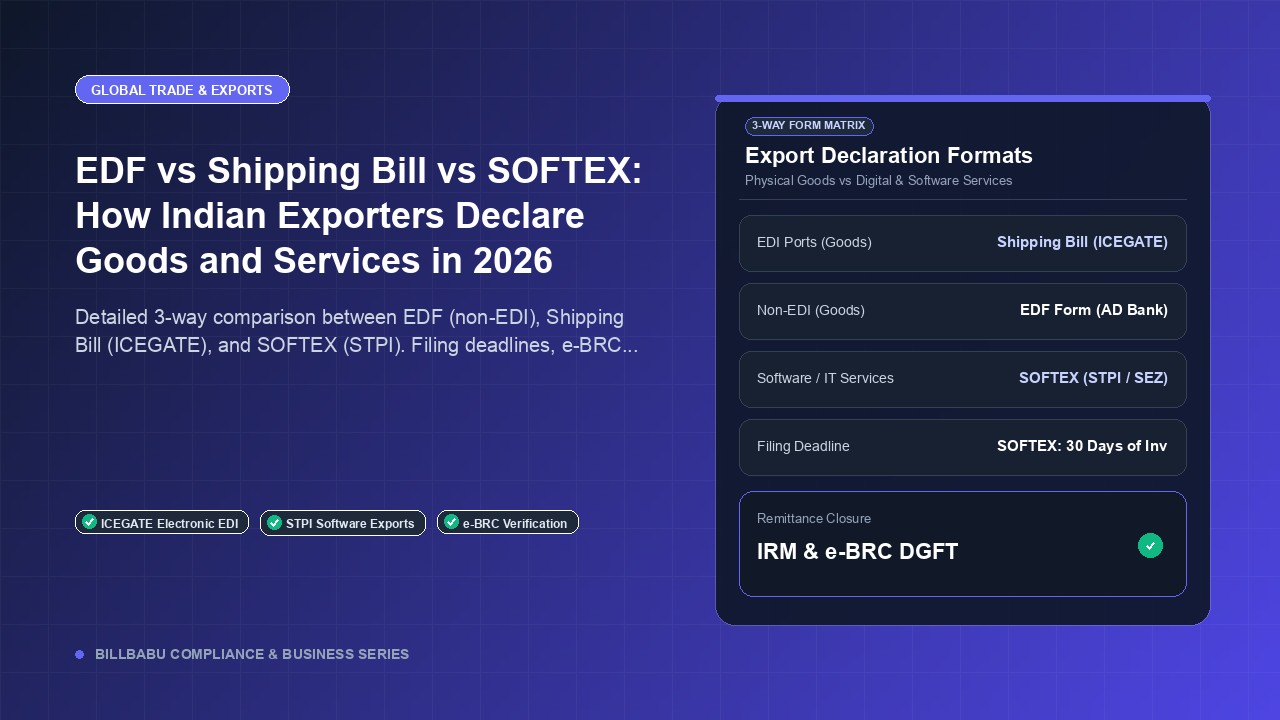
India divides export declarations into three distinct channels based on two parameters: physical tangible goods versus digital/software services, and electronic EDI customs ports versus non-EDI customs ports.
- Shipping Bill (EDI): The digital declaration filed on ICEGATE for physical goods exiting through computerized seaports, airports, and inland container depots.
- Export Declaration Form (EDF): The physical/manual declaration filed for physical goods exiting through non-EDI customs checkpoints, such as Land Customs Stations (LCS) bordering neighboring countries or minor ports.
- SOFTEX Form: The specialized electronic declaration filed for computer software, digital products, and IT-enabled services (ITeS) delivered via telecommunication links or the internet.
In-Depth Comparison Matrix: EDF vs Shipping Bill vs SOFTEX
The following table summarizes the legal, technical, and operational distinctions across all three declaration formats:
| Compliance Parameter | Shipping Bill (EDI) | Export Declaration Form (EDF) | SOFTEX Form |
|---|---|---|---|
| Scope of Export | Physical merchandise and tangible cargo | Physical merchandise and postal parcels | Computer software, SaaS, IT services & ITeS |
| Customs Port Type | EDI Ports (Computerized via ICEGATE) | Non-EDI Ports (Land Customs, Minor Ports) | Not Applicable (Electronic Transmission) |
| Filing Portal / Medium | ICEGATE Portal (Customs Broker / Self) | Physical Paper Form in Duplicate | STPI Portal / SEZ Online System |
| Primary Regulatory Authority | CBIC Customs & DGFT | Customs & Authorized Dealer (AD) Bank | Software Technology Parks of India (STPI) / SEZ DC |
| Mandatory Filing Deadline | Prior to Let Export Order (LEO) | Prior to export; submit to AD bank within 21 days | Within 30 days from Invoice Date |
| Realization Tracking Mechanism | Automated push from ICEGATE to EDPMS | Manual entry by AD Bank into EDPMS | STPI certification pushed to EDPMS |
| Legal Realization Window | 9 Months (15 months for warehouse) | 9 Months from export date | 9 Months from invoice date |
| Incentive Eligibility | RoDTEP, Duty Drawback, Advance Auth | RoDTEP, Duty Drawback (manual scroll) | SEIS (when active), Zero-rated GST refund |
1. The Shipping Bill Workflow (EDI Ports)
For more than nine-tenths of Indian merchandise trade, the Shipping Bill is the single, all-encompassing document. It acts simultaneously as:
- A declaration of cargo content, valuation, and HSN codes to Customs under the Customs Act, 1962.
- A statutory declaration under FEMA Section 7 regarding foreign exchange realization.
- An application for export clearance (culminating in the Let Export Order or LEO).
- An application for refund of IGST paid on export goods under Rule 96 of CGST Rules (when exported with tax payment).
The Automated Data Flow: When the Customs Appraiser clears the shipment and issues the LEO, the ICEGATE server automatically transmits the Shipping Bill data package to the Reserve Bank's EDPMS database. No physical paper declaration needs to be lodged with your bank.
2. The Export Declaration Form (EDF) Workflow (Non-EDI Ports)
While modern logistics relies on computerized hubs, thousands of crores of cross-border commerce flow annually through Land Customs Stations (LCS) along the borders of Bangladesh (e.g., Petrapole, Ghojadanga), Nepal (e.g., Raxaul, Jogbani), and Bhutan, as well as minor non-EDI seaports in Gujarat, Maharashtra, and Andhra Pradesh.
Because these border posts lack direct, real-time integration with the ICEGATE EDPMS pipeline, exporters must complete the physical EDF in duplicate:
- Customs Verification: The Original copy is retained at the border station; the Duplicate copy is endorsed by the customs superintendent with the physical Let Export signature and returned to the exporter.
- Bank Lodgement (21 Days): The exporter must submit this physical Duplicate EDF to their Authorized Dealer Category-I bank within 21 days of shipment.
- Manual EDPMS Injection: The AD bank manual operator keys in the shipping details, port code, invoice value, and currency into EDPMS, converting the paper record into an electronic tracking entry.
3. The SOFTEX Workflow (Software & IT Services Exports)
India is a global powerhouse in IT consulting, enterprise software, SaaS, and IT-enabled services (BPO/KPO). However, because software code and digital deliverables are transmitted across the internet via FTP, cloud repositories, or email, there is no physical border customs checkpoint to verify their valuation or export.
To ensure foreign exchange compliance under FEMA Regulation 3, software exporters must file the SOFTEX Form:
Who Must File SOFTEX?
- Any business or professional exporting computer software, mobile apps, SaaS subscriptions, digital animation, or IT-enabled business services.
- Units located in Software Technology Parks (STPI) or Special Economic Zones (SEZ).
- Non-STPI Units: Even freelance software consultancies or private limited tech firms operating from standard commercial offices must register as a "Non-STPI Unit" with their regional STPI directorate to file SOFTEX.
The Strict 30-Day Filing Rule
Mandatory Timeline: Under RBI Master Direction guidelines, SOFTEX declarations must be submitted to the designated STPI authority within 30 days from the date of the invoice. For multi-contract service providers billing on monthly timesheets, contracts may be consolidated into a single monthly SOFTEX filing submitted within 30 days of the last invoice date of that month.
The SOFTEX Certification & EDPMS Knock-Off
- The exporter logs into the STPI portal and enters client contract details, invoice number, currency, exchange rate, and service classification.
- STPI officials audit the contract, invoices, and bank statements, issuing an electronic SOFTEX Approval Certificate.
- STPI transmits the approved SOFTEX data directly into RBI's EDPMS database.
- When foreign client funds arrive in India, the AD bank issues an Inward Remittance Message (IRM) and knocks off the open SOFTEX record in EDPMS.
Foreign Remittance Closure: IRM, EDPMS & e-BRC
Regardless of whether you filed a Shipping Bill, an EDF, or a SOFTEX Form, the ultimate destination of your transaction is identical: Realization & Reconciliation in EDPMS.
| Step | Compliance Action | Primary Document Generated |
|---|---|---|
| 1. Fund Receipt | Foreign buyer wires funds via SWIFT / Nostro account. | Foreign Inward Remittance Certificate (FIRC) / Advice |
| 2. Bank Reporting | AD Category-I bank uploads receipt to RBI database. | Inward Remittance Message (IRM) |
| 3. Bill Matching | Exporter maps IRM to open Shipping Bill / EDF / SOFTEX. | EDPMS Status Updated to "Closed / Realized" |
| 4. DGFT e-BRC | System transmits electronic realization to DGFT portal. | Electronic Bank Realisation Certificate (e-BRC) |
Common Exporter Traps & Compliance Pitfalls
- The Software "FIRC Trap": Many tech startups believe that possessing a bank FIRC is sufficient proof of export realization. Under FEMA, a FIRC without an approved, certified SOFTEX form leaves the export unlinked in EDPMS. After two years, the RBI system flags the company for automated caution-listing.
- Missing Customs Port Codes on Commercial Invoices: Commercial invoices that omit the 6-character port code (e.g., INNSA1 for Nhava Sheva, INDEL4 for Delhi Air Cargo) create reconciliation failures between GSTR-1 and ICEGATE.
- Failing to Track Intermediary Deduction Offsets: When foreign buyers deduct correspondent banking charges ($25-$50 per wire), the net inflow fails to match the invoice total. Exporters must ensure their bank marks the bill fully realized by accounting for allowable banking deductions.
Frequently Asked Questions (FAQ)
1. Do SaaS companies charging foreign users via Stripe or PayPal need to file SOFTEX?
Yes. If your Indian business provides software subscriptions to overseas customers and repatriates proceeds to an Indian bank account, FEMA regulations classify this as a software export requiring SOFTEX declarations, even if payments are collected through online payment gateways.
2. Can a Shipping Bill be amended after the cargo leaves port?
Yes, under Section 149 of the Customs Act, 1962, a Shipping Bill can be amended with prior permission of the Principal Commissioner / Commissioner of Customs, provided documentary evidence exists showing that the amendment relates to facts existing at the time of export.
3. How long is an e-BRC valid for claiming export incentives?
An electronic Bank Realisation Certificate (e-BRC) does not expire; it acts as permanent statutory evidence of foreign currency repatriation. However, foreign trade incentive schemes like RoDTEP and Duty Drawback impose specific application windows (typically 12 to 24 months from the date of export).
Eliminate Invoicing Friction with BillBabu
Whether managing physical goods or software services, clean invoicing is the foundation of flawless export compliance. BillBabu lets you craft professional, multi-currency export invoices with proper HSN/SAC classifications, automated port code tagging, and LUT declaration statements designed to sail through Customs, STPI, and bank audits.
Get Started with BillBabu TodayTags
Related Articles
UPI for B2B Payments and Invoice Collections: Limits, Dynamic QR, and AutoPay for Indian Businesses
6 min read
Tax Invoice Cancellation Under GST: 24-Hour IRP Window and Credit Notes
3 min read
Subscription Invoice vs One-Time Invoice: Recurring Billing Done Right
2 min read
GST invoicing made easy for Indian small businesses
Create GST-compliant invoices & estimates, track payments, manage parties and inventory — all from your phone. 14-day free trial, no credit card needed.