TDS Section 194Q vs TCS 206C(1H) on Goods: Thresholds, Who Deducts, and Invoice Billing Rules
Understand TDS Section 194Q vs TCS Section 206C(1H) on purchase and sale of goods. Learn ₹50L thresholds, 0.1% rates, tie-breaker rules, and billing entries.
BillBabu Team
BillBabu Compliance Team
In this article (12 sections)
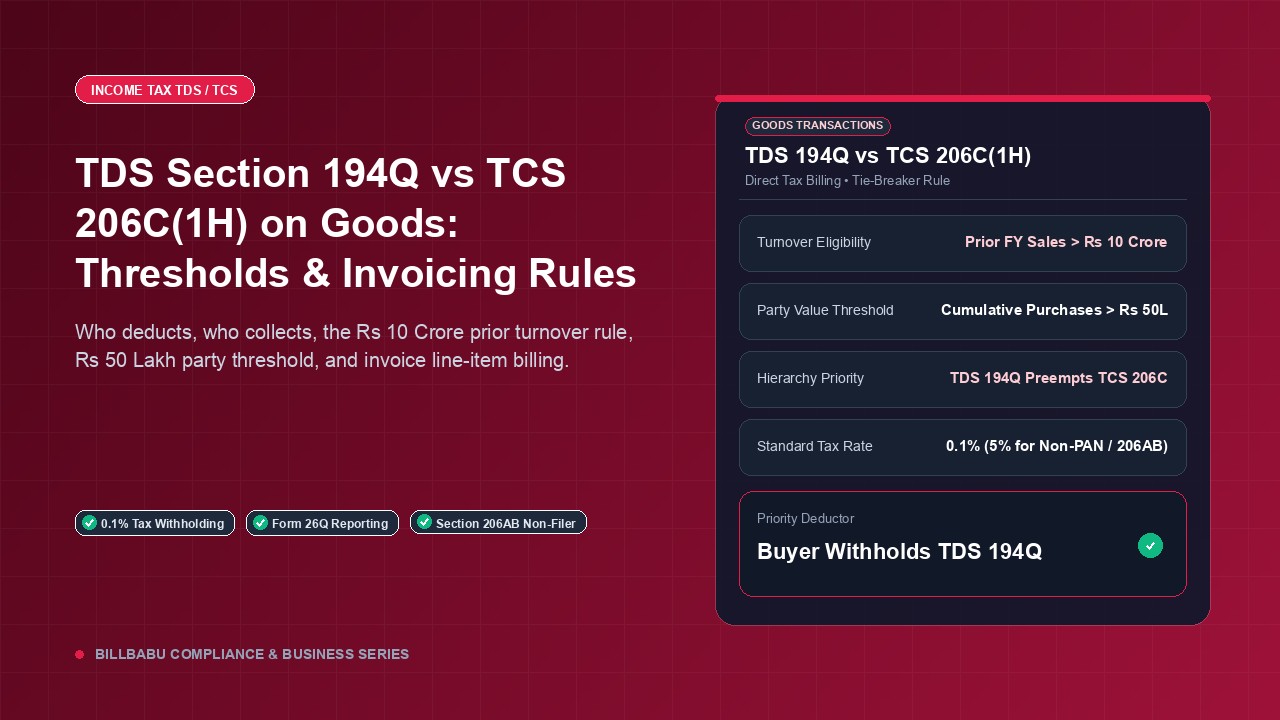
Under the Indian Income Tax Act, 1961, high-value commercial trading in merchandise is monitored by twin withholding provisions: Section 194Q (Tax Deducted at Source by the Buyer) and Section 206C(1H) (Tax Collected at Source by the Seller). Designed to establish an unshakeable digital paper trail over large wholesale transactions, both provisions share a 0.1% tax rate and a ₹50 Lakh single-party annual threshold. However, conflicting operational obligations frequently lead to billing confusion: who must deduct or collect, does the tax apply on the base value or the GST total, and what happens when both parties exceed turnover limits? This guide provides complete clarity on thresholds, hierarchy rules, journal entries, and invoicing compliance for 2026.
Overview of the Two Mirror Provisions
To grasp the statutory interaction, consider the role of each section:
- Section 194Q (Buyer's Obligation - TDS on Purchase): Enacted via Finance Act 2021. Mandates that any buyer whose total turnover exceeded ₹10 Crore in the preceding financial year must deduct 0.1% TDS when purchasing goods from a resident seller if aggregate purchases exceed ₹50 Lakh in the current financial year.
- Section 206C(1H) (Seller's Obligation - TCS on Sale Consideration): Enacted via Finance Act 2020. Mandates that any seller whose total turnover exceeded ₹10 Crore in the preceding financial year must collect 0.1% TCS from the buyer upon receiving payment for sale of goods exceeding ₹50 Lakh in the current financial year.
The Golden Tie-Breaker Rule: 194Q Overrides 206C(1H)
The most common compliance dilemma occurs when both Buyer and Seller have turnovers exceeding ₹10 Crore. In such cases, who is legally responsible?
The Statutory Priority Rule: Section 206C(1H) explicitly contains a sunset sub-clause stating that TCS shall NOT be collected if the buyer is liable to deduct tax at source under any other provision of the Act and has deducted such tax. Therefore, Section 194Q strictly prevails over Section 206C(1H)!
Whenever the buyer's turnover exceeds ₹10 Crore, the buyer must deduct TDS under Section 194Q. The seller is legally prohibited from charging TCS under Section 206C(1H). Section 206C(1H) operates solely as a residual fallback when the buyer's turnover is under ₹10 Crore (or the buyer is otherwise exempt).
| Scenario | Buyer Turnover (Prior FY) | Seller Turnover (Prior FY) | Applicable Statutory Rule |
|---|---|---|---|
| Scenario 1 | > ₹10 Crore | > ₹10 Crore | Buyer deducts TDS under 194Q (No TCS by seller) |
| Scenario 2 | ≤ ₹10 Crore | > ₹10 Crore | Seller collects TCS under 206C(1H) |
| Scenario 3 | > ₹10 Crore | ≤ ₹10 Crore | Buyer deducts TDS under 194Q |
| Scenario 4 | ≤ ₹10 Crore | ≤ ₹10 Crore | Neither applies (Exempt) |
Create GST invoices & track payments in 30 seconds
Join thousands of Indian businesses using BillBabu. 14-day free trial on Android.
Critical Distinction: Base Taxable Value vs Gross Receipt Value
One of the most frequent accounting errors relates to how GST is treated when calculating withholding tax:
1. For TDS Under Section 194Q (CBDT Circular No. 13 of 2021)
The Central Board of Direct Taxes (CBDT) clarified that if tax is deducted at the time of credit to the seller's account and the GST component is indicated separately in the invoice, TDS must be deducted on the taxable amount excluding GST!
Example: Base value = ₹10,00,000, 18% GST = ₹1,80,000. Total invoice = ₹11,80,000. Assuming the ₹50L threshold is already crossed, 0.1% TDS is deducted on ₹10,00,000 = ₹1,000.
2. For TCS Under Section 206C(1H)
In contrast, TCS is triggered at the time of receipt of consideration. Because the seller receives the full payment including GST, CBDT clarified that TCS under 206C(1H) must be collected on the gross amount received, including GST!
Example: On receipt of ₹11,80,000, 0.1% TCS = ₹1,180.
Higher Tax Rates for Non-Filers / Inoperative PAN (Section 206AB & 206CCA)
While the standard rate is 0.1%, severe punitive rates apply if the counterparty fails to fulfill tax compliance:
- If the vendor fails to provide a valid PAN, the tax rate jumps from 0.1% to 5.00% under Section 206AA!
- Under Section 206AB and Section 206CCA (Specified Persons who have not filed their Income Tax Returns for the previous year and have aggregate TDS/TCS ≥ ₹50,000), the applicable rate is 5.00%. Businesses should utilize the income tax portal's automated compliance check utility before processing disbursements.
Accounting Journal Entries (Buyer's Books under Section 194Q)
Consider a purchase of ₹20,00,000 plus 18% GST (₹3,60,000) where the ₹50 Lakh annual threshold has already been exhausted:
Debit:  Purchases Account ........................ ₹20,00,000.00
Debit:  Input CGST Account (9%) .................. ₹ 1,80,000.00
Debit:  Input SGST Account (9%) .................. ₹ 1,80,000.00
Credit: Trade Creditors (Vendor A/c) ............. ₹23,58,000.00
Credit: TDS Payable on Goods u/s 194Q (0.1%) ..... ₹    2,000.00
(Being purchase recorded with 0.1% TDS deducted on base value excluding GST)
Automate TDS 194Q & TCS 206C(1H) Invoicing in BillBabu
Eliminate manual threshold tracking. BillBabu automatically monitors cumulative party sales and purchases across the financial year, alerts you when the ₹50 Lakh threshold is crossed, and applies 0.1% TDS or TCS seamlessly on your invoices.
Start Free Trial on BillBabuFrequently Asked Questions (FAQs)
1. Does Section 194Q apply to import of goods from overseas suppliers?
No. Section 194Q applies strictly to purchases of goods from a resident seller. Imports of merchandise from outside India are exempt from Section 194Q deduction.
2. Does Section 194Q apply to purchase of capital goods (machinery)?
Yes. The statute uses the broad term "goods" without distinguishing between raw materials, trading stock, or capital assets. If a company buys a machine worth ₹75 Lakh, Section 194Q applies to the amount exceeding ₹50 Lakh.
3. What is the penalty for failing to deduct TDS under Section 194Q?
Under Section 40(a)(ia) of the Income Tax Act, failing to deduct or deposit Section 194Q TDS results in 30% of the purchase expenditure being disallowed as a business deduction in that financial year, directly inflating your taxable corporate profit!
Tags
Related Articles
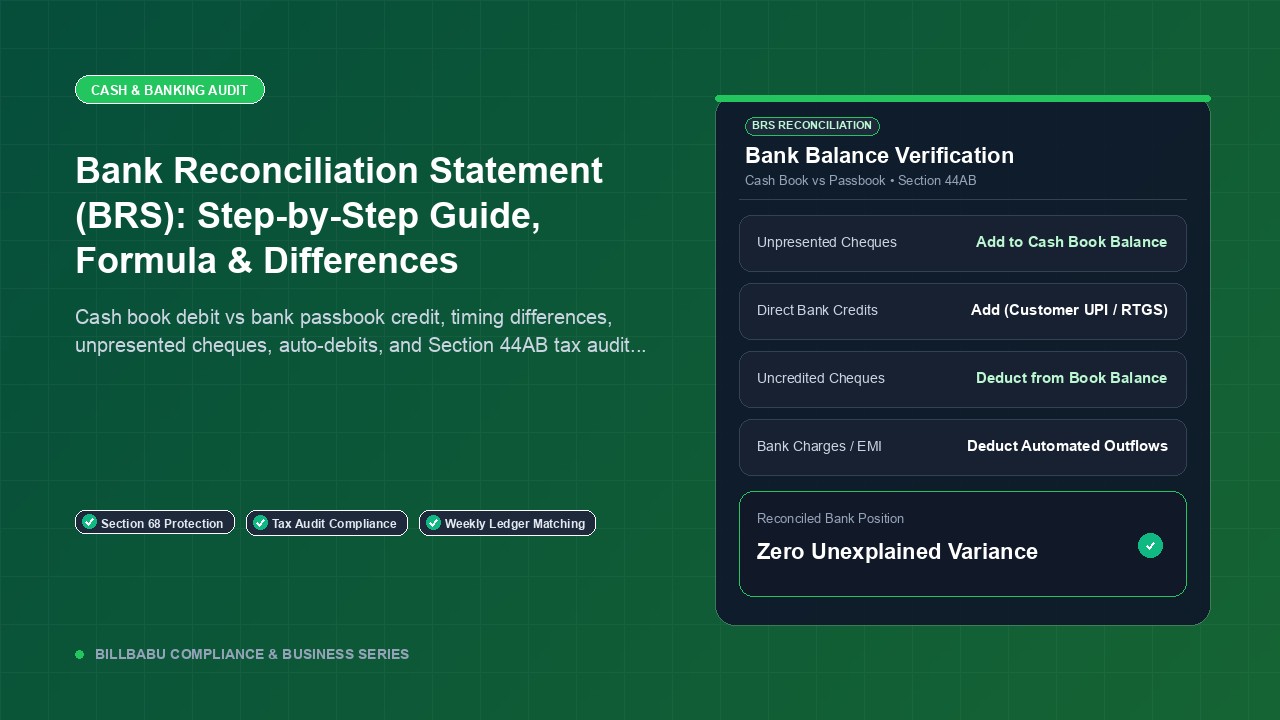
Bank Reconciliation Statement (BRS): Step-by-Step Guide, Formula, and Common Timing Differences
6 min read
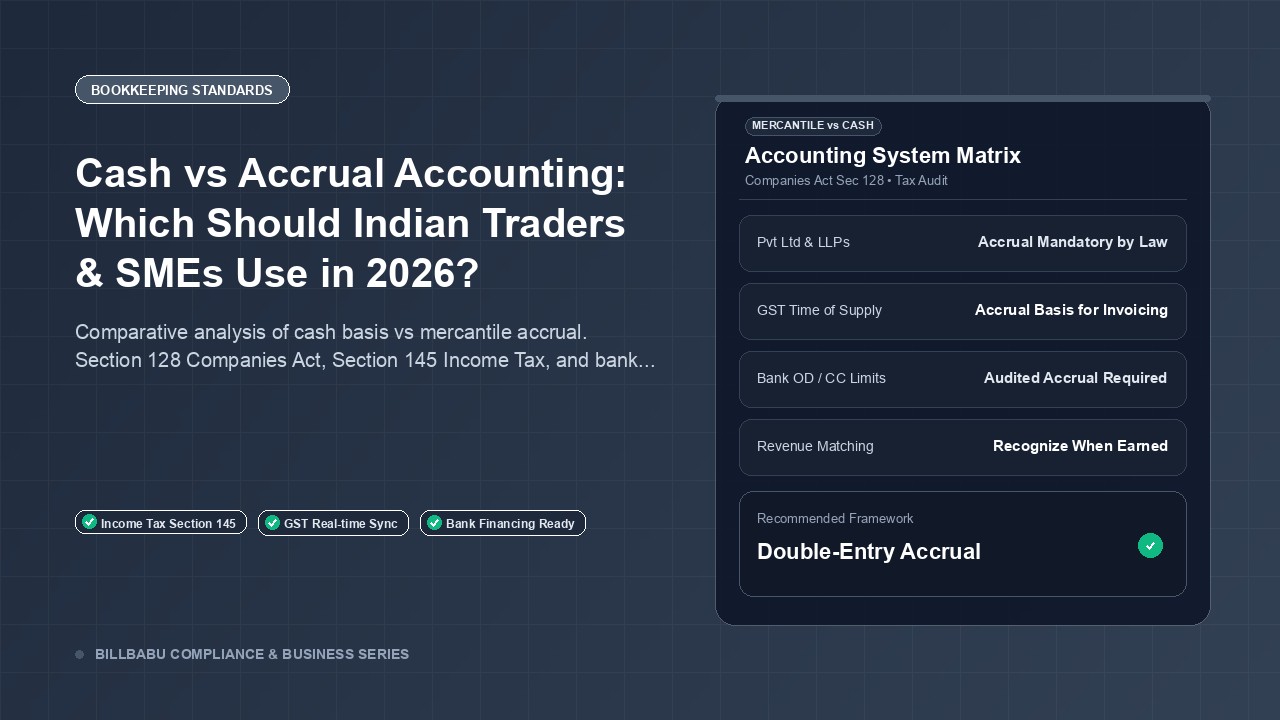
Cash vs Accrual Accounting: Which Should Indian Small Businesses & Traders Use in 2026?
5 min read
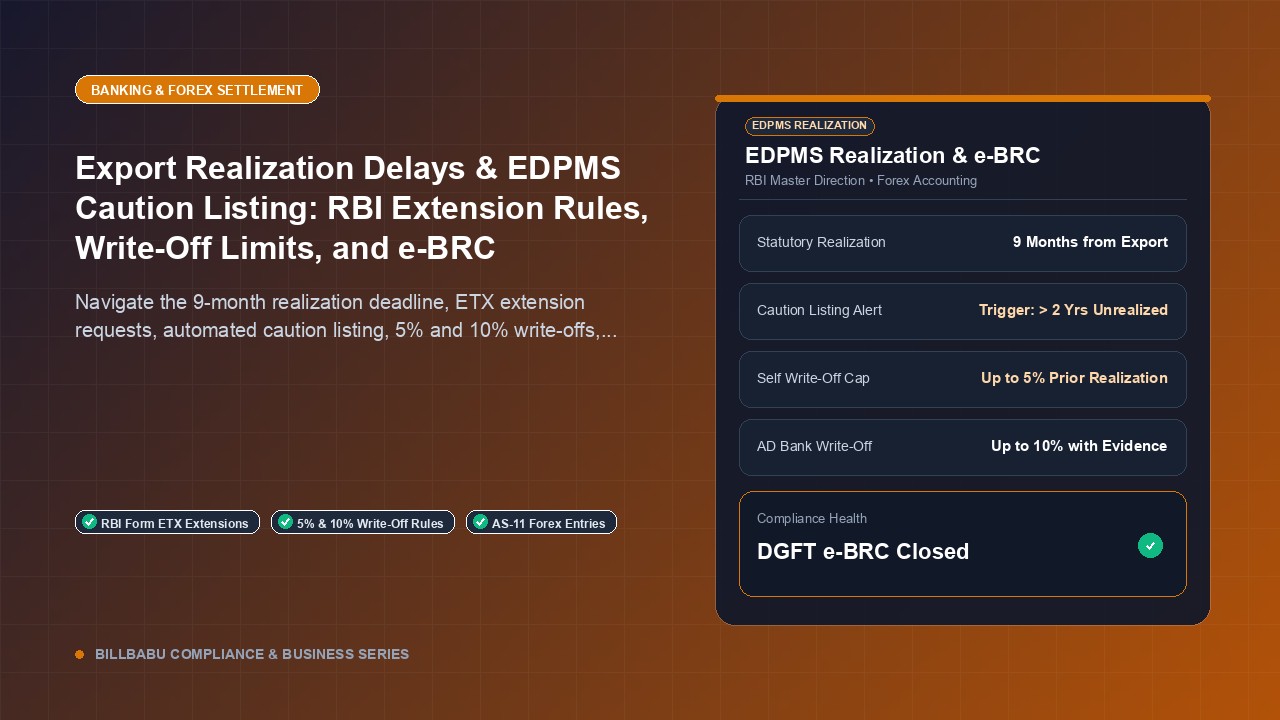
Export Realization Delays & EDPMS Caution Listing: RBI Extension Rules, Write-Off Limits, and e-BRC
8 min read
GST invoicing made easy for Indian small businesses
Create GST-compliant invoices & estimates, track payments, manage parties and inventory — all from your phone. 14-day free trial, no credit card needed.