Bank Reconciliation Statement (BRS): Step-by-Step Guide, Formula, and Common Timing Differences
Master Bank Reconciliation Statements (BRS). Step-by-step formula, cash book vs passbook timing differences, unpresented cheques, and Tax Audit Section 44AB.
BillBabu Team
BillBabu Compliance Team
In this article (14 sections)
For every business operating a current account, the closing balance on your bank statement virtually never matches the bank ledger balance in your accounting books. Cheques issued to suppliers take days to clear, customers remit payments via UPI or NEFT without prior notification, automatic loan EMIs debit in the early morning, and bank service fees quietly shave off cash reserves. The financial instrument designed to reconcile these discrepancies is the Bank Reconciliation Statement (BRS). Beyond basic bookkeeping, a rigorous monthly BRS is a vital internal fraud control, a prerequisite for tax audit compliance under Section 44AB, and a primary safeguard against Section 68 unexplained cash credit notices. This guide explains the mathematical framework, timing differences, worked step-by-step reconciliations, and modern automation tools.
The Fundamental Divergence: Cash Book vs. Bank Passbook
In double-entry bookkeeping, the bank is an external custodian of your company's funds:
- The Cash Book (Bank Column): Maintained by your internal accountant. When money enters your bank, it is recorded on the Debit side (asset increases). When payments are issued, they are recorded on the Credit side (asset decreases).
- The Bank Statement (Passbook): Maintained by the commercial bank from their perspective. When you deposit funds, the bank owes you money, so they Credit your account (their liability). When money is withdrawn, the bank Debits your account.
Therefore, a Debit balance in the Cash Book equals a Credit balance in the Bank Passbook (Favorable balance). Conversely, a Credit balance in the Cash Book represents a Bank Overdraft.
The Two Categories of Discrepancies
All differences between your cash book and bank statement stem from two distinct sources:
1. Timing Differences (Normal Banking Lags)
- Cheques Issued But Not Yet Presented for Payment: You record a payment to a vendor on 28th March, crediting your cash book. The vendor deposits the cheque on 4th April. Between 28th March and 4th April, your cash book balance is lower than your bank balance.
- Cheques Deposited But Not Yet Cleared: A customer hands you a cheque on 30th March. You debit your cash book immediately, but the clearing house settles the funds on 3rd April.
- Direct Credits by Customers: A buyer transfers ₹50,000 via NEFT or RTGS. The bank credits your account instantly, but your accounts team learns of it only when reviewing statements at month-end.
- Automatic Debits (ECS / NACH / Bank Charges): Loan EMIs, insurance premiums, UPI soundbox rentals, or cheque leaf charges debited directly by the bank without prior internal vouchers.
- Interest Credited by Bank: Interest on auto-sweep deposits credited directly to your bank account.
2. Errors and Omissions
- Arithmetic errors, transposition mistakes (recording ₹5,400 as ₹4,500), or recording a cheque in the cash column instead of the bank column.
- Bank errors: Inadvertent debits by the bank intended for another company's account.
Create GST invoices & track payments in 30 seconds
Join thousands of Indian businesses using BillBabu. 14-day free trial on Android.
The Step-by-Step BRS Mathematical Formula
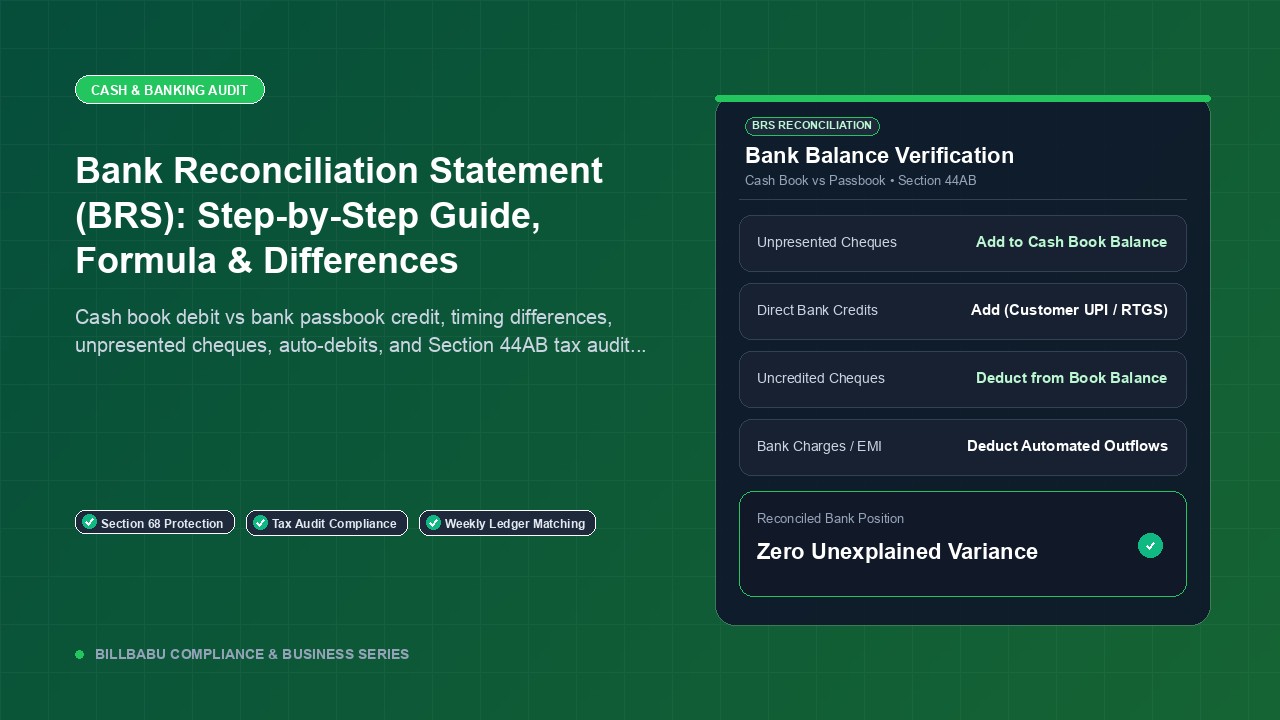
When preparing a BRS starting from a Favorable Cash Book Balance (Debit Balance):
| Reconciliation Item | Action (Starting with Cash Book Debit Balance) | Reasoning |
|---|---|---|
| Cheques issued but not presented | ADD (+) | Cash book was reduced, but bank has not reduced it yet. |
| Direct deposits by customers | ADD (+) | Bank has increased, but cash book was not updated. |
| Interest credited by bank | ADD (+) | Bank balance increased; cash book not yet credited. |
| Cheques deposited but not cleared | LESS (-) | Cash book was increased, but bank has not credited funds yet. |
| Bank charges & fees debited | LESS (-) | Bank has deducted money; cash book not yet reduced. |
| Direct auto-debits (EMIs / Insurance) | LESS (-) | Bank balance dropped; internal voucher missing. |
| Cheques dishonoured / bounced | LESS (-) | Cash book assumed credit, but bank returned unpaid. |
Comprehensive Worked Numerical Example
Consider the books of Shanti Enterprises as of 31st March 2026. The Cash Book displays a bank balance of ₹2,45,000.00, while the HDFC Bank Current Account statement shows ₹2,66,150.00.
Audit Examination Reveals the Following Facts:
- Cheques issued to suppliers in late March but not yet presented for payment: ₹45,000.00.
- Cheques deposited into the bank on 30th March but credited in April clearing: ₹32,000.00.
- A customer transferred funds directly via NEFT into the current account: ₹28,000.00.
- Bank charged annual current account maintenance and SMS alert fees: ₹1,200.00.
- Monthly business loan EMI auto-debited via NACH on 31st March: ₹18,500.00.
- Monthly UPI Soundbox IoT rental fee debited: ₹150.00.
Formal Bank Reconciliation Statement as of 31st March 2026:
| Particulars | Amount (₹) | Total (₹) |
|---|---|---|
| Balance as per Cash Book (Debit / Favorable) | 2,45,000.00 | |
| ADD: Items increasing bank relative to cash book | ||
| • Cheques issued but not yet presented for payment | 45,000.00 | |
| • Direct credit by customer via NEFT | 28,000.00 | +73,000.00 |
| Sub-Total | 3,18,000.00 | |
| LESS: Items reducing bank relative to cash book | ||
| • Cheques deposited but not yet cleared in transit | 32,000.00 | |
| • Bank charges and service fees debited | 1,200.00 | |
| • Monthly business loan EMI auto-debited | 18,500.00 | |
| • UPI Soundbox monthly rental auto-debited | 150.00 | -51,850.00 |
| Balance as per Bank Passbook (Credit / Favorable) | ₹2,66,150.00 | |
The reconciliation is complete, proving that every single rupee of difference is fully accounted for by verifiable timing events.
Tax Audit and Legal Implications (Section 44AB & Section 68)
Maintaining a timely BRS is not merely good internal housekeeping—it is a critical legal defense:
- Clause 11 / Tax Audit Requirements: When a business undergoes a Tax Audit under Section 44AB, tax auditors are legally bound to examine the year-end BRS. Unexplained differences are reported as audit qualifications in Form 3CD.
- Section 68 Protection (Unexplained Cash Credits): During Income Tax scrutiny, assessing officers scrutinize large bank deposits. If customer credits appear in the bank statement but cannot be linked to corresponding sales invoices in your books, the department can treat the entire credit as unexplained taxable income under Section 68, attracting a 78% tax and penalty rate! A reconciled BRS proves the commercial legitimacy of every deposit.
Automate Bank Reconciliation with BillBabu
Tired of spending weekends manually ticking off bank statements against customer ledgers? BillBabu matches incoming payments, links payment gateway settlements, flags unreconciled cheques, and generates audit-ready BRS reports in seconds.
Start Free Trial on BillBabuFrequently Asked Questions (FAQs)
1. How frequently should a small business prepare a BRS?
While tax audits require an annual BRS as of 31st March, businesses should reconcile bank accounts at least monthly. High-volume retail, e-commerce, and wholesale operations should reconcile weekly or daily to detect payment fraud and bounced cheques immediately.
2. What is an Adjusted Cash Book?
An Adjusted Cash Book is a best-practice accounting workflow where, before preparing the formal BRS, the accountant records all genuine omissions (such as direct customer remittances, bank charges, and interest) directly into the cash book. The BRS is then prepared only for pure timing differences (unpresented and uncollected cheques).
3. How does BRS work in case of a Bank Overdraft?
In case of a Bank Overdraft (Unfavorable balance), the mathematical signs are inverted: unpresented cheques are deducted, while uncollected cheques and bank charges are added to reconcile to the passbook debit balance.
Tags
Related Articles
TDS Section 194Q vs TCS 206C(1H) on Goods: Thresholds, Who Deducts, and Invoice Billing Rules
5 min read
Cash vs Accrual Accounting: Which Should Indian Small Businesses & Traders Use in 2026?
5 min read
Export Realization Delays & EDPMS Caution Listing: RBI Extension Rules, Write-Off Limits, and e-BRC
8 min read
GST invoicing made easy for Indian small businesses
Create GST-compliant invoices & estimates, track payments, manage parties and inventory — all from your phone. 14-day free trial, no credit card needed.