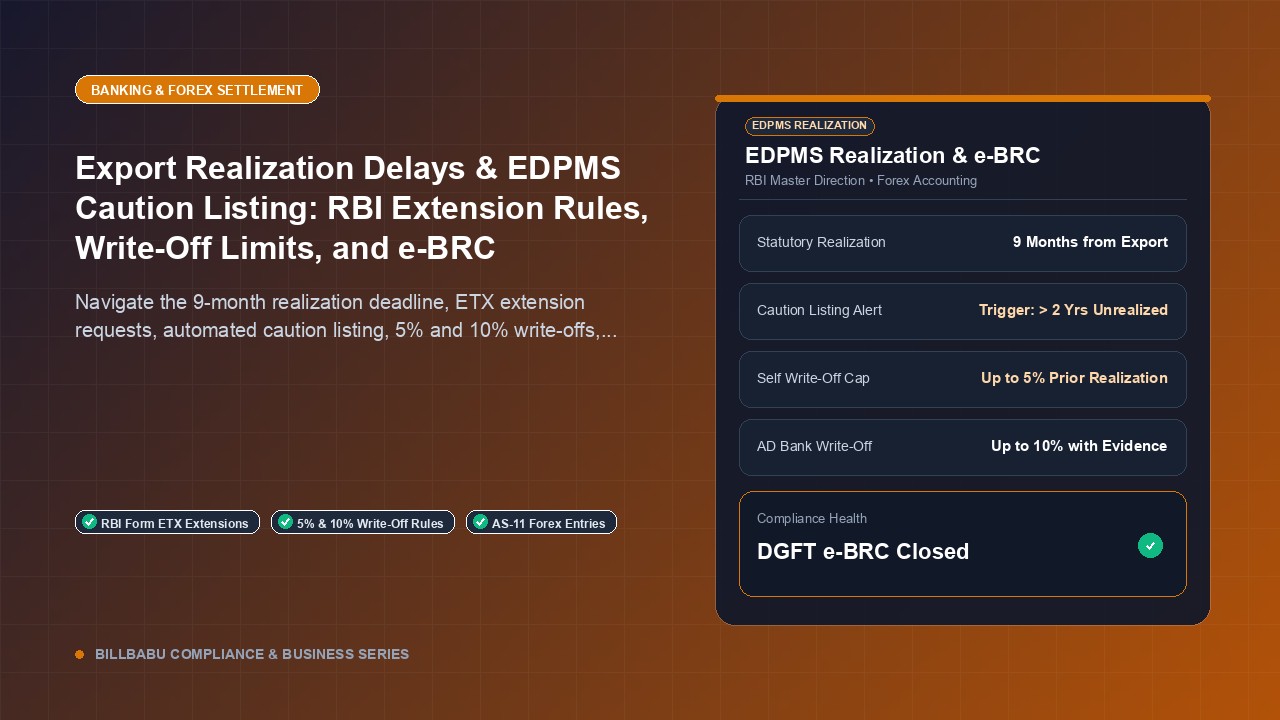
Export Realization Delays & EDPMS Caution Listing: RBI Extension Rules, Write-Off Limits, and e-BRC
Protect your business from RBI EDPMS caution listing. Master the 9-month export realization deadline, AD bank extensions (Form ETX), 5% & 10% write-offs, e-BRC, and forex accounting.
BillBabu Team
BillBabu App Team
Under Indian law, making a cross-border sale is only half the battle—the transaction is legally completed only when the foreign currency is safely repatriated into India. When overseas buyers delay payment, default, or dispute shipments, Indian exporters find themselves caught in a high-stakes regulatory crossfire. Governed by the Reserve Bank of India (RBI) and tracked in real-time by the Export Data Processing and Monitoring System (EDPMS), prolonged realization failures can trigger Automated Caution Listing, freezing banking facilities and crippling foreign trade. This authoritative guide examines statutory timelines, bank extension procedures, write-off thresholds, DGFT e-BRC generation, and standard double-entry accounting for foreign exchange transactions.
The 9-Month Export Realization Mandate under FEMA
Under Regulation 9 of the Foreign Exchange Management (Export of Goods and Services) Regulations, 2016, every exporter is legally obligated to realize the full export value of goods or software and repatriate the proceeds to India within 9 months from the date of export (or date of invoice for software exports).
Special Statutory Exceptions:
- Goods Exported to Overseas Warehouses: Where goods are exported to a warehouse established outside India with prior RBI permission, realization is permitted up to 15 months from shipment.
- Exports to Countries with External Exchange Controls: Where political strife, foreign sanctions, or central bank freezes prevent the overseas buyer from remitting funds, exporters must formally seek relief through their Authorized Dealer (AD Category-I) bank.
Statutory Principle: The 9-month deadline is not a flexible credit guideline; it is a statutory requirement under Section 7 of FEMA 1999. In the absence of an approved extension, an open export entry past 9 months is classified as a regulatory default.
How RBI EDPMS Automated Caution Listing Works
The Reserve Bank monitors every export bill through the centralized Export Data Processing and Monitoring System (EDPMS). When a Shipping Bill or EDF is filed, an open debit record is created against the exporter's Importer Exporter Code (IEC).
The 2-Year Caution Listing Trigger
Under the RBI Master Direction on Export of Goods and Services, an exporter is automatically placed on the RBI Caution List in EDPMS if:
- Any export bill remains outstanding and unrealized for more than two years from the date of export; and
- No formal extension of time (ETX) or write-off approval has been sanctioned by the AD Bank or the Reserve Bank.
Severe Business Consequences of Caution Listing:
- Loss of Clean Export Privileges: The exporter is legally barred from shipping goods on credit terms. Customs and banks will permit exports only against 100% advance remittance or an irrevocable, confirmed Letter of Credit (LC) from a prime international bank.
- Credit Facility Freezes: Commercial banks immediately freeze pre-shipment export credit (PCFC), packing credit, and post-shipment bill discounting facilities.
- Blocking of Export Incentives: DGFT systems withhold issuance of RoDTEP scrips, Duty Drawback scrolls, and Advance Authorization redemption.
- Reputational Blacklisting: The caution status is visible to all Authorized Dealer Category-I banks across India.
How to Apply for Extension of Time (Form ETX)
Exporters facing legitimate payment delays must never wait for the 9-month deadline to lapse. Instead, they must proactively apply for an Extension of Time (ETX) through their AD Category-I bank before the 9th month expires.
Valid Grounds for Seeking an Extension:
- Overseas buyer has filed for insolvency, bankruptcy, or court-supervised restructuring.
- Commercial disputes regarding goods quality undergoing formal international arbitration or trade dispute mediation.
- Temporary foreign exchange shortages, currency devaluation, or central bank rationing in the buyer's destination country.
- Import embargoes or sudden geopolitical conflicts.
AD Bank Powers to Grant Extensions:
Authorized Dealer Category-I banks are empowered by the Reserve Bank to grant extensions of realization up to 6 months at a time, provided:
- The export is not under investigation by the Directorate of Revenue Intelligence (DRI), Enforcement Directorate (ED), or Central Bureau of Investigation (CBI).
- The bank is satisfied that the exporter has taken all reasonable steps to recover the export dues.
- The exporter submits documentary proof, such as correspondence with the foreign buyer, legal recovery notices, or bankruptcy filings.
Write-Off Regulations: Self Write-Off vs. AD Bank Approval
When an export bill becomes entirely uncollectible, FEMA permits the exporter to "write off" the outstanding unrealized value in EDPMS, clearing the regulatory liability without facing caution listing.
| Write-Off Category | Prescribed Ceiling / Limit | Approving Authority & Mandatory Conditions |
|---|---|---|
| Self Write-Off (General Exporter) | Up to 5% of total export proceeds | Exporters in good standing can self-write off up to 5% of export proceeds realized during the previous calendar year. |
| Self Write-Off (Status Holders) | Up to 10% of total export proceeds | Recognized Status Holder exporters (One Star through Five Star) under Foreign Trade Policy. |
| Write-Off by AD Category-I Bank | Up to 10% of total export proceeds | AD Bank writes off up to 10% based on legal recovery proof, foreign debt collection agency reports, or bankruptcy orders. |
| Write-Off Exceeding Limits | Above 10% threshold | Requires formal application through AD Bank to the RBI Regional Office for special approval. |
Surrender of Export Incentives: Writing off an export bill does not mean a free pass. The exporter must surrender all proportionate export benefits previously claimed on the unrealized portion (including Duty Drawback, RoDTEP scrips, and GST refunds), along with statutory interest.
The Modernized DGFT e-BRC System
To eliminate manual paper certificates, DGFT operates an upgraded, API-driven electronic Bank Realisation Certificate (e-BRC) framework:
- Inward Remittance Message (IRM): When foreign funds enter the exporter's bank account, the AD bank transmits an electronic IRM directly to the DGFT server via an automated API gateway.
- Exporter Self-Certification: The exporter logs into the DGFT Portal, views unlinked IRMs, matches them against relevant Shipping Bills or SOFTEX forms, and generates the dynamic e-BRC.
- Incentive Integration: The e-BRC is instantly accessible by Customs, ICEGATE, and DGFT for verifying export incentive claims and Advance Authorization redemption.
Double-Entry Accounting for Foreign Exchange (AS-11 & Ind AS 21)
Exporting in foreign currencies introduces currency fluctuation risk into financial statements. Under Accounting Standard 11 (AS-11) and Indian Accounting Standard 21 (Ind AS 21), foreign trade transactions must follow strict double-entry protocols:
Step 1: Initial Recognition at Transaction Date
Record the export sale at the spot exchange rate on the date of the export invoice.
Example: An exporter sells goods worth $10,000 on 15th January 2026 when the spot rate is ₹85.00 per USD.
Debit:  Trade Receivables (Overseas Buyer A/c)   ₹8,50,000.00
Credit: Export Sales A/c                         ₹8,50,000.00
(Being export sales of $10,000 recorded @ ₹85.00 per USD)
Step 2: Balance Sheet Date Revaluation (Unrealized Forex Gain/Loss)
If the receivable remains unpaid at financial year-end (31st March 2026), monetary assets must be translated at the closing rate. Assume closing rate is ₹86.50 per USD.
Debit:  Trade Receivables (Overseas Buyer A/c)   ₹15,000.00
Credit: Foreign Exchange Fluctuation Gain (P&L)  ₹15,000.00
(Being unrealized forex gain on $10,000 @ ₹1.50 per USD recognised at year-end)
Step 3: Settlement Date Realization (Realized Forex Gain/Loss)
On 10th May 2026, the buyer remits $10,000. The bank converts at ₹86.00 per USD and deducts $50 (₹4,300) in correspondent bank charges.
Debit:  Bank Account (Net Realized Funds)       ₹8,55,700.00
Debit:  Bank Charges A/c (Intermediary Fees)    ₹4,300.00
Debit:  Foreign Exchange Fluctuation Loss (P&L) ₹5,000.00
Credit: Trade Receivables (Overseas Buyer A/c)   ₹8,65,000.00
(Being settlement of $10,000 receivable knocked off against bank remittance)
Step-by-Step Procedure to Remove EDPMS Caution Listing
If an exporter is caution-listed by the RBI, they must undertake an urgent regularization protocol:
- Extract Open EDPMS Ledger: Request a comprehensive list of all outstanding open shipping bills from the designated AD Category-I bank.
- Reconcile Unlinked Remittances: In many instances, funds were received in prior months but the bank failed to link the IRM to the EDPMS shipping bill. Submit invoice copies and request immediate manual knock-off.
- Process Formal Write-Offs: For genuinely unrecoverable bills, file write-off applications under the 5% or 10% limits with the AD bank, surrendering proportionate export incentives.
- Submit Bank Certificate to RBI: Once all overdue entries older than 2 years are closed or reduced below threshold limits, the AD bank issues an EDPMS Regularization Certificate and requests the regional RBI office to remove the exporter's IEC from the caution list.
Frequently Asked Questions (FAQ)
1. Can my bank automatically write off an outstanding export bill without my consent?
No. A write-off requires a formal application and declaration by the exporter, along with documentary proof that the debt is unrecoverable and an undertaking to surrender proportionate export incentives.
2. Does caution listing in EDPMS affect my domestic GST registration or business?
While caution listing does not automatically cancel your GST registration, it damages your credit rating across all Indian commercial banks, halts export financing, and exposes your business to scrutiny during GST and income tax audits.
3. What is the difference between an IRM and an e-BRC?
An Inward Remittance Message (IRM) is an electronic transmission generated by your AD bank to record the receipt of foreign funds. An electronic Bank Realisation Certificate (e-BRC) is generated on the DGFT portal by linking the IRM to specific export shipping bills or SOFTEX forms to prove final realization.
Master Your Global Receivables with BillBabu
Exporting demands rigorous tracking of payment milestones, foreign exchange gains and losses, and statutory bank deadlines. BillBabu helps Indian businesses manage multi-currency receivables, automate payment reminders, track forex accounting entries, and maintain clean audit records that keep your company safe from EDPMS caution listing.
Explore BillBabu Accounting SolutionsTags
Related Articles
GST invoicing made easy for Indian small businesses
Create GST-compliant invoices & estimates, track payments, manage parties and inventory — all from your phone. 14-day free trial, no credit card needed.