Cash vs Accrual Accounting: Which Should Indian Small Businesses & Traders Use in 2026?
Cash vs accrual accounting for Indian small businesses & traders in 2026. Compare tax timing, GST mercantile rules, Section 145 compliance, and bank audits.
BillBabu Team
BillBabu Compliance Team
In this article (12 sections)
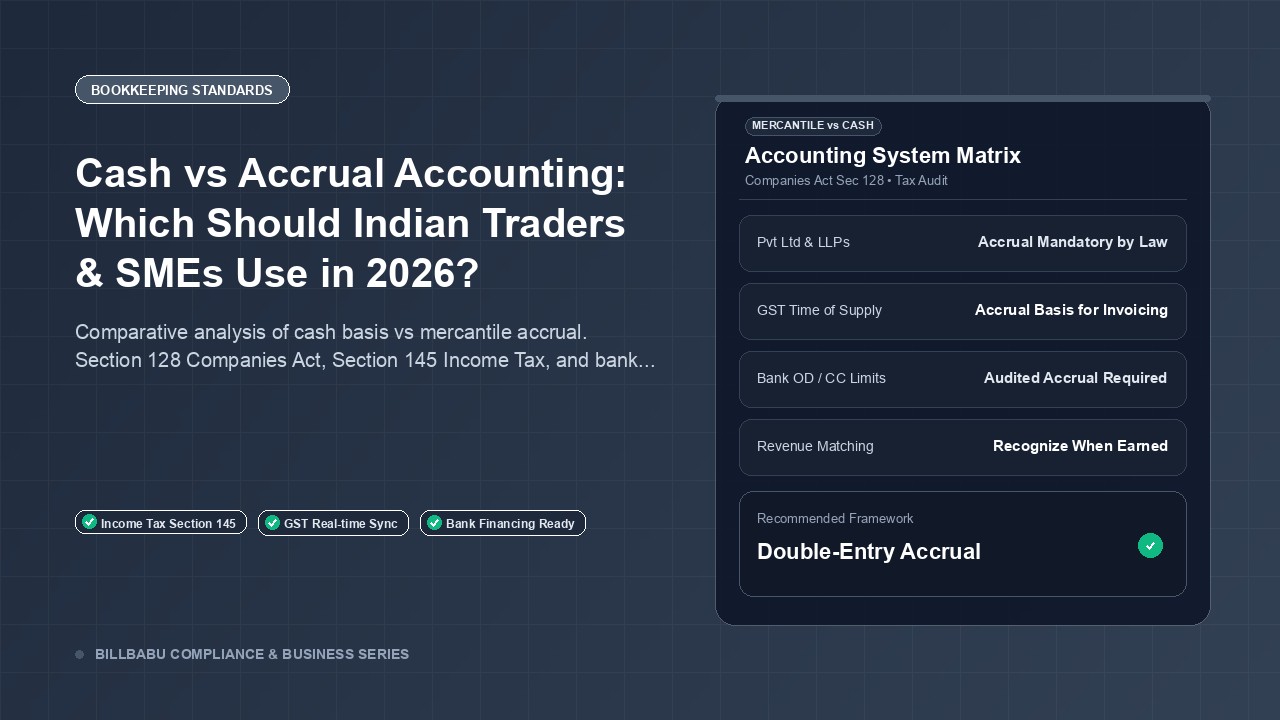
Every Indian trader, distributor, and entrepreneur faces a fundamental bookkeeping decision when organizing their financial affairs: should transactions be recorded when money changes hands, or when invoices are issued? Under Indian commercial law, this divides bookkeeping into the Cash System and the Accrual (Mercantile) System. While the simplicity of cash-based tracking appeals to micro-retailers and sole proprietorships, the statutory mandates of the Goods and Services Tax (GST) Act, Section 145 of the Income Tax Act, and banking loan norms heavily tilt the scales toward accrual accounting in 2026. This comprehensive analysis evaluates statutory mandates, operational trade-offs, tax mismatches, and why modern billing software makes accrual bookkeeping effortless.
The Core Difference: Cash Basis vs. Accrual Basis
The difference between the two systems boils down to transaction timing and the revenue matching principle:
- Cash Accounting: Revenue is recorded only when actual currency or bank funds are received from the customer. Expenses are deducted only when money physically leaves the company's bank account or cash drawer. Accounts receivable and accounts payable do not exist on the balance sheet.
- Accrual (Mercantile) Accounting: Revenue is recognized immediately when an invoice is issued upon delivery of goods or services, regardless of when the customer pays. Expenses are recognized when incurred (upon receiving a vendor bill or employee timesheet), regardless of when cash is disbursed. This creates Trade Debtors (Receivables) and Trade Creditors (Payables).
| Comparison Parameter | Cash Accounting System | Accrual (Mercantile) System |
|---|---|---|
| Revenue Recognition | When cash/bank credit is received | When tax invoice is issued (earned) |
| Expense Recognition | When money is actually paid out | When obligation/vendor bill is incurred |
| Financial Year-End Accuracy | Distorts profitability across months | True and fair view (Matching Principle) |
| GST Return Alignment | Severe mismatch with GSTR-1 & GSTR-3B | 100% matched with GST time of supply |
| Bank Loan (CC/OD Limit) Acceptance | Rejected by commercial banks | Mandatory for CMA data & working capital |
Create GST invoices & track payments in 30 seconds
Join thousands of Indian businesses using BillBabu. 14-day free trial on Android.
Statutory Mandates Across Indian Laws
Before choosing an accounting method, Indian business owners must evaluate their specific legal constitution:
1. The Companies Act, 2013 (Section 128(1))
If your enterprise is registered as a Private Limited Company, Public Limited Company, or One Person Company (OPC), the choice is made for you by statute. Section 128(1) strictly mandates that every company must keep books of accounts on an accrual basis and according to the double-entry system. Cash accounting is illegal for incorporated entities.
2. The Goods and Services Tax (GST) Act, 2017
GST is fundamentally an accrual-based taxation system. Under Section 12 (Time of Supply of Goods) and Section 13 (Time of Supply of Services), liability to pay GST arises upon issuance of the tax invoice or receipt of advance, whichever is earlier. If you sell ₹5,00,000 worth of goods on credit in March 2026, you must pay 18% GST (₹90,000) by 20th April 2026 in GSTR-3B—even if the buyer pays you in August! A business running on cash accounting cannot reconcile its income tax profit with its GST returns.
3. The Income Tax Act, 1961 (Section 145)
Under Section 145(1), income chargeable under the head "Profits and gains of business or profession" may be computed in accordance with either cash or mercantile system regularly employed by the assessee. Sole proprietorships and partnership firms are technically permitted to use cash accounting. However, under Section 145A, valuation of inventory must follow mercantile principles, complicating purely cash-based books.
Real-World Scenario: How Cash Accounting Misleads Business Owners
Consider a wholesale hardware distributor, Rohit Traders, operating in February and March 2026:
- February 2026: Sells ₹15,00,000 worth of electrical tools on 45 days credit. Purchases goods worth ₹11,00,000 on cash.
- Under Cash Accounting: Revenue = ₹0. Expenses = ₹11,00,000. Net Loss = -₹11,00,000! (Artificially depressed).
- Under Accrual Accounting: Revenue = ₹15,00,000. Cost of Goods Sold = ₹11,00,000. Net Profit = +₹4,00,000. (Accurate).
- April 2026: Customers remit the full ₹15,00,000. Rohit makes no new purchases.
- Under Cash Accounting: Revenue = ₹15,00,000. Expenses = ₹0. Net Profit = +₹15,00,000! (Artificially inflated, creating massive tax shock).
- Under Accrual Accounting: Revenue already booked in Feb; collection merely reduces Trade Debtors and increases Bank balance with zero distortion of profit.
Why Small Businesses Should Adopt Accrual Accounting in 2026
Historically, small traders clung to cash accounting because double-entry mercantile ledgers required costly professional accountants. In 2026, intelligent cloud billing tools like BillBabu automate the entire process:
- Audit Preparedness: Tax auditors evaluating books under Section 44AB require complete party reconciliation and debtors aging schedules that only accrual accounting supports.
- Banking Credit (CC / OD Limits): When applying for a Cash Credit (CC) limit or working capital overdraft, banks demand audited balance sheets displaying debtors, creditors, and closing inventory to calculate the Drawing Power (DP). Cash accounting books show zero debtors, resulting in loan rejections!
- True Costing and Margin Clarity: Accrual accounting matches expenses with the revenues they generated, allowing business owners to see exact gross and net margins per product line.
Automate Modern Accrual Bookkeeping with BillBabu
Get the precision of accrual accounting without the complexity. BillBabu automatically updates party ledgers upon invoicing, tracks real-time cash flow, handles GST liability effortlessly, and keeps your business audit-ready 365 days a year.
Start Free Trial on BillBabuFrequently Asked Questions (FAQs)
1. Can a sole proprietorship switch from cash accounting to accrual accounting?
Yes. A business can switch its method of accounting. However, the change must be bona fide and disclosed in the Income Tax Return and financial statements along with the financial impact of the transition.
2. Can freelance professionals use cash accounting under Section 44ADA?
Yes. Professionals such as software consultants, doctors, lawyers, and architects filing under the Presumptive Taxation Scheme of Section 44ADA often find cash accounting convenient, as their operations carry minimal inventory or physical goods.
3. If I use accrual accounting, do I have to pay income tax on unpaid invoices?
Yes. Under accrual accounting, taxable profit includes revenue from invoices issued during the financial year even if the money has not yet been collected. If a debt subsequently becomes unrecoverable, it can be formally written off as a Bad Debt under Section 36(1)(vii) in the year it becomes uncollectible.
Tags
Related Articles
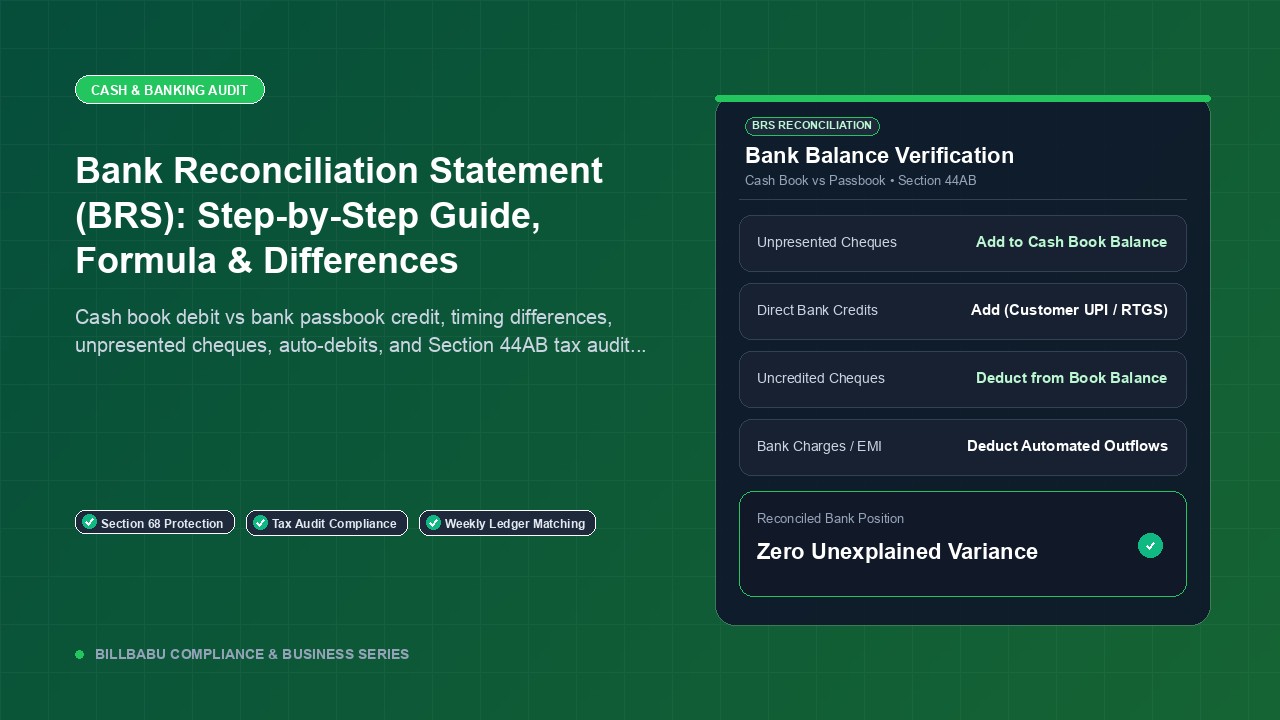
Bank Reconciliation Statement (BRS): Step-by-Step Guide, Formula, and Common Timing Differences
6 min read
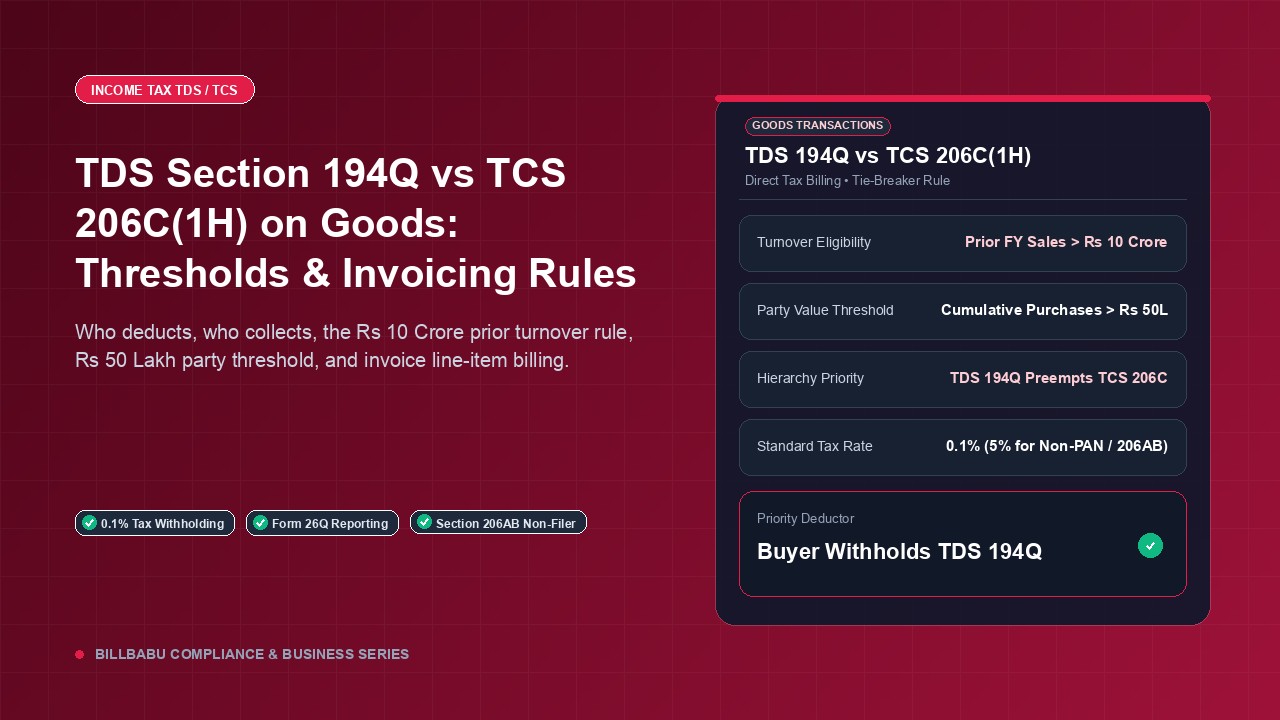
TDS Section 194Q vs TCS 206C(1H) on Goods: Thresholds, Who Deducts, and Invoice Billing Rules
5 min read
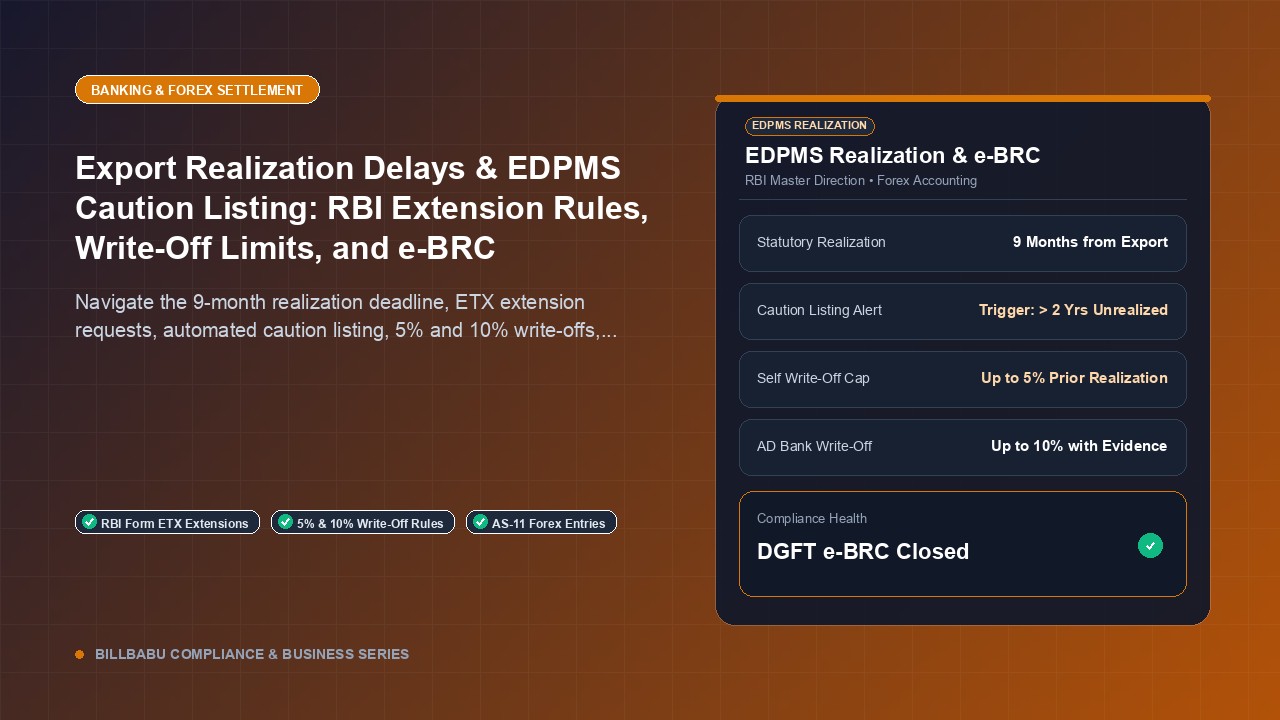
Export Realization Delays & EDPMS Caution Listing: RBI Extension Rules, Write-Off Limits, and e-BRC
8 min read
GST invoicing made easy for Indian small businesses
Create GST-compliant invoices & estimates, track payments, manage parties and inventory — all from your phone. 14-day free trial, no credit card needed.