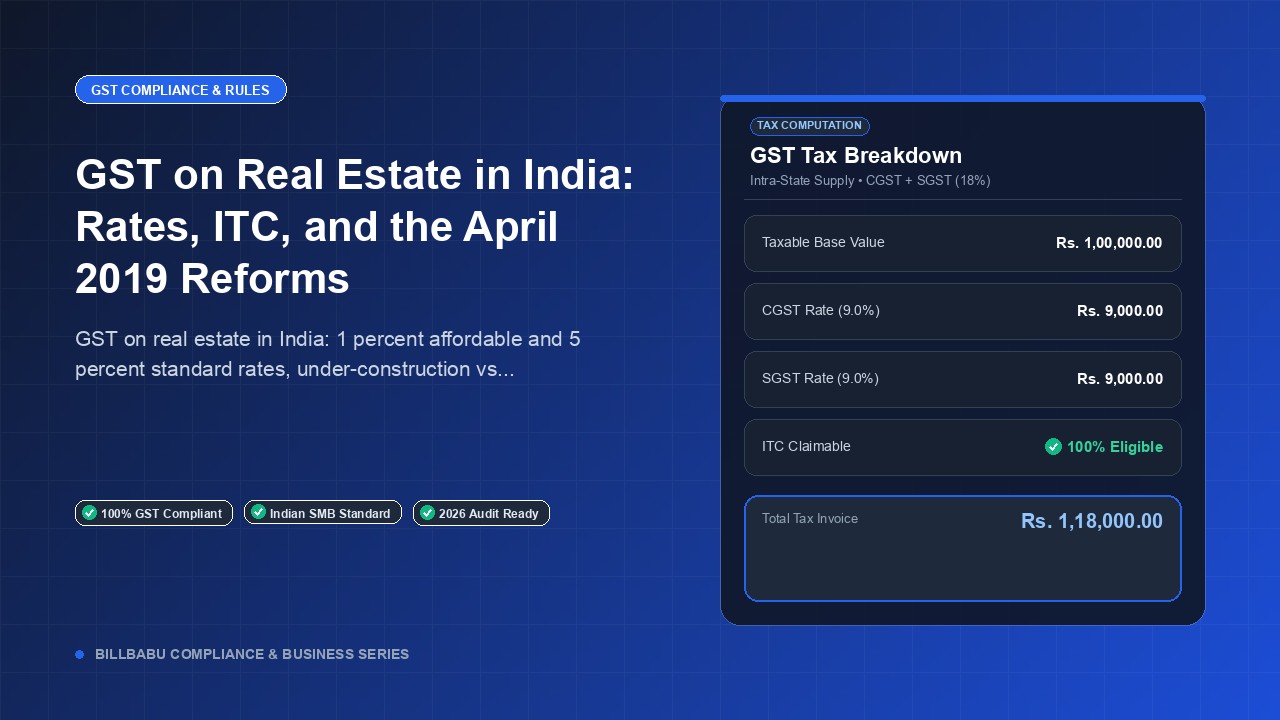
GST on Real Estate in India: Rates, ITC, and the April 2019 Reforms
GST on real estate in India: 1 percent affordable and 5 percent standard rates, under-construction vs ready-to-move, and the April 2019 ITC withdrawal.
BillBabu Team
BillBabu App Team
GST on real estate in India: 1 percent affordable and 5 percent standard rates, under-construction vs ready-to-move, and the April 2019 ITC withdrawal.
The April 2019 GST Council Overhaul
On 1 April 2019 the GST Council fundamentally restructured how GST applies to residential real estate. The earlier rates of 12 percent (standard) and 8 percent (affordable) with full ITC were replaced by 5 percent and 1 percent respectively, without ITC. The change was driven by complaints that builders were not passing on ITC benefits to homebuyers, leading to inflated prices. Projects under construction on 1 April 2019 were given a one-time option to continue with the old scheme or migrate.
Current GST Rates on Residential Property
For affordable housing (carpet area up to 60 sqm in metros and 90 sqm in non-metros, with price up to Rs. 45 lakh), GST is 1 percent without ITC. For all other residential under-construction property, GST is 5 percent without ITC. Commercial property in mixed-use projects (where commercial is up to 15 percent of total carpet area) attracts the same 5 percent rate, while pure commercial under-construction property attracts 12 percent with ITC. Land value is deducted at one-third (Schedule II) before applying these rates.
Under-Construction vs Ready-to-Move Property
GST applies only to under-construction property where part of the consideration is paid before the Completion Certificate (CC) is issued. Once the CC is issued or the property is occupied (whichever is earlier), the sale is treated as a transfer of immovable property and falls outside GST entirely. This is why ready-to-move flats are often priced higher per square foot despite saving 5 percent GST. Buyers should always insist on seeing the CC date before signing a sale deed to confirm the GST treatment.
ITC Removal and the 80 Percent Procurement Rule
Under the new 5 percent and 1 percent regime, builders cannot claim ITC on inputs such as cement, steel, and contractor services. To prevent leakage, Notification 11/2017 (as amended) requires builders to procure at least 80 percent of inputs and input services from registered suppliers. Shortfalls attract 18 percent GST on a reverse-charge basis, except for cement which always attracts 28 percent on any unregistered procurement. This rule has formalized a large slice of the construction supply chain.
Tracking Real-Estate GST With BillBabu
Builders, brokers, and contractors juggling multiple projects and rate slabs need clean per-project ledgers, RCM tracking on unregistered procurement, and clear separation between land value and construction value. BillBabu supports project-wise tagging, RCM auto-computation, and tax-rate templates for the 1 percent, 5 percent, and 12 percent slabs so real-estate businesses can invoice buyers and reconcile GSTR-1 without manual gymnastics. For small builders and brokers, this is often the difference between filing on time and paying late-fee penalties every quarter.
Built for Indian small businesses. BillBabu is GST-compliant billing software that helps you create invoices, manage estimates, track payments and stay audit-ready — from your phone. Learn more about BillBabu or download the app.
Tags
Related Articles
GST on Exports with EDF & Shipping Bill: Zero-Rated Supply, LUT Filing, and Invoicing Rules
8 min read
Export Declaration Form (EDF) in India: Complete Guide to RBI Rules, FEMA Compliance & EDPMS
10 min read
QRMP Scheme Under GST: Quarterly Returns, Monthly Payments Explained
2 min read
GST invoicing made easy for Indian small businesses
Create GST-compliant invoices & estimates, track payments, manage parties and inventory — all from your phone. 14-day free trial, no credit card needed.