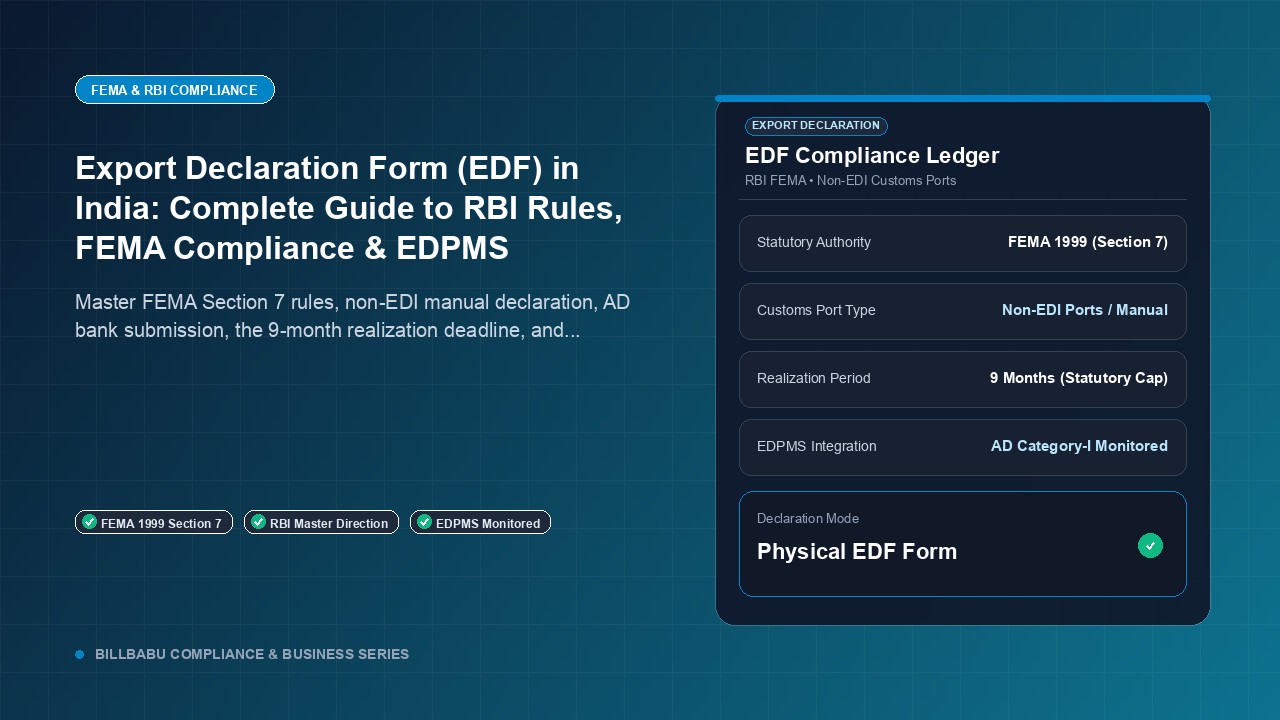
Export Declaration Form (EDF) in India: Complete Guide to RBI Rules, FEMA Compliance & EDPMS
Master the Export Declaration Form (EDF) in India under FEMA 1999 and RBI Master Directions. Understand non-EDI customs filing, AD bank processing, the 9-month realization deadline, and EDPMS tracking.
BillBabu Team
BillBabu App Team
Exporting goods from India involves navigating not just customs tariffs and logistics, but stringent sovereign foreign exchange controls. Governed by the Foreign Exchange Management Act, 1999 (FEMA) and Reserve Bank of India (RBI) regulations, every exporter is legally bound to declare the full true value of exported merchandise and repatriate proceeds back to India. At the center of this compliance architecture for physical goods shipped through non-EDI customs ports is the Export Declaration Form (EDF). This authoritative guide examines statutory mandates, operational filing steps, bank reconciliation workflows, realization deadlines, and EDPMS record matching.
Statutory Authority: Section 7 of FEMA 1999 & RBI Regulations
India's foreign trade regulatory regime is built on the premise that foreign exchange earned through exports is a national economic asset. The statutory mandate for export declarations derives directly from Section 7 of the Foreign Exchange Management Act, 1999 (FEMA):
- Section 7(1)(a): Mandates that every exporter of goods shall furnish to the Reserve Bank of India, or to such other authority as specified, a declaration in such form and manner as may be prescribed, containing a true and correct statement of the full export value of the goods.
- Section 7(1)(b): Requires that if the full export value cannot be ascertained at the time of export due to prevailing market conditions, the declaration must state the value that the exporter, having regard to prevailing market circumstances, expects to receive upon sale in the overseas market.
- Section 7(2): Empowers the Reserve Bank of India to direct any exporter to submit information regarding realization of export proceeds to ensure that export proceeds are repatriated without delay.
Operating under Section 7, the Reserve Bank exercises regulatory oversight through the Foreign Exchange Management (Export of Goods and Services) Regulations, 2016 (as updated by periodic A.P. (DIR Series) circulars) and the comprehensive RBI Master Direction on Export of Goods and Services.
Statutory Core: Under Section 7 of FEMA 1999, failing to submit an export declaration or misrepresenting the export value is a non-bailable civil and economic offence punishable with fiscal penalties up to thrice the undeclared sum, cancellation of the Importer Exporter Code (IEC), and prosecution.
The Evolution from GR and PP Forms to the Unified EDF
Historically, Indian exporters were required to fill out multiple cumbersome paper declaration forms depending on how goods departed the country:
| Legacy Form | Original Purpose | Modern Replacement (2026) |
|---|---|---|
| GR Form (Guaranteed Remittance) | Declaration for physical goods exported by sea, air, or rail. | Unified Export Declaration Form (EDF) / Electronic Shipping Bill |
| PP Form (Post Parcel) | Declaration for physical merchandise exported via postal parcel post. | Unified Export Declaration Form (EDF) / Postal Bill of Export (PBE) |
| SDF (Statutory Declaration Form) | Electronic annexure appended to Shipping Bills at computerized ports. | Integrated directly into ICEGATE Electronic Shipping Bill |
| SOFTEX Form | Declaration for export of computer software and IT-enabled services. | Retained as dedicated digital form via STPI / SEZ Online |
To eliminate duplicity and harmonize export documentation, the Reserve Bank merged the legacy GR and PP paper forms into a single Export Declaration Form (EDF). Today, the EDF serves as the standard physical declaration form wherever electronic customs systems are absent.
EDI Ports vs. Non-EDI Ports: When is EDF Mandatory?
One of the most frequent misconceptions among businesses is whether every export requires an EDF. The answer depends strictly on the Customs Port Infrastructure through which the consignment exits India:
1. Electronic Data Interchange (EDI) Ports
Over 95% of India's commercial cargo by value passes through computerized EDI customs locations (such as Nhava Sheva / JNPT, Mundra, Chennai Port, Delhi Air Cargo, and Bengaluru ICD). At these ports:
- The exporter or customs broker files an electronic Shipping Bill via ICEGATE (Indian Customs Electronic Gateway).
- The declaration required under FEMA Section 7 is digitally integrated directly into the Shipping Bill.
- No physical EDF form is required. Customs electronically pushes shipping bill data directly into RBI's EDPMS database upon grant of the Let Export Order (LEO).
2. Non-EDI Ports (Where Physical EDF is Mandatory)
In contrast, non-EDI ports lack an integrated electronic data interchange feed to ICEGATE. These include:
- Minor riverine and coastal ports in regional maritime states.
- Land Customs Stations (LCS) bordering Nepal, Bhutan, Bangladesh, and Myanmar.
- Certain remote Inland Container Depots (ICDs) and legacy air cargo transit sheds.
- Certain postal parcel export hubs not yet integrated with Dak Niryat Kendra electronic systems.
When exporting through a non-EDI port, the exporter must manually generate and submit a physical Export Declaration Form (EDF) in duplicate to Customs authorities.
Step-by-Step Procedure for Submitting an EDF
The submission of an EDF follows a strictly audited, multi-stakeholder pathway involving the exporter, Customs at the non-EDI port, and an Authorized Dealer Category-I (AD) bank:
- Generating the Form: The exporter downloads the prescribed EDF template from the RBI website or obtains pre-printed standardized stationery from their designated AD Category-I bank.
- Completing Declaration Details: The exporter enters comprehensive transaction data:
- Exporter Name, Address, PAN, GSTIN, and Importer Exporter Code (IEC).
- Authorized Dealer (AD) Bank Name, Branch, and 14-digit AD Code.
- Buyer Name, Overseas Destination Address, and Country of Consignment.
- Customs Port of Shipment and Port of Destination.
- Description of goods, 6-digit or 8-digit HSN code, quantity, net weight, invoice number, and invoice date.
- Analysis of export value: Free on Board (FOB), freight, marine insurance, and total CIF/C&F value in foreign currency (USD, EUR, GBP, etc.).
- Submission to Customs: Both the Original and Duplicate copies of the EDF, accompanied by the commercial invoice, packing list, and contract copy, are presented to the Customs appraising officer at the non-EDI port prior to shipment.
- Customs Assessment & Endorsement: Customs officers examine the cargo, assess the declared value, certify that the cargo has been inspected, grant the export clearance order, retain the Original EDF for their official records, and return the Duplicate EDF duly stamped and signed to the exporter.
- Submission to AD Category-I Bank (Within 21 Days): Within 21 calendar days from the date of export (date of customs clearance endorsement), the exporter must submit the duplicate endorsed EDF, along with the bill of lading or lorry receipt and the commercial invoice, to their Authorized Dealer bank.
- Bank Entry into EDPMS: The AD bank verifies the shipping documents against the duplicate EDF and manually logs the export record into the RBI's Export Data Processing and Monitoring System (EDPMS), generating an EDPMS reference number.
Critical 21-Day Deadline: Submitting the duplicate EDF to your AD bank past the 21-day window constitutes a procedural FEMA default. Banks require written explanations and formal delay regularization condonations before accepting delayed physical forms.
The 9-Month Statutory Realization Deadline
Submitting the EDF is only the first half of compliance. The core responsibility under FEMA is ensuring that the full financial value of the shipment is realized and repatriated into India within the statutory time limit.
Standard Statutory Window: 9 Months
Under Regulation 9 of the Foreign Exchange Management (Export of Goods and Services) Regulations, the full value of exported goods must be realized and repatriated to India through an AD Category-I bank within 9 months from the date of export.
Warehouse Exports: 15 Months
Where goods are exported to a warehouse established outside India with the permission of the Reserve Bank (or an overseas distribution branch), the realization period is extended up to 15 months from the date of shipment.
Special Economic Zones (SEZ) & Status Holders
While earlier regulations granted special multi-year realization windows for SEZ units, current RBI directives have harmonized the standard realization window to 9 months across general exporters, requiring formal extension approvals for overdue receivables.
EDPMS Integration, Bill Matching & Closure
The Reserve Bank introduced the Export Data Processing and Monitoring System (EDPMS) to replace physical manual register maintenance by commercial banks. EDPMS acts as a centralized cloud database where:
- Inward Feed: Customs (for EDI shipping bills) or AD Banks (for manual non-EDI EDF submissions) upload every export transaction, creating an open outstanding debit entry against the exporter's IEC.
- Settlement Feed: When the overseas buyer pays via SWIFT or international wire transfer, the receiving AD bank issues an Inward Remittance Message (IRM) and credits the funds to the exporter's Current or EEFC account.
- Bill Knock-Off: The exporter provides the commercial invoice and EDF/Shipping Bill reference to the bank. The bank links the IRM to the outstanding EDPMS entry, closing the export bill.
- e-BRC Generation: Once closed in EDPMS, the transaction flows to the DGFT portal, enabling the generation of an electronic Bank Realisation Certificate (e-BRC) necessary to claim government export benefits like RoDTEP and Duty Drawback.
Exemptions from EDF Submission
Under Regulation 4 of the Foreign Exchange Management (Export of Goods and Services) Regulations, certain categories of exports are legally exempt from furnishing an EDF:
- Trade Samples and Advertising Material: Commercial samples and advertising merchandise supplied free of charge, conforming to DGFT valuation limits (typically up to prescribed annual ceilings).
- Personal Gifts: Export of gifts by an individual or business where the value does not exceed ₹5,00,000 in a financial year, provided the consignment is bona fide and non-commercial.
- Goods for International Exhibitions & Demonstration: Export of articles for display in overseas exhibitions, provided they are re-imported into India within 6 months, or sold with proceeds repatriated through an AD bank.
- Defective Goods Exported for Repair / Replacement: Goods imported into India found defective and returned to the foreign supplier for repair, replacement, or testing, without any commercial consideration.
- Aircraft Engines & Spares: Spares and components sent abroad for overhaul and return under general or specific approvals.
- Exports Approved by the RBI: Consignments exported under humanitarian relief or specific sovereign trade treaties where the Reserve Bank has issued a formal waiver of declaration.
Common EDF Compliance Errors and Penalties
Indian exporters frequently stumble into avoidable compliance penalties due to minor documentation oversights:
- Discrepancy in Declared Value: If the commercial invoice displays $20,000 CIF but the EDF mistakenly records $18,000 FOB without deducting freight and insurance lines, Customs or the AD bank will flag a valuation discrepancy.
- Unlinked Inward Remittances: If foreign remittance arrives under a generalized reference like "Advance payment" without quoting the specific EDF or commercial invoice number, the bank cannot link the IRM in EDPMS. The export bill remains technically "unrealized" even though cash is in the account.
- Intermediary Bank Charges Deduction: When a buyer pays $10,000, but foreign intermediary correspondent banks deduct $45 in wire charges, the bank receives $9,955. Unless the exporter submits an exchange deduction certificate or regularizes the difference, EDPMS retains an open unliquidated balance of $45.
Frequently Asked Questions (FAQ)
1. Is an EDF required if I export through Nhava Sheva (JNPT) or Delhi Air Cargo?
No. Major seaports and air cargo complexes are computerized EDI ports connected to ICEGATE. At these ports, your electronic Shipping Bill incorporates the mandatory FEMA Section 7 declaration. An EDF is required only at non-EDI manual ports.
2. Can an IT service exporter or SaaS company file an EDF?
No. Software, IT services, and digital deliverables transmitted via electronic networks are declared through the SOFTEX Form filed with the Software Technology Parks of India (STPI) or SEZ Development Commissioners, not through an EDF.
3. Who issues the EDF number?
EDF forms carry a unique running serial number allocated by the Reserve Bank of India or pre-assigned through the Authorized Dealer Category-I bank system.
4. What happens if export proceeds are not received within 9 months?
If payment is delayed beyond 9 months, the exporter must formally apply for an Extension of Time (Form ETX) through their AD bank before the deadline expires. If bills remain unliquidated beyond 2 years, RBI will caution-list the exporter in EDPMS, crippling future exports.
Automate Your Export Compliance with BillBabu
Exporting demands precision across invoice currency, customs port codes, and regulatory endorsements. BillBabu empowers Indian exporters to generate dual-currency export invoices, maintain accurate HSN classifications, track outstanding overseas receivables, and maintain audit-ready records compliant with GST and FEMA rules.
Explore BillBabu Invoicing SoftwareTags
Related Articles
GST invoicing made easy for Indian small businesses
Create GST-compliant invoices & estimates, track payments, manage parties and inventory — all from your phone. 14-day free trial, no credit card needed.