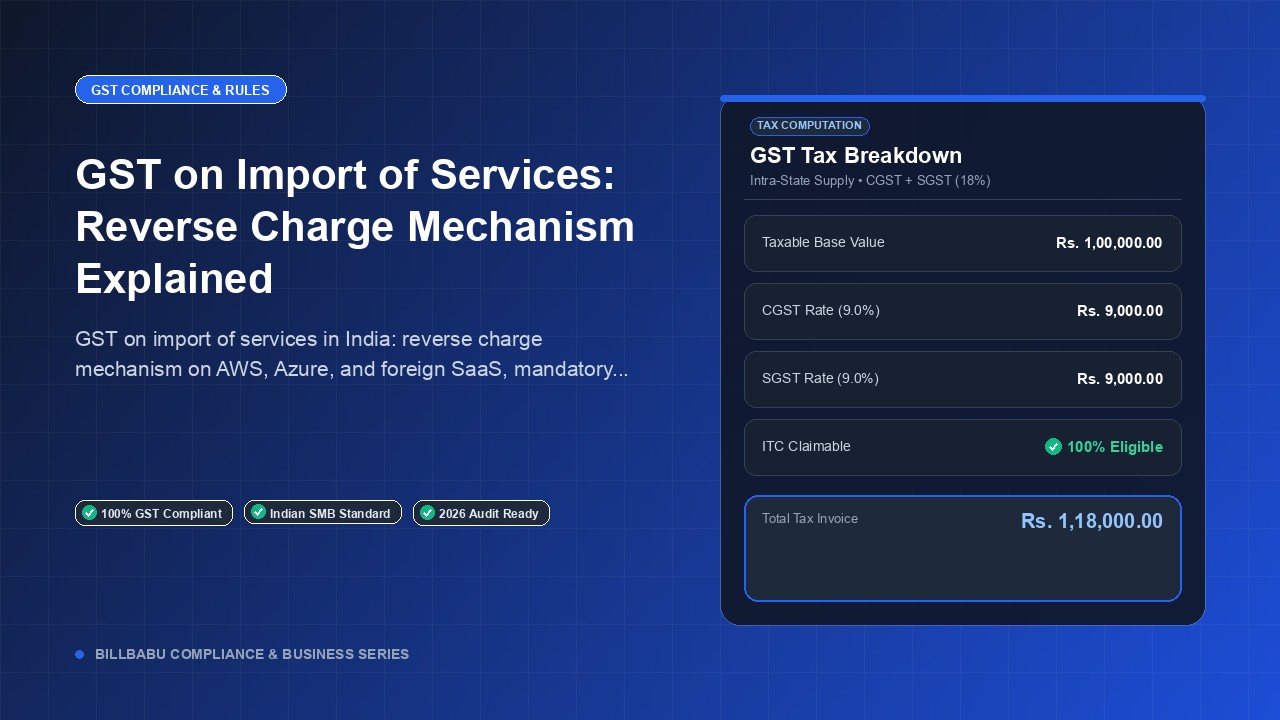
GST on Import of Services: Reverse Charge Mechanism Explained
GST on import of services in India: reverse charge mechanism on AWS, Azure, and foreign SaaS, mandatory self-invoice, and ITC claim in the next month.
BillBabu Team
BillBabu App Team
GST on import of services in India: reverse charge mechanism on AWS, Azure, and foreign SaaS, mandatory self-invoice, and ITC claim in the next month.
Why Import of Services Attracts Reverse Charge
Under Section 5(3) of the IGST Act read with Notification 10/2017, import of services by any person in India (other than non-taxable online recipients) attracts IGST under the reverse charge mechanism (RCM). The recipient, not the foreign supplier, pays the tax to the government. This ensures domestic suppliers are not disadvantaged versus offshore providers and that the Indian exchequer captures GST on cross-border consumption. AWS, Microsoft Azure, Google Workspace, Zoom, LinkedIn ads, and most foreign SaaS subscriptions fall into this bucket.
Calculating IGST on Foreign Invoices
IGST is computed at 18 percent on the rupee value of the foreign invoice, using the RBI reference rate or the exchange rate prevailing on the date of payment or invoice (whichever is earlier under Section 13). For example, a Rs. 10,000 equivalent AWS invoice attracts Rs. 1,800 IGST, payable when filing GSTR-3B for the month in which the invoice is recorded. The same amount can be claimed as ITC in the next month GSTR-3B once payment is made and conditions are met. RCM tax is paid only in cash, never via ITC.
Self-Invoice and Documentation Requirements
Rule 46 read with Section 31(3)(f) requires the recipient to issue a self-invoice on the date of receipt of services, containing all the particulars of a regular tax invoice including the suppliers details, description of service, place of supply, and IGST charged. This self-invoice is the documentary basis for paying RCM and subsequently claiming ITC. Foreign invoices alone are insufficient, the self-invoice is mandatory. Most businesses generate one consolidated self-invoice per supplier per month to keep paperwork manageable.
Reporting in GSTR-1 and GSTR-3B
RCM imports are reported in Table 3.1(d) "Inward supplies (liable to reverse charge)" of GSTR-3B with IGST being paid. The corresponding ITC is claimed in Table 4(A)(3) "Inward supplies liable to reverse charge". In GSTR-1, RCM inward supplies are not reported (since the supplier is foreign), but the self-invoice must be retained for audit. Failure to discharge RCM tax invites interest at 18 percent and a penalty equal to the tax amount, so this is one of the most aggressively audited areas.
Tracking Foreign Vendor RCM With BillBabu
BillBabu lets you flag foreign vendors as RCM-applicable, automatically computes IGST at 18 percent on every imported service invoice using the prevailing exchange rate, and generates a compliant self-invoice. The monthly GSTR-3B summary picks up RCM liabilities in Table 3.1(d) and ITC claims in Table 4(A)(3) without manual intervention. For Indian startups paying AWS, GitHub, Stripe, and Notion every month, this collapses what is often a Rs. 50,000-plus quarterly compliance risk into a five-minute review.
Built for Indian small businesses. BillBabu is GST-compliant billing software that helps you create invoices, manage estimates, track payments and stay audit-ready — from your phone. Learn more about BillBabu or download the app.
Tags
Related Articles
GST on Exports with EDF & Shipping Bill: Zero-Rated Supply, LUT Filing, and Invoicing Rules
8 min read
Export Declaration Form (EDF) in India: Complete Guide to RBI Rules, FEMA Compliance & EDPMS
10 min read
QRMP Scheme Under GST: Quarterly Returns, Monthly Payments Explained
2 min read
GST invoicing made easy for Indian small businesses
Create GST-compliant invoices & estimates, track payments, manage parties and inventory — all from your phone. 14-day free trial, no credit card needed.