TDS for Small Business in India: A Complete Practical Guide
TDS for small business in India explained — Section 194C, 194J, 194I rates, TAN, Form 26Q filing dates and common mistakes to avoid.
BillBabu Team
BillBabu App Team
TDS for small business in India explained — Section 194C, 194J, 194I rates, TAN, Form 26Q filing dates and common mistakes to avoid.
What TDS Means for a Small Business
Tax Deducted at Source (TDS) is a mechanism under the Income Tax Act where the payer deducts tax before releasing payment and deposits it with the government. As a small business in India, the moment your turnover crosses Rs. 1 crore (or Rs. 50 lakh for professionals), you become a "deductor" for most contractor, rent and professional payments. Failure to deduct invites disallowance of the expense under Section 40(a)(ia) — up to 30% of the payment is added back to your income. So TDS is not just a compliance burden, it directly impacts your taxable profit.
Key Sections You Will Use Every Month
Section 194C covers payments to contractors and sub-contractors — 1% if the payee is an individual or HUF, 2% for companies and firms, threshold Rs. 30,000 per bill or Rs. 1,00,000 in a year. Section 194J covers professional and technical fees (CA, lawyer, consultant) at 10%, threshold Rs. 30,000 per year. Section 194I covers rent — 10% on land or building, 2% on plant and machinery, threshold Rs. 2,40,000 per year. Section 194Q (purchases above Rs. 50 lakh) and 194O (e-commerce) are newer additions you should evaluate every quarter.
Getting a TAN and Depositing the Tax
Before you deduct your first rupee, apply for a TAN (Tax Deduction Account Number) via Form 49B on the NSDL portal — it takes 5–7 working days. Tax deducted in any month must be deposited by the 7th of the following month (30th April for March deductions) using Challan ITNS 281. Late deposit attracts 1.5% interest per month from the date of deduction until the date of payment. Always keep the BSR code and challan serial number — you will need it while filing the quarterly return.
Quarterly Filing — Form 26Q and Form 16A
Form 26Q is the quarterly statement for all non-salary TDS and is due on 31st July, 31st October, 31st January and 31st May. After filing, you must generate Form 16A from TRACES and issue it to deductees within 15 days — vendors often refuse to release the next invoice without it. Mismatches between your 26Q and the deductee's 26AS are the single biggest cause of notices, so reconcile PAN and amount before uploading. Late filing fee under Section 234E is Rs. 200 per day, capped at the TDS amount.
Track TDS Inside Your Billing Workflow with BillBabu
Most TDS errors happen because the deduction is decided at payment time, not invoice time — by then the threshold has silently been crossed. With BillBabu you can flag vendors as TDS-applicable, set the section and rate against each party, and the system warns you when cumulative payments in a financial year approach the threshold. At quarter-end you can export a vendor-wise deduction report that maps directly to Form 26Q columns. That single workflow change is usually enough to keep a small business notice-free.
Built for Indian small businesses. BillBabu is GST-compliant billing software that helps you create invoices, manage estimates, track payments and stay audit-ready — from your phone. Learn more about BillBabu or download the app.
Tags
Related Articles
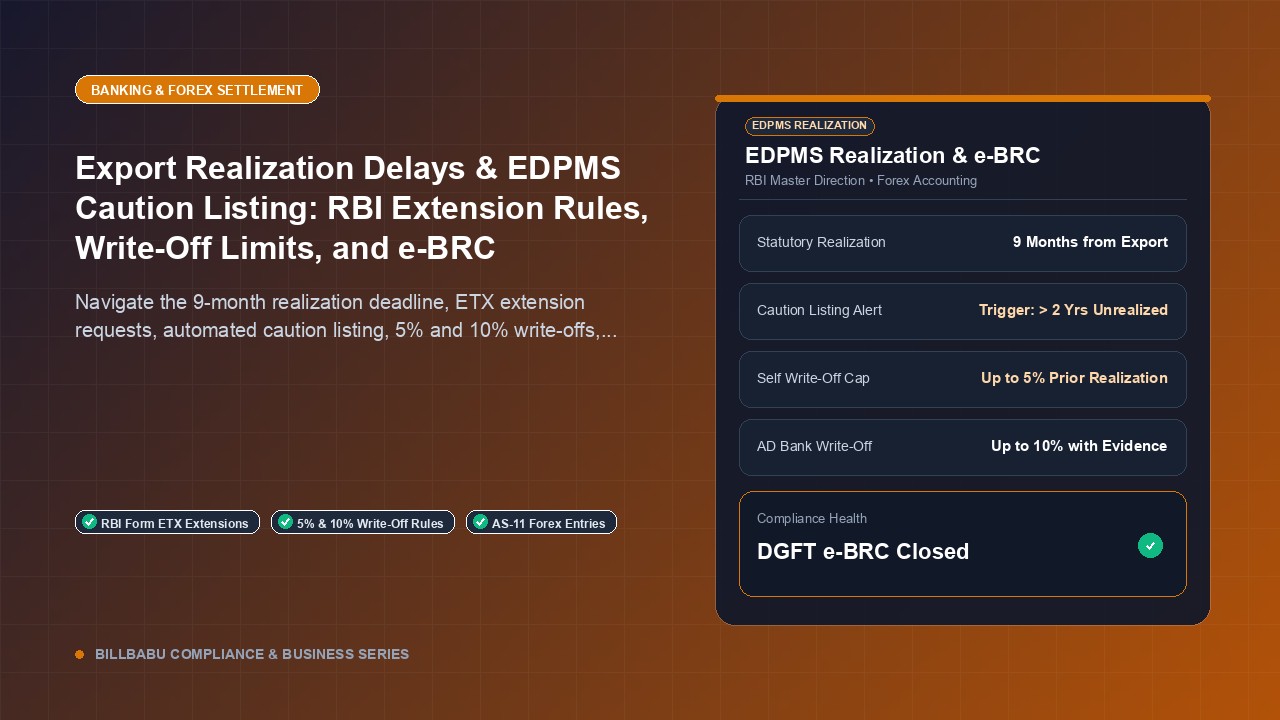
Export Realization Delays & EDPMS Caution Listing: RBI Extension Rules, Write-Off Limits, and e-BRC
8 min read
GST on Payment Gateway MDR & Daily UPI Settlements: Journal Entries, ITC, and Reconciliation Guide
7 min read
Fixed Assets Register: Format, Contents and Depreciation Schedule
3 min read
GST invoicing made easy for Indian small businesses
Create GST-compliant invoices & estimates, track payments, manage parties and inventory — all from your phone. 14-day free trial, no credit card needed.