How to Recover Delayed Payments Using MSME Samadhaan Portal: Step-by-Step Filing Guide
Step-by-step guide to recovering delayed buyer payments via MSME Samadhaan portal. Learn MSEFC conciliation, 3x compound interest, and 75% court pre-deposit.
BillBabu Team
BillBabu Compliance Team
In this article (16 sections)
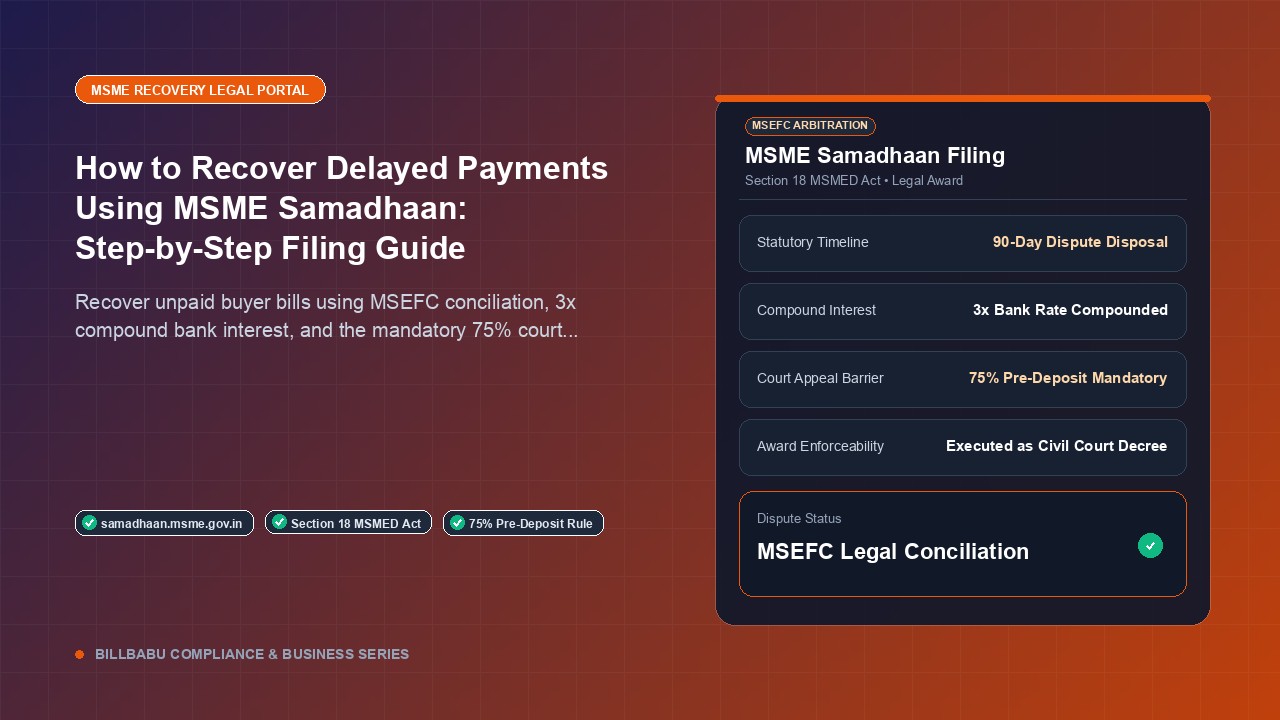
Delayed payments represent the single greatest existential threat to Indian micro and small enterprises. Big corporate buyers, government departments, and public sector undertakings frequently withhold vendor payments for months, treating small suppliers as zero-cost working capital lenders. To dismantle this systemic exploitation, the Ministry of MSME established the MSME Samadhaan Portal (samadhaan.msme.gov.in) under the MSMED Act, 2006. Empowered by statutory arbitration mechanisms, mandatory conciliation councils, compounding penal interest at three times the RBI bank rate, and a legal requirement forcing buyers to pre-deposit 75% of disputed amounts before appealing in court, MSME Samadhaan is India's most potent recovery weapon. This comprehensive guide walks you through eligibility, documentation, step-by-step portal filing, and recovery strategies.
Statutory Teeth: Section 18 & Section 19 of MSMED Act, 2006
Many business owners mistakenly believe that MSME Samadhaan is merely a public grievance grievance portal that forwards polite emails. In reality, it is a formal statutory judicial mechanism:
1. Micro and Small Enterprises Facilitation Council (MSEFC)
Under Section 18 of the MSMED Act, when a buyer fails to make payment within the statutory 15 or 45-day window under Section 15, any registered Micro or Small supplier can make a formal legal reference to the state MSEFC.
- Stage 1 (Mandatory Conciliation): The Council first conducts conciliation proceedings between the buyer and seller under the Arbitration and Conciliation Act, 1996.
- Stage 2 (Statutory Arbitration): If conciliation fails, the Council takes up dispute arbitration directly or refers it to an institutional arbitration center.
- Binding Court Decree: The award rendered by the MSEFC has the legal status of an executable decree of a Civil Court!
- Statutory 90-Day Mandate: Section 18(5) specifies that every reference made to the MSEFC shall be decided within a period of 90 days from the date of making the reference.
2. The Powerful 75% Pre-Deposit Shield (Section 19)
In standard civil litigation, large corporations drag small suppliers through years of appellate appeals. Under Section 19 of the MSMED Act, the law creates an extraordinary safeguard:
Section 19 Pre-Deposit Rule: No court or appellate authority shall entertain any application from a buyer challenging an MSEFC decree unless the appellant buyer pre-deposits with the court 75% of the total awarded amount (principal plus accrued compound interest)! Furthermore, the court is empowered to disburse a portion of this pre-deposit to the supplier pending appeal.
Eligibility Checklist: Who Can File on MSME Samadhaan?
Before initiating an application, verify that your business meets the strict statutory criteria:
| Eligibility Parameter | Statutory Requirement | Compliance Verification |
|---|---|---|
| Udyam Registration Status | MANDATORY at the time of supply | Supplier must have held active Udyam registration on or before the invoice date. |
| Enterprise Scale | Micro or Small Enterprise ONLY | Medium enterprises (Turnover > ₹50 Cr) are legally barred from filing on Samadhaan. |
| Nature of Activity | Manufacturer or Service Provider | Pure wholesale/retail traders are excluded under Office Memorandum clarifications. |
| Target Respondent (Buyer) | Any Commercial Buyer | Private Ltd, Public Ltd, PSUs, Central/State Govts, Proprietorships. |
Create GST invoices & track payments in 30 seconds
Join thousands of Indian businesses using BillBabu. 14-day free trial on Android.
Pre-Filing Document Checklist
To ensure your case is not rejected by the Council scrutiny committee, assemble the following documents in PDF format (file sizes strictly under 2MB):
- Active Udyam Registration Certificate: Downloaded from the official portal.
- Purchase Order (PO) / Work Order / Contract: Signed agreement or official email confirming order placement and agreed terms. (If no written PO exists, supply delivery proof establishing agreement).
- Original Tax Invoices: Showing clear invoice numbers, dates, HSN codes, and delivery addresses.
- Proof of Delivery (POD): Signed delivery challans, transporter Lorry Receipts (LR), or courier tracking confirmations proving the buyer actually received the goods.
- Bank Statement: Bank statement covering the period to establish that the invoice remains unpaid.
- Prior Payment Reminder / Demand Notice: Copies of emails, WhatsApp reminders, or formal legal demand letters sent to the buyer demanding settlement.
Step-by-Step Guide to Filing an Application Online
Step 1: Access the Portal & Authenticate
Navigate to samadhaan.msme.gov.in. Click on "Case Filing for Entrepreneur / MSE". Enter your Udyam Registration Number and your registered mobile number. Enter the OTP sent to your Aadhaar-linked mobile phone to log in.
Step 2: Enter Buyer Details (Respondent)
Select the buyer category: Private Company, Central PSU, State PSU, Central Government Ministry, or Proprietary/Partnership firm. Enter the buyer's Name, PAN, GSTIN, registered office address, state, district, official email, and mobile number. Ensure the buyer's email is 100% accurate, as the portal transmits automated statutory notices directly to this address!
Step 3: Enter Invoice & Payment Data
You can upload up to 5 unpaid invoices in a single application (or consolidate multiple invoices into combined batches). Enter:
- Invoice Number and Invoice Date.
- Agreed Payment Date (cannot exceed 45 days from delivery).
- Invoice Amount (including GST).
- Amount Paid (if partial payment was made) and Net Overdue Amount.
Step 4: Upload Supporting Documents & Submit
Upload the combined PDF containing the PO, invoices, and delivery receipts. Review the comprehensive declaration confirming that the dispute has not been filed before any civil court. Submit the application.
Upon submission, the portal generates a permanent Application Number (e.g., MH/01/M/2026/00123). An official statutory notification is automatically dispatched to the buyer's registered email notifying them of the filing.
What Happens After Filing: The 4-Phase Lifecycle
| Phase | Action & Mechanism | Typical Timeline |
|---|---|---|
| Phase 1: Intimation Notice | Portal sends formal notice to buyer giving 15 days to settle or submit objections. Most corporate buyers settle here to avoid public listing. | Day 1 to Day 15 |
| Phase 2: Council Scrutiny | MSEFC examines documents; converts application into a formal registered case. | Day 15 to Day 30 |
| Phase 3: Conciliation Hearing | Council summons both parties (in-person or video conference) to negotiate settlement terms and payment schedules. | Day 30 to Day 60 |
| Phase 4: Arbitration Award | If buyer defaults, Council issues binding arbitration decree for principal + 3x compound interest! | Within 90 Days |
Maintain Bulletproof Debtors Ledgers with BillBabu
To win recovery cases on MSME Samadhaan, you need undisputed invoices, clean proof of delivery, and accurate interest calculations. BillBabu maintains full audit trails, automates WhatsApp payment reminders, and generates Samadhaan-ready dispute files with one click.
Start Free Trial on BillBabuFrequently Asked Questions (FAQs)
1. Do I need to hire an expensive advocate to file on MSME Samadhaan?
No. The MSME Samadhaan portal is designed for small business owners. Entrepreneurs can file cases directly online in under 15 minutes. During Council hearings, business owners can represent themselves without requiring legal counsel.
2. Can I file a case against a Central Government department or PSU?
Yes! In fact, MSME Samadhaan is exceptionally effective against Public Sector Undertakings (PSUs) and government bodies. Government portals publicly display unpaid MSE vendor claims, forcing PSU executives to expedite overdue payments to protect department ratings.
3. What if the buyer claims they never received the invoice?
This is why proof of dispatch is essential. Always maintain proof of email delivery, registered post acknowledgments, or WhatsApp invoice receipts generated through software like BillBabu. Digital communication records establish valid service before the Council.
Tags
Related Articles
GST invoicing made easy for Indian small businesses
Create GST-compliant invoices & estimates, track payments, manage parties and inventory — all from your phone. 14-day free trial, no credit card needed.