Income Tax for Proprietors: ITR-3 vs ITR-4 and Audit Limits
Income tax for proprietors in India — ITR-3 vs ITR-4, presumptive taxation under 44AD/44ADA, advance tax dates and the Rs. 1 crore audit threshold.
BillBabu Team
BillBabu App Team
Income tax for proprietors in India — ITR-3 vs ITR-4, presumptive taxation under 44AD/44ADA, advance tax dates and the Rs. 1 crore audit threshold.
How a Proprietor Is Taxed Differently from a Company
A proprietorship is not a separate legal entity — your business profit is your personal income and is taxed at slab rates ranging from nil up to 30% plus surcharge and cess. There is no separate PAN for the firm; the proprietor's PAN is the firm's PAN. This means you pay tax under the new regime (default from AY 2024-25) or opt out into the old regime with Form 10-IEA before the due date. Unlike a company, you cannot pay yourself a salary — withdrawals are simply drawings against capital and are not deductible.
Choosing Between ITR-3 and ITR-4
ITR-3 is for proprietors maintaining regular books of account — it has full Profit & Loss, Balance Sheet and Schedule BP. ITR-4 (Sugam) is a shorter form for those declaring income on a presumptive basis under Section 44AD, 44ADA or 44AE, and requires only a four-line P&L. You cannot use ITR-4 if you have capital gains, foreign assets, more than one house property or income above Rs. 50 lakh. Choosing the wrong form leads to a defective return notice under Section 139(9) — fix it within 15 days or your return is treated as never filed.
Presumptive Taxation under 44AD and 44ADA
Section 44AD allows businesses with turnover up to Rs. 3 crore (raised from Rs. 2 crore for FY 2023-24 if cash receipts are below 5%) to declare 8% of turnover as profit, or 6% on digital receipts. Section 44ADA covers specified professionals (doctors, CAs, lawyers, architects, engineers) up to Rs. 75 lakh receipts and presumes 50% as income. You cannot claim any further expense or depreciation. There is a five-year lock-in — if you opt out of 44AD before five years, you are barred from re-entering for the next five years and must compulsorily get accounts audited.
Advance Tax and the Audit Threshold
Advance tax is payable in four instalments — 15% by 15 June, 45% by 15 September, 75% by 15 December and 100% by 15 March. Section 234B and 234C interest of 1% per month kicks in for shortfalls. A proprietor opting for 44AD pays the entire advance tax in a single instalment by 15 March. Tax audit under Section 44AB is mandatory if turnover crosses Rs. 1 crore (Rs. 10 crore if cash receipts and payments are each below 5% of total) — the audit report (Form 3CD) is due 30 September, the ITR by 31 October.
Keeping Books That Survive a Notice with BillBabu
The single biggest reason proprietors get notices is mismatch between bank credits in AIS and turnover declared in the ITR. Maintain invoice-wise sales, party-wise receivables and a clean expense ledger throughout the year so that the Profit & Loss in your return matches every rupee in your bank. BillBabu generates ITR-ready reports — turnover summary, GST reconciliation, party ledger and a fixed asset register — that your CA can drop straight into ITR-3 or ITR-4. Filing becomes a 30-minute task instead of a two-week scramble in July.
Built for Indian small businesses. BillBabu is GST-compliant billing software that helps you create invoices, manage estimates, track payments and stay audit-ready — from your phone. Learn more about BillBabu or download the app.
Tags
Related Articles
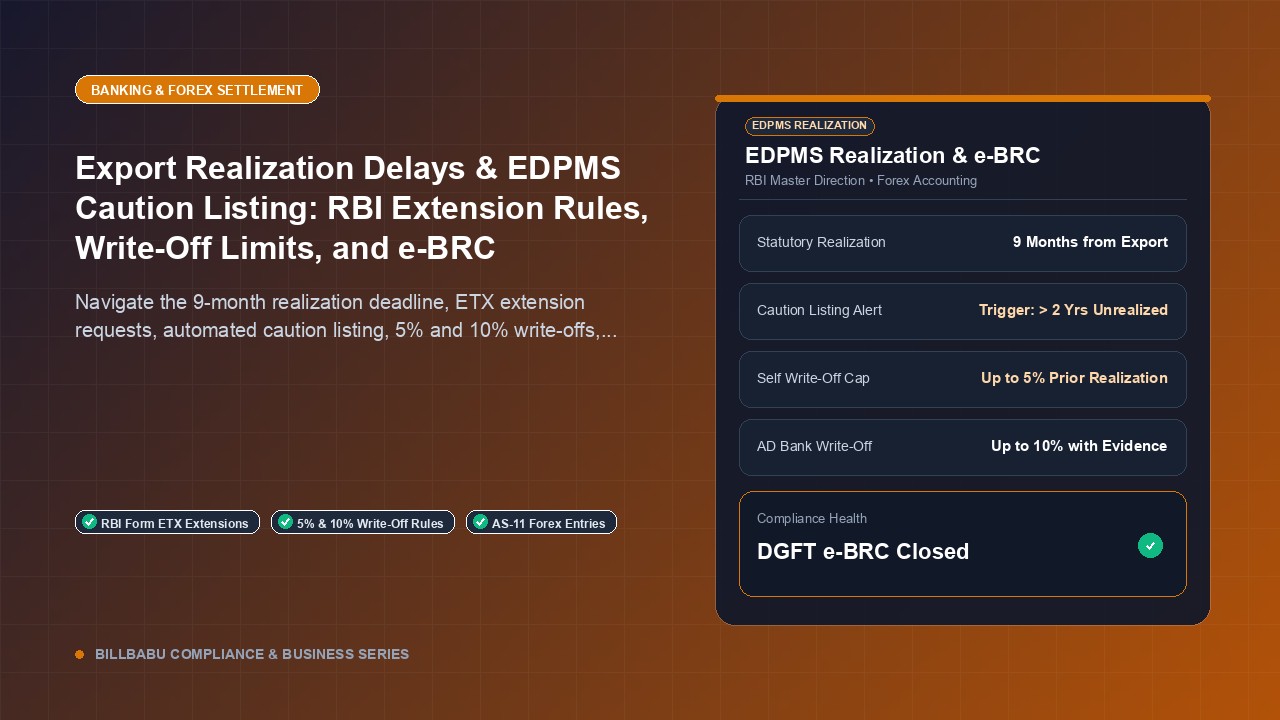
Export Realization Delays & EDPMS Caution Listing: RBI Extension Rules, Write-Off Limits, and e-BRC
8 min read
GST on Payment Gateway MDR & Daily UPI Settlements: Journal Entries, ITC, and Reconciliation Guide
7 min read
Fixed Assets Register: Format, Contents and Depreciation Schedule
3 min read
GST invoicing made easy for Indian small businesses
Create GST-compliant invoices & estimates, track payments, manage parties and inventory — all from your phone. 14-day free trial, no credit card needed.